Asbestos Removal in Fountain Valley, CA — MoldRx
Licensed Asbestos Removal Professionals Serving Fountain Valley and Central Orange County
Asbestos is not something you deal with later, and it is not something you handle on your own. Fountain Valley — incorporated in 1957 on drained wetlands once called Gospel Swamp, built out almost entirely during the 1960s and 1970s when asbestos was embedded in virtually every residential building material on the market — contains thousands of homes constructed during the exact decades that produced the highest asbestos concentrations in American housing. When those materials are disturbed during the renovations and upgrades that aging tract homes inevitably require, they release microscopic fibers that cause fatal diseases. California law is explicit: asbestos abatement must be performed by licensed, certified professionals following strict regulatory protocols. There is no legal shortcut and no safe DIY method. MoldRx only sends vetted, licensed asbestos abatement professionals who work in full compliance with EPA NESHAP, OSHA 1926.1101, and Cal/OSHA Title 8 regulations.
Request your free estimate — we'll assess your Fountain Valley property and explain your options.
Why Fountain Valley Properties May Contain Asbestos
Fountain Valley sits at roughly 10 to 45 feet above sea level on the flat coastal plain of central Orange County, with a population of approximately 56,000 across ZIP code 92708. The city is bordered by Huntington Beach to the west, Costa Mesa to the south, Santa Ana to the east, and Westminster to the north — with the 405 Freeway bisecting the community and Mile Square Regional Park anchoring its geographic center. The area's extremely high water table — the source of the artesian wells that gave the city its name — and its origins as reclaimed marshland meant that when postwar suburbanization arrived, the entire city was built in a compressed window of time on freshly graded former agricultural land. That compressed construction timeline, falling squarely in the peak asbestos era, is exactly why asbestos risk here is so pervasive.
Construction Era and Asbestos Use
Asbestos was used extensively in American construction from the 1930s through the late 1970s — cheap, fireproof, and durable. The EPA began restricting asbestos in the late 1970s, but manufacturers were allowed to exhaust existing inventory well into the mid-1980s.
Fountain Valley's development timeline aligns almost perfectly with peak asbestos use. Before incorporation, the area was agricultural land — former wetlands drained through canals built in the 1890s that transformed Gospel Swamp into productive farmland growing sugar beets, beans, barley, strawberries, and truck crops. The Tongva people inhabited this land long before European settlement, and the area passed through Spanish rancho grants, Mexican sovereignty, and early American farming communities before suburbanization arrived.
The city incorporated in 1957, but agriculture remained the dominant land use until the early 1960s. Then the transformation was rapid and nearly total. Large landowners sold off parcels to housing developers, and tract after tract of single-family homes went up on the flat, newly graded former farmland. Green Valley emerged in the 1960s with family-oriented homes on generous lots near what would become Mile Square Park. Fountain Valley Estates, Tamura, and the neighborhoods ringing the park's perimeter filled in through the mid-1960s. By the late 1960s and early 1970s, developments like Southlake and areas south of Slater Avenue were completing the residential buildout. Westmont arrived in the late 1970s with slightly more modern construction — but still within the window of asbestos-containing materials.
Meanwhile, Mile Square Regional Park was taking shape on the former Mile Square Naval Outer Landing Field — 640 acres the Navy had purchased from agricultural landowners in 1942. Orange County leased the perimeter in 1967 and opened the first 85-acre phase in 1970, with subsequent phases expanding through 1976. The park's development drove surrounding residential construction as families sought proximity to the county's newest recreation amenity.
The median home in Fountain Valley was built around 1970, putting asbestos likelihood in the very high category. The vast majority of the city's 19,250 housing units were constructed between 1960 and 1978. Any Fountain Valley property built before 1980 should be presumed to contain asbestos until professional testing proves otherwise, and properties through the mid-1980s also warrant testing.
Common Asbestos-Containing Materials in Fountain Valley Properties
Fountain Valley's tract-built housing stock contains the full spectrum of asbestos-containing materials. In properties built before 1980, asbestos is commonly found in:
- 9x9-inch floor tiles and black mastic adhesive — the single most common ACM in residential properties, found extensively in 1960s–1970s tract homes across Green Valley, Fountain Valley Estates, Tamura, and every neighborhood in the city
- Popcorn (acoustic) ceiling texture — widely applied from the 1950s through the early 1980s, especially prevalent in the ranch-style tract homes that define Fountain Valley's housing stock
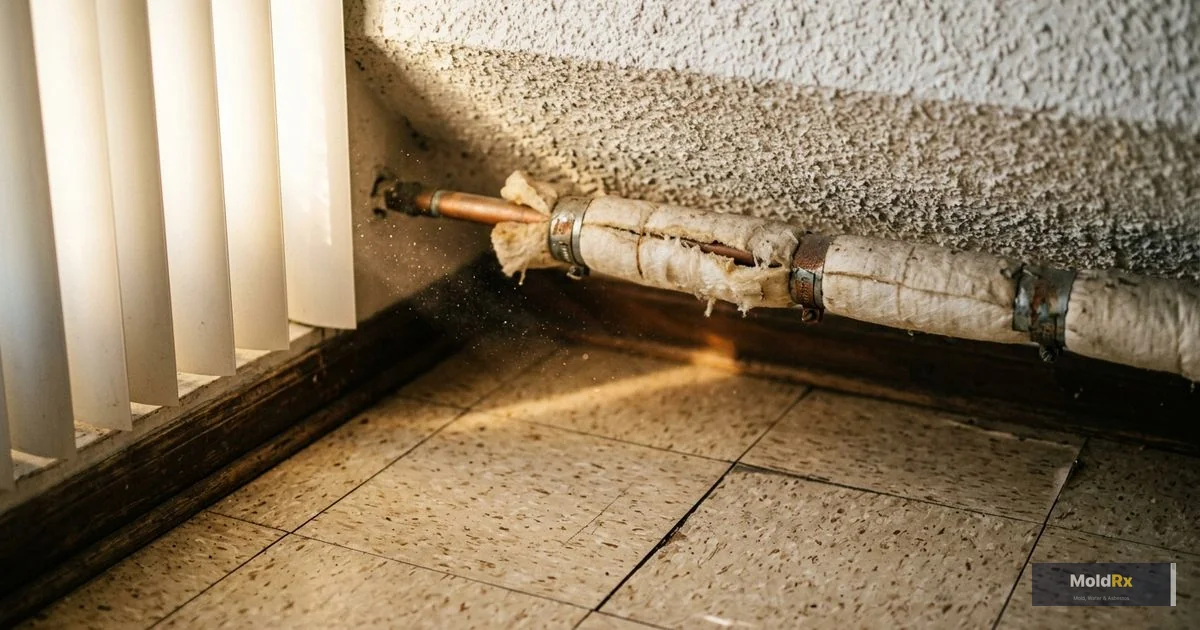
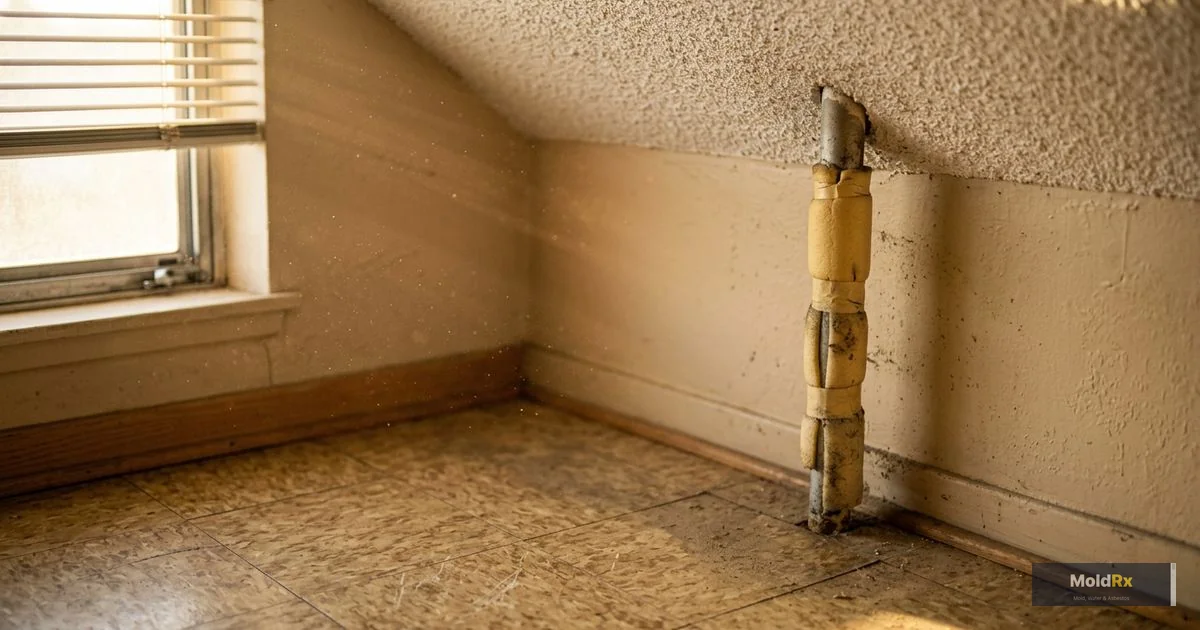
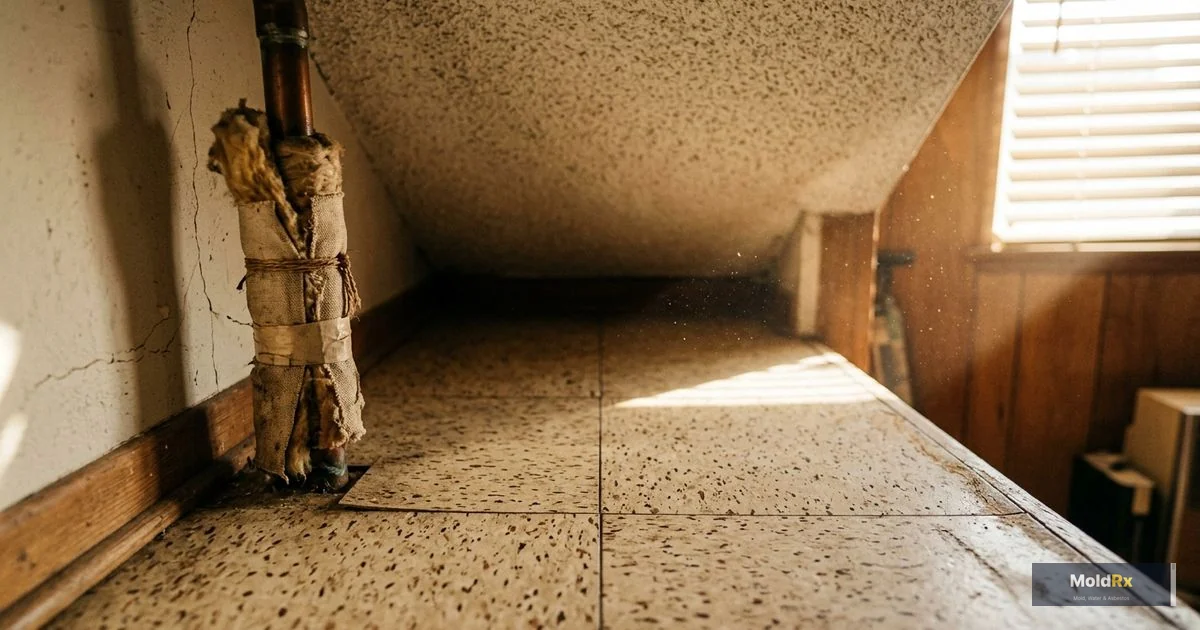
- Pipe insulation and duct wrap — in homes with original HVAC systems, particularly common in pre-1970 construction
- Roof materials and adhesives — shingles, felts, and tar products used on the low-slope and flat-roof designs common in mid-century Orange County construction
- Transite siding and cement-asbestos shingles — durable exterior products used throughout the 1960s
- Vermiculite attic insulation — particularly Zonolite brand, frequently contaminated with tremolite asbestos
- Joint compound, drywall mud, and textured wall coatings — used in wall finishing throughout the 1960s and 1970s
- Furnace cement, gaskets, and boiler insulation — in older heating and cooling systems
- Garage and utility area materials — including cement board, fireproofing, and original electrical panel insulation
When Asbestos Becomes Dangerous
Intact, undisturbed asbestos materials do not automatically release fibers. The danger begins when materials are disturbed. Friable materials — crumbled by hand pressure, like pipe insulation or sprayed-on texture — release fibers easily. Non-friable materials — bound in a solid matrix, like floor tiles or transite siding — become hazardous when cut, sanded, drilled, or broken. Renovation is the most common trigger. Tearing out old flooring, scraping popcorn ceilings, or demolishing walls in a pre-1980 Fountain Valley property without testing first can contaminate the entire structure in minutes.
Fountain Valley-Specific Risk Factors
Fountain Valley's central Orange County location produces mild, Mediterranean conditions — warm summers averaging in the mid-70s, mild winters rarely dipping below the mid-40s, and the marine layer that rolls in from the coast most spring and early summer mornings. While these conditions are gentler on building materials than desert extremes, the city's unusually high water table — the defining geographic feature that gave Fountain Valley its name — creates persistent ground-level moisture that slowly degrades foundation-level ACMs, including floor tile adhesives, sub-slab insulation, and utility area materials. Decades of this steady moisture exposure, combined with the seismic activity inherent to Southern California, gradually compromise materials that might otherwise remain stable.
But the primary asbestos risk driver in Fountain Valley is the sheer age and uniformity of the housing stock. Unlike cities that developed across multiple eras, Fountain Valley was built almost entirely in one compressed window — the 1960s and 1970s — meaning virtually every home in the city falls within the peak asbestos construction period. There are no pre-war bungalow districts or 1990s infill neighborhoods to dilute the risk. The entire residential inventory is aging simultaneously, and homeowners across every neighborhood are now undertaking the renovations, kitchen remodels, bathroom upgrades, and flooring replacements that 50- to 60-year-old homes inevitably demand.
Every one of these renovation projects on pre-1980 homes carries asbestos risk. A contractor scraping popcorn ceilings in a 1965 Green Valley ranch home or tearing out original 9x9 floor tiles in a Tamura tract house can contaminate every room before anyone realizes what has happened. The renovation cycle that is updating Fountain Valley's housing stock is also the single greatest source of potential asbestos exposure in the city.
When Asbestos Removal Is Required
Before Renovation or Demolition
California law and SCAQMD Rule 1403 require an asbestos survey before any renovation or demolition of structures built before 1980. Notification must be submitted for any project disturbing more than 100 square feet of ACM. If you are planning to remodel a kitchen, replace original flooring, remove popcorn ceilings, re-roof an older home, or demolish any structure in Fountain Valley, testing must come first. This is not a recommendation — it is law.
When Materials Are Damaged or Deteriorating
Friable asbestos materials that are crumbling, water-damaged, or visibly deteriorating require professional attention immediately. Cracked pipe insulation shedding fibers, peeling acoustic ceiling texture, or crumbling duct wrap all demand assessment. In Fountain Valley's older neighborhoods — throughout Green Valley, Fountain Valley Estates, Tamura, Westmont, Southlake, and every pre-1980 tract — decades of settling, ground moisture, and normal wear may have already compromised materials that were stable when first installed.
Real Estate Transactions
California Civil Code requires sellers to disclose known asbestos hazards. While the state does not mandate removal before a sale, buyers increasingly require testing as part of due diligence, and ACMs directly affect property valuations. In Fountain Valley's real estate market — where median household income exceeds $115,000, where 67% of housing units are owner-occupied single-family homes, and where proximity to Mile Square Park and central Orange County amenities keeps demand steady — a clean asbestos clearance report protects both sides of the transaction and prevents costly renegotiations at closing.
After Professional Testing Confirms ACMs
No removal should begin without laboratory-confirmed test results from an NVLAP-accredited lab using PLM or TEM analysis. Only after testing confirms the presence, type, and condition of ACMs can a proper abatement plan be developed.
Our Asbestos Removal Process
Asbestos abatement is among the most heavily regulated construction activities in California. Every step is governed by federal, state, and regional rules. The professionals MoldRx sends to your Fountain Valley property follow a six-phase process designed for complete compliance and maximum safety.
1. Pre-Abatement Survey and Testing
A certified inspector surveys your property, identifies suspect materials, and collects samples for NVLAP-accredited laboratory analysis (PLM or TEM). The survey follows AHERA protocols and produces a detailed report documenting every material tested, its location, condition, and asbestos content. For Fountain Valley homes, this commonly includes evaluating original flooring and mastic, popcorn ceilings, pipe insulation, HVAC components, roof materials, and garage fireproofing — the materials used heavily across the city's 1960s–1970s tract developments.
2. Regulatory Notification
Required regulatory notifications are filed before abatement begins. SCAQMD Rule 1403 requires advance written notification for projects disturbing more than 100 square feet of intact asbestos-containing material. DOSH also requires notification. All permits are obtained and the project documented from day one.
3. Containment and Worker Protection
The work area is completely isolated using polyethylene sheeting and HEPA-filtered negative-pressure air scrubbers. A decontamination unit with separate clean room, shower, and equipment room controls entry and exit. Workers wear full PPE including NIOSH-approved respirators with P100 HEPA filters and disposable protective suits per OSHA 1926.1101. Critical barriers seal every doorway and HVAC register to prevent fiber migration — essential in Fountain Valley's open-plan ranch homes where forced-air systems can spread contamination through ductwork in minutes.
4. Wet Removal and Abatement
All ACMs are thoroughly wetted before removal to suppress fiber release — a core requirement under both NESHAP and OSHA. Materials are carefully removed using hand tools to minimize breakage. For pipe insulation, glovebag techniques allow removal without exposing the surrounding area. Larger projects use amended water for better fiber suppression. Continuous air monitoring tracks fiber levels inside and outside the containment.
5. Disposal
Removed asbestos waste is double-bagged in labeled 6-mil polyethylene bags, placed in rigid containers, and marked with required warning labels. A waste manifest documents the chain of custody from your Fountain Valley property to an approved disposal landfill — a legal document that protects you.
6. Air Monitoring and Clearance Testing
After removal and cleaning, an independent air monitoring professional collects samples analyzed by TEM or Phase Contrast Microscopy (PCM). Clearance requires fiber concentrations below 0.01 f/cc. Only after clearance testing confirms safe conditions is the containment dismantled. You receive a complete clearance report — your permanent record that the work was performed safely.
Asbestos Removal vs. Encapsulation
Not every asbestos situation requires full removal. Encapsulation — applying a sealant that binds fibers in place — is sometimes an acceptable alternative for non-friable materials in good condition that will not be disturbed. It is faster and less invasive than removal.
However, encapsulation does not eliminate the asbestos — it only contains it temporarily. If the encapsulant deteriorates or the material is later disturbed, full removal becomes necessary. In Fountain Valley — where the high water table and persistent ground moisture can degrade sealants on floor-level materials more quickly than in drier locations, and where homeowners are now systematically renovating 50- to 60-year-old homes that all aged simultaneously — encapsulant longevity requires careful evaluation. In a city where renovation pressure makes it likely that today's encapsulated material will eventually be disturbed by tomorrow's remodel, removal is often the more definitive solution. California regulations require removal before demolition. The professionals MoldRx sends will give you an honest assessment: if encapsulation is sufficient, they will say so. If removal is necessary, they will explain why.
Get your free estimate — no obligations.
Regulations That Govern Asbestos Removal in California
Asbestos abatement operates under a layered regulatory framework. Understanding these regulations matters because they exist to protect you, your family, and your community.
Federal: EPA NESHAP
The National Emission Standards for Hazardous Air Pollutants (NESHAP) under the Clean Air Act establish baseline federal requirements governing work practices, emission controls, and waste disposal — including inspection before demolition or renovation, proper notification, wet methods during removal, and disposal at approved facilities.
Federal: OSHA 1926.1101
OSHA's Construction Industry Standard for asbestos (29 CFR 1926.1101) protects workers performing abatement — establishing a permissible exposure limit (PEL) of 0.1 f/cc over an 8-hour TWA, requiring medical surveillance and specific training, and dictating engineering controls.
California: Cal/OSHA Title 8 Section 1529
California's asbestos standard meets or exceeds federal OSHA. Cal/OSHA Section 1529 establishes California-specific requirements including contractor registration, employee training, and medical monitoring. DOSH enforces these regulations and inspects active abatement projects throughout Orange County.
Regional: SCAQMD Rule 1403
Fountain Valley falls within the jurisdiction of the South Coast Air Quality Management District (SCAQMD). Rule 1403 governs asbestos emissions from demolition and renovation — requiring pre-project surveys by Cal/OSHA-certified or AHERA-certified inspectors, advance notification for projects disturbing more than 100 square feet of intact ACM, adequate wetting during removal, and proper waste disposal. A Rule 1403 survey is required regardless of when the structure was built, the size of the renovation, or whether the owner believes asbestos is present. Failure to perform a pre-project asbestos survey or failure to notify SCAQMD can result in fines upwards of $20,000 per day or jail time in cases where negligence leads to bodily or environmental harm. SCAQMD actively enforces Rule 1403 through scheduled and unannounced inspections across Orange County. The SCAQMD Asbestos Hot Line — (909) 396-2336 — provides compliance guidance.
Licensing: CSLB Requirements
California law requires asbestos abatement be performed by contractors holding a C-22 Asbestos Abatement license from the CSLB. Workers must hold current ASB certification and complete EPA-accredited training — 40 hours initial plus 8-hour annual refreshers. Every professional MoldRx sends holds the required licenses, certifications, and current training.
Health Risks of Asbestos Exposure
Asbestos exposure causes serious, often fatal diseases. The medical evidence is unambiguous, and there is no safe level of asbestos exposure according to OSHA.
Mesothelioma
An aggressive cancer of the lining of the lungs, abdomen, or heart — caused almost exclusively by asbestos exposure. Incurable in most cases, with median survival of 12 to 21 months after diagnosis. Even brief exposure can trigger this disease decades later.
Asbestosis
A chronic lung disease caused by inhaling asbestos fibers that permanently scar lung tissue, leading to progressive difficulty breathing. Asbestosis worsens over time. There is no cure.
Lung Cancer
Asbestos exposure significantly increases lung cancer risk, particularly combined with smoking.
Latency Period
Asbestos-related diseases typically do not appear until 10 to 50 years after exposure. A Fountain Valley homeowner who disturbs ACMs during a weekend renovation may not develop symptoms for decades. By the time symptoms appear, the damage is irreversible — which is why prevention through proper abatement is critical.
For authoritative information, consult the EPA asbestos page and OSHA's asbestos safety topics.
What Sets MoldRx Apart
- Licensed, certified, compliant. Every professional holds a CSLB C-22 license, EPA-accredited training, and works in full compliance with Cal/OSHA Title 8 and SCAQMD Rule 1403 notification requirements.
- Full regulatory documentation. Notifications, waste manifests, chain-of-custody records, lab results, and clearance reports — everything you need for compliance, real estate transactions, or insurance claims.
- Honest assessment. If encapsulation is sufficient, we will tell you. If removal is necessary, you will understand why. No upselling, no minimizing genuine hazards.
- Family-owned accountability. We only send vetted professionals we stand behind. Every contractor is verified for licensing, insurance, training, and track record.
Fountain Valley Neighborhoods and Areas We Serve
MoldRx sends licensed asbestos abatement professionals throughout Fountain Valley and the surrounding central Orange County communities. Each neighborhood carries its own construction history and asbestos risk profile.
Green Valley — A family-favorite neighborhood built in the 1960s and 1970s with well-maintained ranch homes on generous lots, many with pools, located near Mile Square Regional Park. Homes here are 50 to 60+ years old, built during the height of asbestos use — popcorn ceilings, floor tiles, pipe insulation, and original HVAC components are high-probability ACM locations. The neighborhood's proximity to the park and its tree-lined streets drive steady renovation activity as families invest in one of the city's most desirable communities.
Fountain Valley Estates — One of the city's established residential tracts dating to the 1960s development wave that transformed former agricultural land into suburban neighborhoods. Original construction materials in these homes fall squarely within the peak asbestos window. Floor tiles and mastic, ceiling textures, pipe wrap, and roof materials all warrant testing before any renovation work begins.
Tamura — A residential area developed during Fountain Valley's 1960s buildout period, featuring single-family tract homes characteristic of the era. These properties share the same construction-era asbestos risks as homes throughout the city — the open floor plans common in these ranch-style homes mean disturbed fibers travel quickly through the entire living space.
Westmont — Built in the late 1970s with slightly more modern construction and spacious single-family homes. While later than the peak asbestos period, these homes still fall within the window when manufacturers were exhausting asbestos-containing material inventory. Popcorn ceilings, floor tiles, pipe insulation, and joint compound in late-1970s construction commonly contain asbestos.
Southlake — A residential neighborhood in the southern portion of Fountain Valley developed during the late 1960s to early 1970s. Homes in this area carry the full range of mid-century asbestos-containing materials and are now at the age where major renovations — kitchen remodels, bathroom upgrades, flooring replacement — trigger the disturbance that makes dormant asbestos dangerous.
Mile Square Park Area — Properties surrounding Fountain Valley's 607-acre centerpiece — the former Mile Square Naval Outer Landing Field converted to a regional park beginning in 1967. Homes built in the neighborhoods ringing the park date primarily to the 1960s and early 1970s, timed with the park's phased development. Standard mid-century asbestos risks apply throughout these residential blocks.
Downtown Village / City Center — The commercial and civic core of Fountain Valley along Brookhurst Street and Warner Avenue. Commercial renovations in this district require full SCAQMD Rule 1403 compliance. Older retail and office buildings from the 1960s and 1970s contain common ACMs including ceiling tiles, floor tiles, insulation, and fireproofing materials.
Nearby Communities We Also Serve
MoldRx also serves Huntington Beach, Costa Mesa, Santa Ana, Westminster, Garden Grove, Midway City, Newport Beach, Irvine, Tustin, and properties throughout Orange County.
Related Services in Fountain Valley
- Asbestos Testing in Fountain Valley
- Mold Removal in Fountain Valley
- Mold Testing in Fountain Valley
- Water Damage Restoration in Fountain Valley
-> All remediation services in Fountain Valley
Frequently Asked Questions
Is it legal to remove asbestos myself in California?
California law requires asbestos abatement be performed by C-22 licensed contractors. A narrow exemption exists for homeowners removing small quantities of non-friable asbestos from their own residence, but containment, wet methods, disposal, and notification requirements still apply. Improper removal can contaminate your entire home and result in substantial fines.
How do I know if my Fountain Valley home has asbestos?
The only way to confirm asbestos is laboratory testing by an NVLAP-accredited lab — visual inspection cannot identify it. If your property was built before 1980, it likely contains asbestos. Properties through the mid-1980s should also be tested. A certified inspector collects samples for PLM or TEM analysis, with results typically in three to five business days.
I'm renovating an older home in Fountain Valley. Do I need asbestos testing first?
Yes — this is a critical requirement. Homes built during Fountain Valley's development boom of the 1960s and 1970s — including tract homes in Green Valley, Fountain Valley Estates, Tamura, Westmont, and Southlake — were constructed during peak asbestos use. Popcorn ceilings, floor tiles, pipe insulation, roof materials, duct wrap, and joint compound in these homes commonly contain asbestos. SCAQMD Rule 1403 requires an asbestos survey before any renovation or demolition of pre-1980 structures. This is a legal requirement. Disturbing ACMs without proper abatement exposes everyone in the home to potentially fatal fibers and can result in fines exceeding $20,000 per day.
What materials commonly contain asbestos?
The most common ACMs in older Fountain Valley properties include 9x9-inch vinyl floor tiles and black mastic, popcorn ceiling texture, pipe and duct insulation, roof shingles and adhesives, transite siding, vermiculite attic insulation, joint compound, furnace cement and gaskets, textured wall coatings, and garage or utility area fireproofing materials.
How long does asbestos removal take?
Most residential projects in Fountain Valley take two to five days depending on scope. Small projects like pipe insulation removal may be completed in one to two days. Projects involving multiple rooms or whole-house popcorn ceiling abatement take longer. The regulatory notification process adds lead time — SCAQMD Rule 1403 requires advance notice, so plan accordingly.
Can I stay in my home during asbestos removal?
For small, contained projects limited to one area, you may be able to remain in unaffected sections. Larger projects typically require temporary relocation. Your abatement team will advise you based on scope of work.
What is the difference between friable and non-friable asbestos?
Friable asbestos can be crumbled by hand pressure (pipe insulation, sprayed-on fireproofing, ceiling textures) and releases fibers easily. Non-friable materials have fibers bound in a solid matrix (floor tiles, transite siding) and are less hazardous when intact but become dangerous when cut, broken, or sanded. Both types require professional handling.
Do I need asbestos testing before renovation?
Yes. SCAQMD Rule 1403 requires an asbestos survey before any renovation or demolition — regardless of when the structure was built, the size of the renovation, or whether the owner believes asbestos is present. The survey must be conducted by a Cal/OSHA-certified inspector or AHERA-certified building inspector. Testing protects you from unknowingly disturbing ACMs and protects your contractor from exposure.
What happens to the asbestos after removal?
Removed asbestos waste is double-bagged in labeled 6-mil polyethylene bags, placed in rigid containers, and transported by licensed haulers to approved disposal landfills. A waste manifest documents the chain of custody from your property to the landfill — a legal document you receive as part of your project records.
Will my homeowner's insurance cover asbestos removal?
Standard policies typically exclude asbestos abatement. However, if ACMs are damaged by a covered peril (fire, storm, water damage), your policy may cover abatement as part of the claim. Review your policy language.
Is encapsulation as safe as removal?
Encapsulation can be effective for non-friable materials in good condition that will not be disturbed. However, it does not eliminate the asbestos — the material remains and must be monitored. In Fountain Valley, where homes are now 50 to 60 years old and owners are systematically renovating, removal is often the more permanent solution.
Get Asbestos Removal in Fountain Valley
Asbestos in your Fountain Valley property demands a professional response — not next month, not when you get around to it. The diseases are irreversible, the fibers are invisible, and the latency period spans decades. Every day that damaged ACMs remain in your property, your family's exposure risk continues. In a city built almost entirely during the peak asbestos era — where former Gospel Swamp wetlands became 19,000+ housing units in barely two decades, where the same 1960s and 1970s tract homes in Green Valley and Tamura and Fountain Valley Estates are now reaching the age where major renovation is unavoidable, and where the high water table that gave this city its name has been quietly degrading ground-level materials for half a century — the risk is not theoretical. It is present in the walls, ceilings, floors, and ductwork of thousands of homes across ZIP code 92708.
Whether you have confirmed ACMs, suspect your property contains asbestos, or need testing before renovating an older home anywhere in Fountain Valley, MoldRx only sends licensed, insured, and fully compliant abatement professionals. Your family's safety is not something to gamble on.
Call MoldRx for your free estimate — (888) 609-8907. Licensed. Compliant. Done right.