Asbestos Testing in Eastvale, CA — MoldRx
Vetted Asbestos Testing Professionals Serving Eastvale and Southwest Riverside County
Eastvale is one of California's youngest cities — incorporated in 2010 with a population of approximately 75,000 — and the overwhelming majority of its homes were built during the 2000s and 2010s, well after asbestos was phased out of mainstream construction materials. That makes Eastvale a lower-risk city for asbestos compared to its older neighbors. But lower risk does not mean zero risk. SCAQMD Rule 1403 requires an asbestos survey before demolition regardless of when a building was constructed, some structures within Eastvale's boundaries predate the 2000s housing boom, and certain imported building products have tested positive for asbestos well into the 21st century. When testing is needed, accuracy matters. MoldRx only sends vetted asbestos testing professionals who follow EPA sampling protocols, use NVLAP-accredited laboratories, and deliver results that meet SCAQMD and Cal/OSHA requirements.
Request your free consultation — we will help you determine if testing is needed for your project.
When Asbestos Testing Is Necessary in Eastvale
Most Eastvale homeowners will not need asbestos testing for routine renovations. But there are specific situations where testing is either legally required or a practical necessity.
Before Demolition (California Law — Regardless of Building Age)
SCAQMD Rule 1403 requires an asbestos survey before demolition of any structure within the South Coast Air Quality Management District — regardless of when the building was constructed. If you are tearing down a structure in Eastvale, even a 2008 home, a certified consultant must complete a survey before you pull a demolition permit. This is a common surprise for owners of newer homes who assume their property is exempt. Non-compliance fines can exceed $20,000 per day.
Before Renovating Older Structures Within Eastvale's Boundaries
Although Eastvale is defined by its 2000s-era subdivisions, not every structure within the city limits was built during the housing boom. Scattered across the area — particularly along Hamner Avenue, near the Jurupa Valley border, and on parcels that were formerly agricultural — are older homes, barns, commercial buildings, and converted structures dating from the 1960s, 1970s, and 1980s. These properties carry the same asbestos risk as similar-age structures in neighboring cities. If you own or are purchasing one of these older properties, testing is required before renovation under SCAQMD Rule 1403 and Cal/OSHA Section 1529.
When Buying or Selling a Property
California disclosure laws require sellers to report known hazards. While most Eastvale homes carry low asbestos risk, a pre-purchase asbestos test on an older structure provides factual information for negotiation. For newer homes, testing is rarely necessary for standard real estate transactions — but your inspector can advise based on the specific property.
When Materials Show Unexpected Damage or Deterioration
Even in newer homes, unusual material deterioration warrants investigation. While asbestos is unlikely in most 2000s-era materials, certain imported products — particularly cement board, some roofing materials, and specific tile products — have been found to contain asbestos in EPA enforcement actions as recently as the 2010s. If materials in your home are deteriorating in unexpected ways, testing can rule out asbestos as a factor.
Commercial and Industrial Properties
Eastvale's commercial and industrial corridor along Hamner Avenue and the 15 freeway includes properties with a wider range of construction dates than the residential areas. Warehouse conversions, older commercial buildings, and properties on former agricultural parcels may contain asbestos-bearing materials. Testing is required before any renovation or demolition of these structures.
Common Asbestos-Containing Materials — What to Know in Eastvale
Because most Eastvale homes are newer construction, the following information is most relevant for older structures within the city boundaries or for understanding what testing would look for in an atypical situation.
Floor Tiles and Mastic (9"x9" Vinyl)
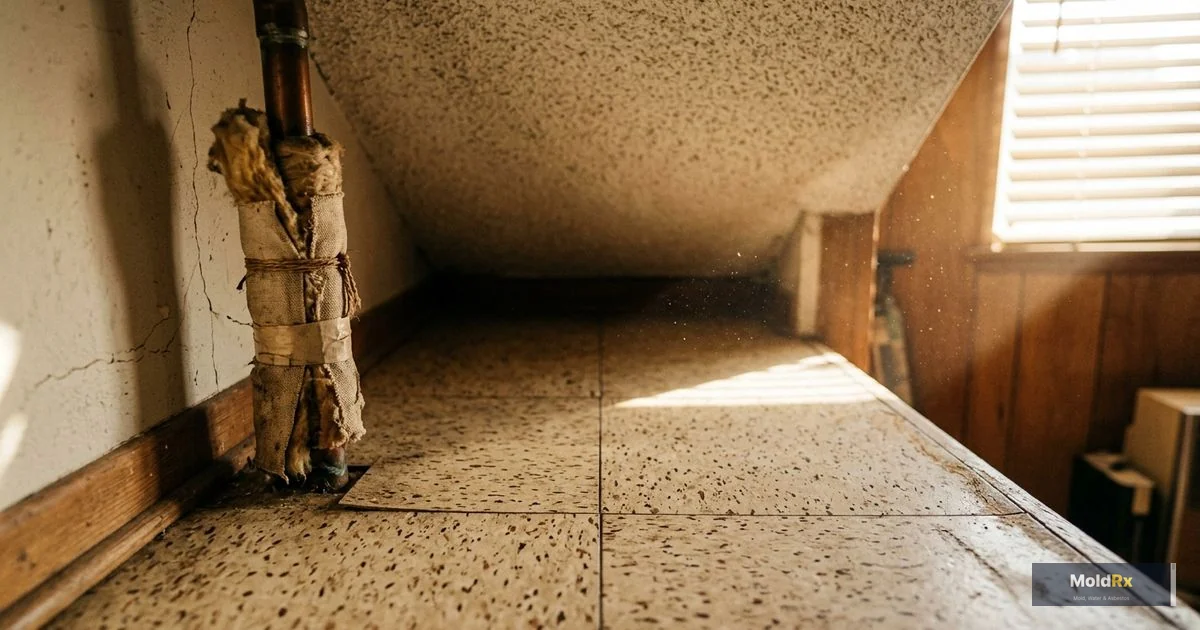
Produced from the 1950s through the early 1980s, 9"x9" vinyl floor tiles contained 5% to 70% chrysotile asbestos. The black cutback adhesive (mastic) beneath them frequently contains asbestos. These tiles are found in older structures predating Eastvale's incorporation — particularly homes, barns, and commercial buildings along the rural parcels. If you encounter 9"x9" tiles in any Eastvale property, do not disturb them until testing confirms whether asbestos is present.
Popcorn and Textured Ceilings
Spray-applied textured ceilings containing asbestos were standard from the mid-1960s through 1980. The EPA banned asbestos in spray-applied surfacing in 1978, but existing stock continued to be installed into the early 1980s. Modern textured ceilings in 2000s-era Eastvale homes do not contain asbestos. But if you own an older property within the city limits, textured ceilings are one of the first materials that should be tested.
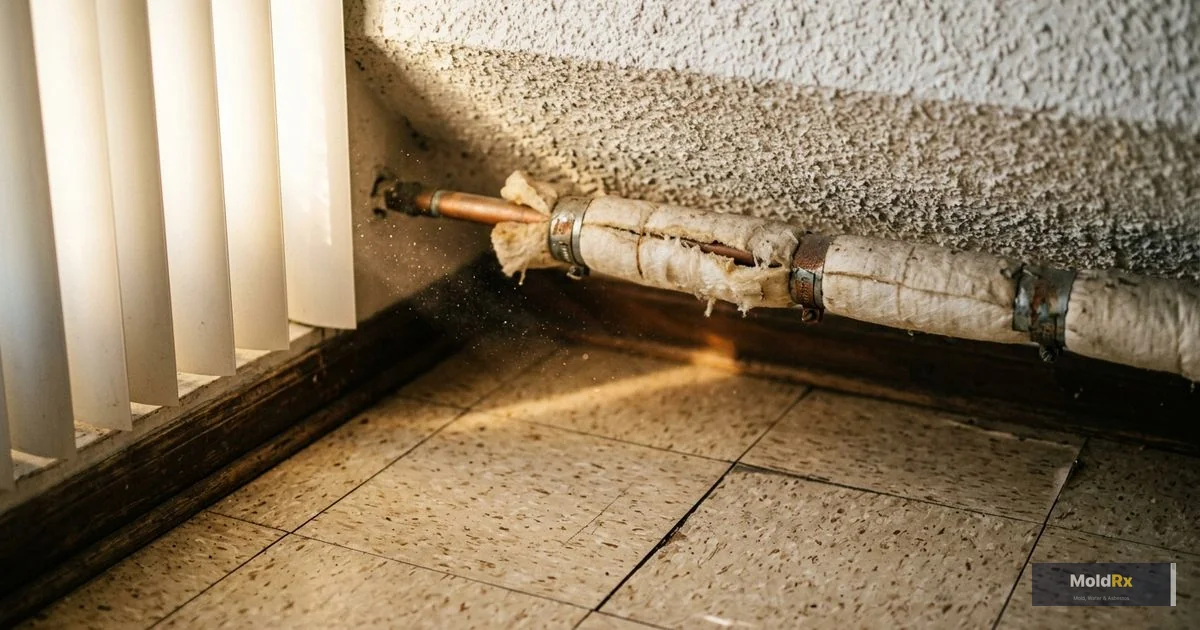
Pipe and Duct Insulation
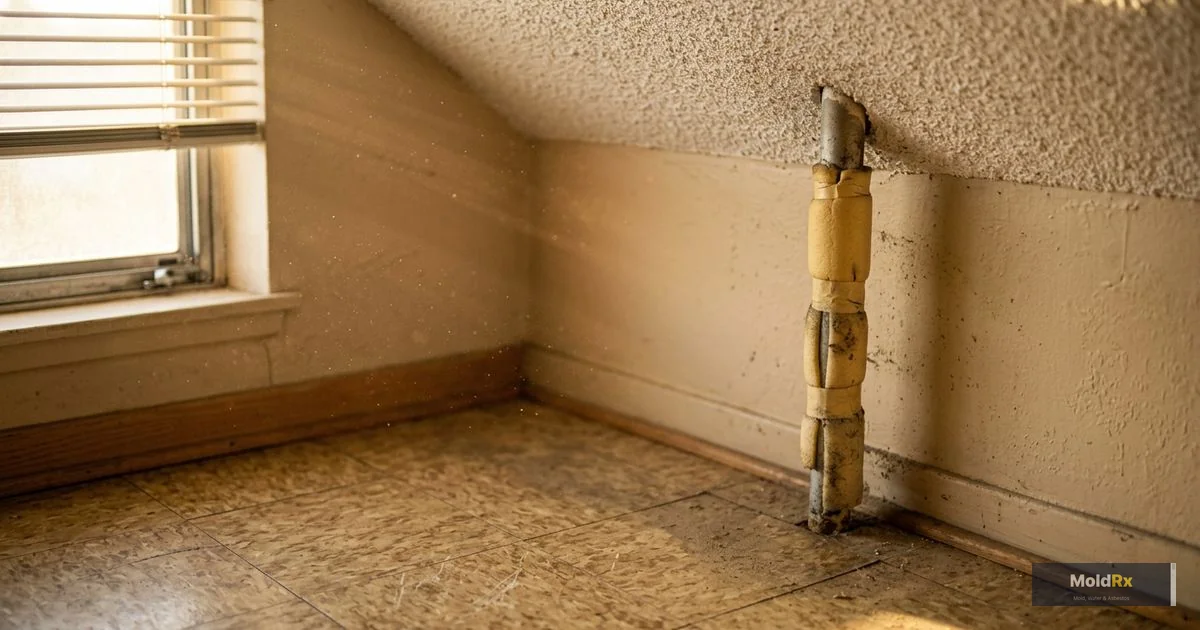
Corrugated paper wrap, calcium-silicate blocks, and air-cell insulation on heating pipes and ductwork in pre-1980 buildings commonly contain asbestos. Modern Eastvale homes use fiberglass or foam insulation in their HVAC systems, which does not contain asbestos. Older structures — particularly those with original mechanical systems — may have asbestos-containing insulation.
Roofing Materials
Asbestos-cement roofing and roofing felt were common through the 1970s. These materials are not expected in 2000s-era Eastvale homes. However, they may be present on older structures within the city boundaries. Additionally, some imported cement-based roofing products have been found to contain asbestos in recent enforcement actions — a rare but documented occurrence.
Cement Board and Imported Products
This is the most relevant ACM category for newer Eastvale homes. EPA enforcement actions and independent testing have documented asbestos in imported cement board, gaskets, and certain tile products sold in the United States during the 2000s and 2010s. While the risk is low for any individual home, it is not zero. If your renovation involves materials with foreign-sourced components and you want certainty, testing provides a definitive answer.
How Asbestos Testing Works
Understanding the testing process helps you plan your project timeline and know what to expect at each stage.
1. Pre-Testing Consultation
Testing begins with a conversation about your property and your project — when the building was constructed, what materials you plan to disturb, and whether any structures on the property predate the 2000s housing boom. For most Eastvale homeowners, this consultation may be all that is needed — your inspector may determine that testing is not required for your specific project and tell you so.
2. Bulk Sample Collection
When testing is warranted, a certified inspector collects bulk samples following EPA procedures outlined in EPA 600/R-93/116. Each suspected material is sampled separately — the inspector wets the material to suppress fiber release, removes a small section (about the size of a half-dollar), and seals it in a labeled container. Homogeneous materials like floor tiles require a minimum of three samples per distinct area. Each collection point is sealed after sampling.
3. NVLAP-Accredited Laboratory Analysis
Samples go to an NVLAP-accredited laboratory — the National Voluntary Laboratory Accreditation Program ensures the lab meets ISO 17025 standards for asbestos analysis. The primary method is PLM (Polarized Light Microscopy), which identifies asbestos fiber type and estimates concentration above approximately 1%. When PLM results are negative but low-level asbestos is suspected, TEM (Transmission Electron Microscopy) provides higher sensitivity. Standard PLM turnaround is 3 to 5 business days; rush service (24 to 48 hours) is available.
4. Results Interpretation and Recommendations
You receive a written report identifying each material sampled, whether asbestos was detected, the fiber type, and the estimated concentration. We walk you through what each result means for your specific project: which materials require licensed abatement, which can be managed in place, and which areas are clear for standard construction work.
Types of Asbestos Analysis
Different analytical methods serve different purposes. The method used depends on the material type, regulatory context, and level of certainty required.
PLM (Polarized Light Microscopy)
PLM is the standard method for bulk building material samples. The analyst identifies asbestos fibers based on optical properties — refractive index, birefringence, color, and morphology — and can detect all six regulated fiber types. PLM estimates concentration as a percentage of total material and is accepted by EPA, OSHA, and Cal/OSHA for regulatory compliance. Most residential testing uses PLM following EPA Method 600/R-93/116.
TEM (Transmission Electron Microscopy)
TEM provides higher magnification than PLM, detecting fibers too small for light microscopy. It is used when PLM results are negative but asbestos is still suspected — for example, when testing vermiculite insulation or materials with dense matrices that may mask fibers. TEM is also the required method for air monitoring samples.
Point Counting
Point counting is a supplemental PLM technique used when visual estimation detects between 1% and 10% asbestos. The analyst counts grid points falling on asbestos versus non-asbestos material, providing a statistically valid concentration estimate. EPA specifies point counting for regulatory determinations near the 1% threshold — the dividing line between ACM and non-ACM under NESHAP.
Can You Identify Asbestos by Looking at It?
No. Asbestos fibers are microscopic — 0.1 to 10 micrometers in diameter — invisible to the naked eye and mixed into the matrix of building materials during manufacturing. A floor tile containing 30% chrysotile looks identical to one containing zero asbestos. Even experienced inspectors cannot determine asbestos content by sight, smell, or touch. Laboratory analysis of a physical sample is the only way to confirm or rule out asbestos. This is the consistent position of the EPA, OSHA, Cal/OSHA, and every accredited testing consultant in California.
What Happens If Asbestos Is Found?
A positive test result does not automatically mean your home is dangerous or that expensive removal is required. The appropriate response depends on the condition of the material, your project scope, and applicable regulations.
When Removal Is Required
Removal is required when your renovation will physically disturb ACM — tearing out positive-testing flooring, removing a wall with ACM joint compound, or demolishing a structure with ACM present. SCAQMD Rule 1403 requires notification at least 10 working days before removal begins, and all abatement must be performed by a DOSH-registered contractor holding a valid CSLB license with asbestos certification.
When Encapsulation May Be an Option
Encapsulation applies a sealant over intact ACM to prevent fiber release without removal. It is appropriate for materials in good condition that will remain in place — intact floor tiles being covered with new flooring, or asbestos-cement siding on a wall not being renovated. Encapsulation is only viable when the material is undamaged and will not be disturbed by future work.
When Leaving It Undisturbed Is Acceptable
If ACM is in good condition and will not be disturbed by renovation or normal use, leaving it in place is often the safest and most cost-effective option. Intact asbestos materials do not release fibers. For the occasional older property within Eastvale's boundaries, this is often the most practical approach for materials in areas not being renovated.
Regulations That Require Asbestos Testing in California
Multiple overlapping federal and state regulations govern asbestos testing in Eastvale. Understanding which apply to your project helps you plan timelines and avoid compliance issues.
SCAQMD Rule 1403 (Pre-Renovation/Demolition Survey)
The regulation most directly relevant to Eastvale property owners. Requires an asbestos survey by a certified consultant before any renovation or demolition, regardless of building age. This means even a 2010 home in Eastvale requires a survey before demolition. If asbestos is found, SCAQMD must be notified at least 10 working days before removal. Penalties for non-compliance can exceed $20,000 per day.
Cal/OSHA Title 8 Section 1529
California's construction-industry asbestos standard requires determining the presence and quantity of ACM or presumed ACM (PACM) before construction, alteration, repair, or renovation. In pre-1980 buildings, all thermal system insulation, surfacing material, and resilient flooring is presumed to contain asbestos until tested. For older structures within Eastvale, this creates a presumption that testing must rebut before work proceeds.
EPA AHERA (Asbestos Hazard Emergency Response Act)
Establishes inspection and management requirements for asbestos in public and commercial buildings. While AHERA does not directly regulate single-family homes, its protocols and accreditation requirements form the foundation for residential testing practices. Inspectors performing surveys in California hold AHERA-accredited certifications.
OSHA 1926.1101 and California Health and Safety Code
Federal and state standards establish pre-renovation testing requirements, contractor licensing, and notification obligations. Any person performing asbestos-related work in California must be registered with DOSH. OSHA 1926.1101 establishes permissible exposure limits. For Eastvale property owners, the practical impact is that all testing, abatement, and disposal must be performed by certified, registered professionals.
Eastvale-Specific Asbestos Risk by Construction Era
Eastvale incorporated in 2010 after decades as an unincorporated community in western Riverside County. Understanding what was built and when helps frame realistic asbestos expectations.
Pre-1980 (Scattered Rural and Agricultural Structures): Before the housing boom, the area that is now Eastvale was primarily dairy land and agricultural parcels. Scattered across the city are older homes, barns, utility buildings, and converted agricultural structures dating from the 1960s and 1970s. These carry the same high asbestos risk as similar-age structures anywhere in the Inland Empire — floor tiles, pipe insulation, roofing, ceilings, and joint compound are all suspect. If you are purchasing or renovating one of these properties, comprehensive testing is essential.
1980s-1990s (Early Residential Development): A small number of homes along Hamner Avenue and near the borders with Jurupa Valley and Ontario were built during the 1980s and 1990s as the area began transitioning from rural to suburban. These homes carry low to moderate asbestos risk — some building products from the early 1980s contained asbestos, and testing is recommended before major renovation.
2000s-2010s (The Dominant Housing Stock): The vast majority of Eastvale's approximately 20,000 homes were built during this period. Master-planned communities like Eastvale Gateway, The Enclave, Cloverdale, Roosevelt, and Summerfield were constructed with modern materials that do not contain asbestos as a standard component. Asbestos risk is minimal for these properties. However, SCAQMD Rule 1403 still requires a survey before demolition, and the remote possibility of imported asbestos-containing products exists.
Commercial and Industrial Properties: Eastvale's commercial corridor along Hamner Avenue and the 15 freeway includes a wider range of construction dates. Warehouses, commercial buildings, and properties on former agricultural land may contain older construction materials. Testing is required before renovation or demolition of these structures.
What Sets MoldRx Apart
- Honest assessment. Eastvale is a newer city, and many projects here do not require asbestos testing. If yours is one of them, we will tell you — there is no reason to test materials that pose no realistic risk.
- NVLAP-accredited lab partners. When testing is needed, every sample is analyzed by a nationally accredited laboratory using PLM and, when warranted, TEM methods that meet EPA and Cal/OSHA standards.
- Clear, actionable results. No jargon-filled reports that leave you guessing. Plain language, specific recommendations, and a clear path forward for your project.
- Family-owned accountability. We only send vetted asbestos testing professionals we stand behind. No subcontractor roulette — the people who show up are the people we trust with our own homes.
Get your free consultation — no obligations.
Eastvale Neighborhoods We Serve
Our asbestos testing services cover all residential and commercial properties in Eastvale, including:
- Eastvale Gateway — 2000s master-planned community. Minimal asbestos risk for standard renovation. Survey required before demolition.
- The Enclave — Newer residential development with low asbestos risk in standard building materials.
- Cloverdale — 2000s-era subdivision. Low asbestos risk for renovation projects.
- Roosevelt — Residential community built in the 2000s-2010s with modern construction materials.
- Summerfield — Newer development with minimal asbestos risk.
- Hamner Avenue Corridor — Mixed commercial, industrial, and residential properties with a wider range of construction dates. Older structures may carry moderate to high asbestos risk.
- Border areas (Jurupa Valley / Ontario) — Properties near Eastvale's boundaries may include older structures predating the 2000s housing boom.
We serve Eastvale ZIP codes 92880 and 91752, as well as neighboring communities.
Nearby Communities
We also serve Corona, Jurupa Valley, Ontario, Norco, Chino, and Riverside.
Related Services in Eastvale
- Asbestos Removal in Eastvale
- Mold Removal in Eastvale
- Mold Testing in Eastvale
- Water Damage Restoration in Eastvale
Frequently Asked Questions
Is asbestos testing required before renovation in Eastvale?
It depends on the property. SCAQMD Rule 1403 requires an asbestos survey before demolition in the South Coast district regardless of building age. For renovation, testing is required when disturbing materials in pre-1980 buildings. Most Eastvale homes were built after 2000 and do not require testing for standard renovation — but older structures within the city do. Your inspector can advise based on your specific property.
My Eastvale home was built in 2005. Do I need asbestos testing?
For most renovation projects, no. Homes built in 2005 used modern materials that do not contain asbestos as a standard component. However, testing is required if you are demolishing the structure (SCAQMD Rule 1403 applies regardless of age). If you want certainty about specific materials — particularly imported products — testing can provide a definitive answer.
How many samples need to be collected?
EPA procedures require a minimum of three samples per homogeneous material in each distinct area. For the occasional older property within Eastvale that requires testing, sample counts depend on the number of distinct materials and the scope of your project.
How long do asbestos test results take?
Standard PLM analysis through an NVLAP-accredited laboratory takes 3 to 5 business days from the time samples arrive at the lab. Rush service is available with turnaround as fast as 24 hours. TEM analysis, if needed, typically requires 5 to 7 business days.
Can I collect asbestos samples myself?
California does not prohibit homeowners from collecting samples in their own single-family home, but it is strongly discouraged. Improper technique can release fibers. Samples collected by uncertified individuals may not be accepted for regulatory compliance or real estate transactions. Use a certified inspector.
What does a positive asbestos test mean?
A positive result means asbestos fibers were detected above 1%, classifying the material as ACM under federal and California regulations. A positive result does not mean immediate danger — intact, undisturbed ACM does not release fibers. But if your renovation will disturb that material, licensed abatement must be performed first.
What is the difference between friable and non-friable asbestos?
Friable ACM can be crumbled by hand pressure — pipe insulation, spray-applied ceiling texture, deteriorated thermal insulation. Non-friable ACM is bound into a solid matrix — floor tiles, cement siding, roofing shingles. Non-friable materials can become friable through cutting, grinding, or sanding. Both types require testing before disturbance, but friable materials are subject to stricter handling requirements.
Do newer homes ever contain asbestos?
Rarely, but it has been documented. EPA enforcement actions have identified asbestos in imported cement board, gaskets, and certain building products sold in the United States during the 2000s and 2010s. The Consumer Product Safety Commission and EPA continue to monitor for asbestos in imported products. The risk to any individual newer home is very low.
Will my contractor handle asbestos testing?
Some general contractors coordinate testing as part of pre-construction planning, but many do not — especially in newer cities like Eastvale where asbestos is not top-of-mind. If your project involves an older structure, getting testing done independently is the most reliable approach.
Get Asbestos Testing in Eastvale
Most Eastvale homes were built after 2000, and most renovation projects in those homes do not require asbestos testing. But when testing is needed — for a demolition permit, an older structure on the property, or a commercial building along Hamner Avenue — accuracy and honesty matter. MoldRx sends vetted professionals who will tell you whether testing is actually necessary for your situation before anyone collects a sample.
Call MoldRx to schedule your asbestos test — (888) 609-8907. Know before you start.