Asbestos Removal in Eastvale, CA — MoldRx
Licensed Asbestos Removal Professionals Serving Eastvale and the Western Inland Empire
Asbestos is not something you postpone, and it is not something you handle without licensed professionals. Eastvale — a city of approximately 75,000 residents in western Riverside County, incorporated in 2010, ZIPs 92880 and 91752, sitting at 627 feet elevation on the former dairy plains of the Santa Ana River basin — is one of the youngest cities in California. Over 91 percent of its housing stock was built after 2000, well past the peak asbestos era. That leads many Eastvale property owners to assume asbestos is not their problem. That assumption is dangerous. Pre-2000 structures still exist — former dairy buildings, agricultural infrastructure, older ranch homes along Archibald and Hamner Avenues, commercial properties predating the housing boom — and newer construction is not automatically asbestos-free. Imported materials, vermiculite insulation from contaminated mines, and non-compliant products have been documented in post-2000 buildings across Southern California. When asbestos-containing material is disturbed, it releases microscopic fibers that cause fatal diseases with no cure. California law is unambiguous: asbestos abatement must be performed by licensed, certified professionals. There is no legal shortcut and no safe DIY method. MoldRx only sends vetted, licensed abatement professionals who work in full compliance with EPA NESHAP, OSHA 1926.1101, Cal/OSHA Title 8 Section 1529, and SCAQMD Rule 1403.
Request your free estimate — we will assess your Eastvale property and explain your options.
Why Eastvale Properties May Contain Asbestos
Eastvale sits in the western Inland Empire, bordered by Jurupa Valley to the west, Ontario and Chino to the north, Corona to the south, and Norco to the east. The Santa Ana River defines the western boundary, Interstate 15 runs along the eastern edge, and the flat alluvial plain that once supported one of the largest dairy concentrations in the nation now holds master-planned subdivisions, shopping centers, and commercial parks. Semi-arid Mediterranean climate delivers summer temperatures regularly in the mid-90s to low 100s, mild winters in the 40s to 60s, and roughly 12 inches of annual rainfall. These temperature extremes drive constant HVAC demand and year-round renovation activity — both of which can disturb asbestos-containing materials where they exist.
Construction Era and Asbestos Use
Asbestos was used extensively from the 1920s through the late 1970s. The EPA began restrictions in the late 1970s, but manufacturers exhausted inventory into the mid-1980s, and some asbestos-containing products remained legally available well into the 1990s. Any property built before 1980 should be presumed to contain asbestos until testing proves otherwise.
Eastvale's development history is unlike most Inland Empire cities. For over a century, this land was agricultural — first citrus groves, then dairy operations that dominated from the 1950s through the 1990s. In 1990, there were more dairy cows than people. The population was roughly 1,600 in 1990, grew to 6,000 by 2000, then exploded past 50,000 by the 2010 incorporation. The median construction year for Eastvale housing is 2007, and 91.5 percent of the city's 18,484 housing units were built after 2000.
This overwhelmingly modern housing stock creates a false sense of security. Asbestos risk in Eastvale is lower than in older cities like Riverside or Corona — but it is not zero, and complacency is the real danger.
Common Asbestos-Containing Materials Found in the Eastvale Area
Even in a predominantly post-2000 city, asbestos-containing materials can be present in:
- Pre-2000 residential structures — homes along Archibald Avenue, Hamner Avenue, Limonite Avenue, and near original dairy settlements may contain 9x9-inch floor tiles, black mastic adhesive, popcorn ceilings, pipe insulation, and roof materials
- Former agricultural and dairy buildings — barns, milking parlors, cold storage, and equipment sheds commonly used transite (asbestos-cement) panels, asbestos roofing, pipe lagging, and boiler insulation
- Older commercial structures — properties along Hamner Avenue and the Limonite corridor predating the housing boom may contain asbestos in fireproofing, insulation, ceiling tiles, and HVAC components
- Vermiculite attic insulation — Zonolite-brand vermiculite from the contaminated Libby, Montana mine was distributed nationally through the 1990s and found in post-1990 construction
- Imported construction materials — drywall, joint compound, and cement products manufactured outside the US have been documented containing asbestos in products sold as recently as the 2000s
- HVAC duct connectors, gaskets, and furnace components — heat-resistant asbestos components used across all construction eras
- Roof materials, textured coatings, window glazing — shingles, felts, flashing cements, joint compound, putty, and caulking found across multiple decades of construction
When Asbestos Becomes Dangerous
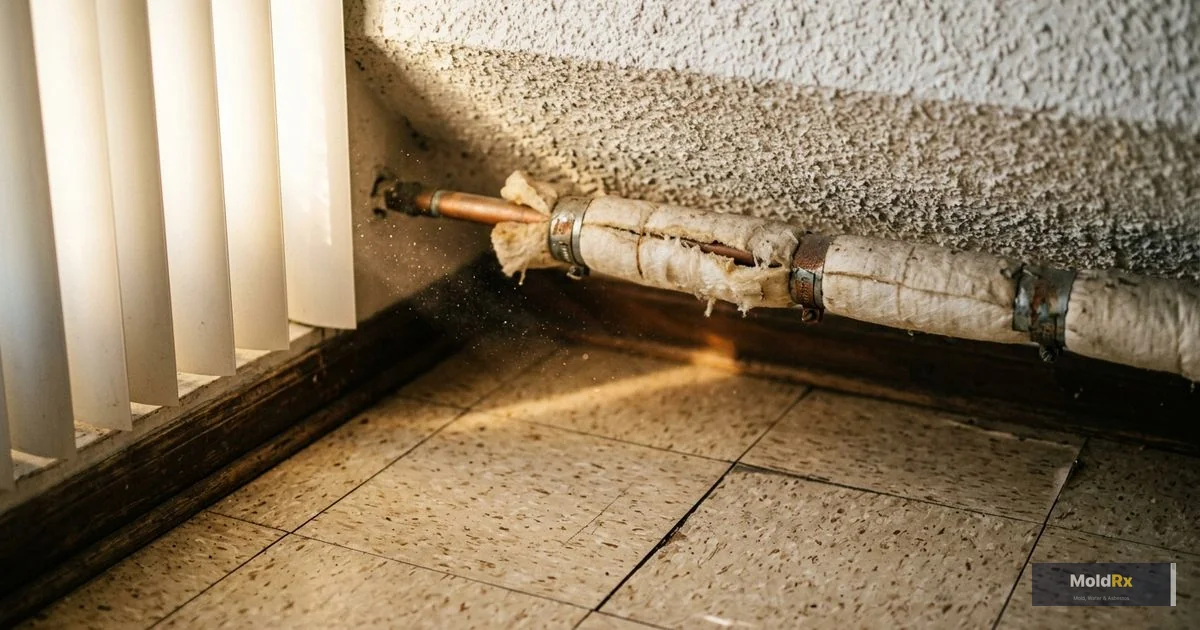
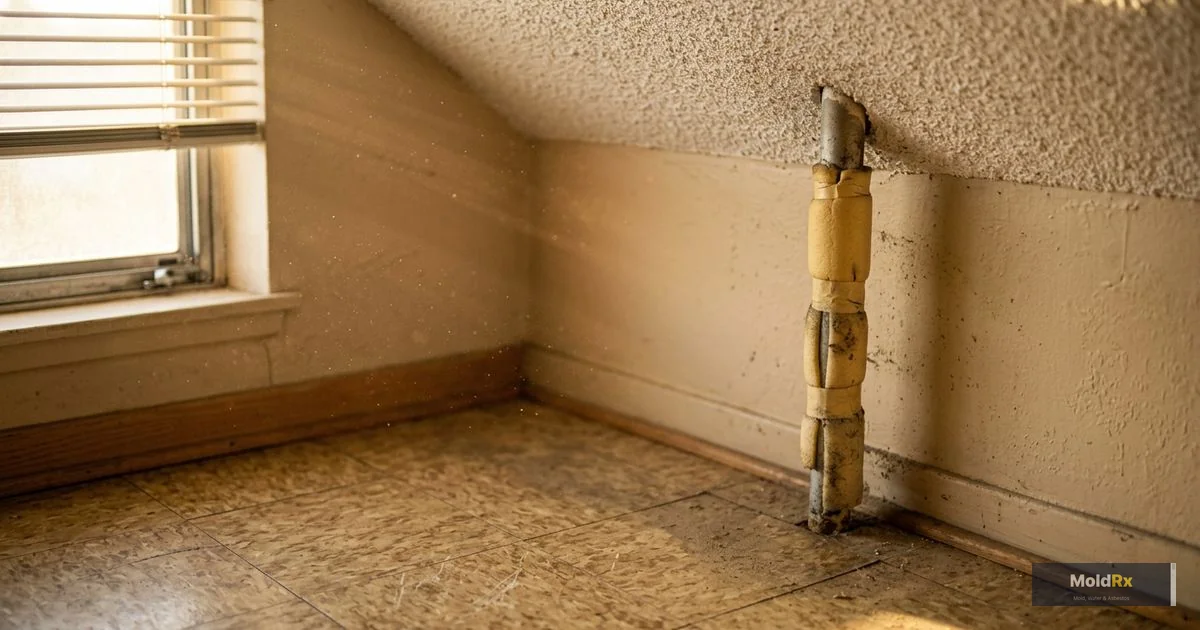
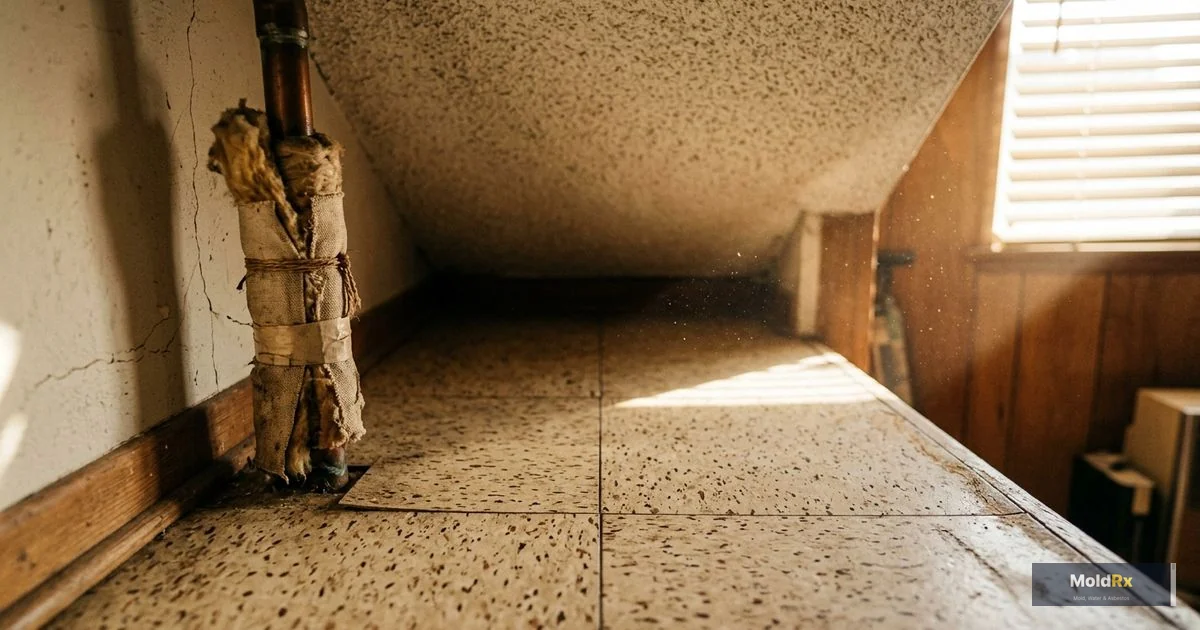
Intact, undisturbed asbestos does not automatically release fibers. The danger begins when materials are disturbed. Friable materials — those that crumble under hand pressure, like pipe insulation or acoustic ceiling texture — release fibers with minimal disturbance. Non-friable materials — floor tiles, transite siding — become hazardous when cut, sanded, drilled, or broken. Renovation is the most common trigger. Tearing out old flooring in a converted dairy structure, scraping ceilings in a pre-2000 home, or demolishing walls in a commercial building without testing can contaminate the entire structure in minutes.
Eastvale-Specific Risk Factors
Pre-2000 residential pockets — the 8.5 percent that everyone forgets. While 91.5 percent of Eastvale housing is post-2000, the remaining properties are scattered along the city's original roads — Archibald Avenue, Hamner Avenue, Limonite Avenue, Schleisman Road — and near the edges bordering Jurupa Valley and Ontario. Some are original ranch houses from the 1960s-1980s dairy era. Others are 1990s tract homes from the early wave of suburban conversion. These properties carry the same asbestos risk as equivalent-age homes anywhere in Riverside County.
Former dairy and agricultural infrastructure. Eastvale's dairy heritage left behind structures predating the residential boom. Some were demolished. Others were converted into workshops, storage buildings, or incorporated into residential lots. Dairy buildings from the 1950s through 1980s commonly used transite panels, asbestos-insulated steam lines, and heat-resistant materials. If you own property that includes any pre-2000 agricultural structure, testing is essential.
Commercial corridor with mixed-era construction. The Goodman Commerce Center and Eastvale Gateway represent modern construction, but Eastvale's commercial corridor along Hamner and Limonite Avenues includes older structures built before current regulations took full effect. Commercial tenants renovating leased space must comply with SCAQMD Rule 1403 survey requirements.
Imported building materials. Eastvale's housing boom coincided with peak global construction material imports. Imported drywall, joint compound, and cement products from countries with less restrictive standards have been documented containing asbestos in post-2000 construction. The EPA has issued multiple enforcement actions. Newer does not automatically mean safer.
Inland Empire heat and thermal cycling. Summer temperatures exceeding 100 degrees subject building materials to extreme thermal stress. Over decades, this cycling degrades binders in asbestos-containing materials, making non-friable materials increasingly prone to fiber release.
When Asbestos Removal Is Required
Before renovation or demolition. SCAQMD Rule 1403 requires an asbestos survey before any renovation or demolition, regardless of building age. Notification must be submitted for projects disturbing more than 100 square feet of ACM. If you are planning any work on a pre-2000 Eastvale property — remodeling a kitchen, converting an agricultural building, renovating a commercial space — testing must come first. This is law, not suggestion.
When materials are damaged or deteriorating. Friable materials that are crumbling, water-damaged, or visibly deteriorating require immediate professional attention. Former dairy structures exposed to decades of weather, older homes with deferred repairs, and commercial buildings with aging mechanical systems are the highest-priority situations in Eastvale.
Real estate transactions. California Civil Code requires sellers to disclose known asbestos hazards. In Eastvale's active market — driven by families relocating from LA and Orange Counties — a clean clearance report prevents costly renegotiations. Pre-2000 properties, agricultural conversions, and structures with uncertain construction history should be tested before closing.
After professional testing confirms ACMs. No removal begins without laboratory-confirmed results from an NVLAP-accredited lab using PLM or TEM analysis.
Our Asbestos Removal Process
The professionals MoldRx sends to your Eastvale property follow a six-phase process designed for complete regulatory compliance and maximum safety.
1. Pre-Abatement Survey and Testing. A certified inspector surveys your property and collects samples for NVLAP-accredited lab analysis following AHERA protocols. For Eastvale, this commonly includes flooring, ceiling textures, pipe insulation, HVAC components, roof materials, and — in older or converted structures — transite panels and boiler insulation.
2. Regulatory Notification. SCAQMD Rule 1403 advance written notification for projects disturbing more than 100 square feet of ACM. Cal/OSHA DOSH notification and registration verification. All permits obtained including City of Eastvale building permits where required.
3. Containment and Worker Protection. Complete isolation with polyethylene sheeting and HEPA-filtered negative-pressure air scrubbers. Decontamination unit at entry/exit. Full PPE with NIOSH-approved P100 HEPA respirators per OSHA 1926.1101. Containment scales to property type — residential lots, commercial buildings, or converted agricultural structures. Boundary air monitoring is standard.
4. Wet Removal and Abatement. All ACMs thoroughly wetted before removal per NESHAP and OSHA. Hand tools minimize breakage. Glovebag techniques for pipe insulation. Continuous air monitoring throughout.
5. Disposal. Double-bagged in labeled 6-mil poly bags, rigid containers, warning labels. Waste manifest documents chain of custody to approved disposal landfill.
6. Air Monitoring and Clearance Testing. Independent TEM or PCM analysis. Clearance requires fiber concentrations below 0.01 f/cc. Complete clearance report provided as your permanent record.
Asbestos Removal vs. Encapsulation
Encapsulation — applying a sealant that binds fibers — is sometimes acceptable for non-friable materials in good condition that will not be disturbed. However, encapsulation does not eliminate the asbestos. It remains in your property, requires ongoing monitoring, and any future renovation reactivates the full abatement requirement. In Eastvale's Inland Empire climate — where extreme heat degrades sealants and thermal cycling stresses materials — encapsulant longevity demands careful evaluation. For weathered agricultural structures, encapsulation is rarely appropriate. Removal is usually the more definitive long-term solution. The professionals MoldRx sends will give you an honest assessment — not a sales pitch.
Get your free estimate — no obligations.
Regulations That Govern Asbestos Removal in California
Asbestos removal in Eastvale is governed by overlapping federal, state, and regional regulations. Every professional MoldRx sends operates in full compliance.
Federal: EPA NESHAP. National Emission Standards for Hazardous Air Pollutants — inspection before demolition or renovation, proper notification, wet removal methods, disposal at approved facilities.
Federal: OSHA 1926.1101. Construction Industry Standard — PEL of 0.1 f/cc over 8-hour TWA, medical surveillance, engineering controls, containment, ventilation, PPE.
California: Cal/OSHA Title 8 Section 1529. Meets or exceeds federal OSHA — mandatory contractor registration with DOSH, AHERA-approved training (4-day initial, annual refreshers), medical monitoring. DOSH inspects active projects throughout Riverside County.
Regional: SCAQMD Rule 1403. Governs asbestos emissions during demolition and renovation in LA, Orange, Riverside, and San Bernardino Counties. Pre-project surveys mandatory. Advance notification for projects disturbing 100+ square feet of ACM — submitted online at least 10 working days before work begins. Failure to comply can result in fines exceeding $20,000 per day. SCAQMD Asbestos Hot Line: (909) 396-2336.
Licensing: CSLB C-22. California requires a C-22 Asbestos Abatement license. Workers must hold ASB certification and EPA-accredited training — 40 hours initial, 8-hour annual refreshers. Every professional MoldRx sends holds required licenses and active DOSH registration.
Schools: AHERA. Asbestos Hazard Emergency Response Act requires management plans for all K-12 buildings. Eastvale's schools within Corona-Norco Unified School District must maintain AHERA compliance.
Health Risks of Asbestos Exposure
There is no safe level of asbestos exposure according to OSHA.
Mesothelioma — aggressive cancer of the lung, abdominal, or heart lining, caused almost exclusively by asbestos. Incurable in most cases. Median survival 12-21 months. Even brief, one-time exposure can trigger this disease decades later.
Asbestosis — chronic lung disease from inhaled fibers that permanently scar tissue. Progressive difficulty breathing. No cure.
Lung cancer — asbestos significantly increases risk, multiplying dramatically with smoking.
Latency period — symptoms typically appear 10 to 50 years after exposure. An Eastvale homeowner who disturbs ACMs during renovation today may not develop symptoms until the 2040s or 2050s. A contractor who cuts through transite panels in a former dairy building without protection carries that risk for decades. A family whose children play in a home where asbestos ceiling texture was improperly scraped faces consequences that will not manifest for a generation. The fibers are invisible, odorless, and too small to feel. This is precisely why California mandates professional testing and licensed removal. Do not wait.
For authoritative information, consult the EPA asbestos page and OSHA's asbestos safety topics.
What Sets MoldRx Apart
- Licensed, certified, compliant. Every professional MoldRx sends holds a CSLB C-22 license, EPA-accredited training, active DOSH registration, and full compliance with Cal/OSHA Title 8, OSHA 1926.1101, and SCAQMD Rule 1403. Licensing and insurance are verified before any contractor is sent to your property.
- Full regulatory documentation. SCAQMD notifications, waste manifests, NVLAP-accredited lab results, clearance reports — everything needed for regulatory compliance, real estate transactions, insurance claims, and permanent property records.
- Honest assessment. If encapsulation is sufficient, we say so. If materials are asbestos-free, we say that too. If testing shows no asbestos, we do not recommend removal you do not need. No upselling. No minimizing genuine hazards. Straight answers.
- Family-owned accountability. Every contractor is vetted for licensing, insurance, training, and track record before we send them to your Eastvale property. MoldRx does not operate a revolving door of unverified subcontractors.
Eastvale Neighborhoods and Areas We Serve
Riverland Village and Riverwalk Park area — along the Santa Ana River corridor on Eastvale's western edge. Closest to the Jurupa Valley boundary where some of the area's oldest structures remain. Properties backing to the river may include remnant agricultural structures. Any pre-2000 structure warrants asbestos testing before renovation.
Eastvale Summit and The Preserve — master-planned communities from the 2000s-2010s boom. Lower asbestos risk but not immune — imported materials and vermiculite insulation are documented in post-2000 Southern California construction. Test suspect materials before proceeding.
Heritage Trails and Villages of Eastvale — newer developments with community amenities. Similar risk profile — overwhelmingly modern construction, but material verification during renovation remains prudent.
Hamner Avenue Corridor — Eastvale's primary commercial spine. Eastvale Gateway (70-plus stores and restaurants), medical offices, and retail centers. Older commercial structures predating the housing boom may contain asbestos in fireproofing, ceiling tiles, and HVAC components. SCAQMD Rule 1403 applies to all renovation.
Limonite Avenue and Schleisman Road areas — east-west corridors that defined the original agricultural landscape. Eastvale's oldest remaining structures — former dairy buildings, ranch homes, early commercial properties — carry the highest asbestos risk in the city.
Goodman Commerce Center and I-15 Industrial Corridor — modern Class A construction, but any renovation or tenant improvement requires SCAQMD Rule 1403 compliance regardless of building age.
We serve all Eastvale ZIP codes: 92880 and 91752.
Nearby Communities We Also Serve
MoldRx also serves Jurupa Valley, Corona, Norco, Ontario, Chino, Chino Hills, Riverside, Mira Loma, and properties throughout the western Inland Empire and northwestern Riverside County.
Related Services in Eastvale
- Asbestos Testing in Eastvale
- Mold Removal in Eastvale
- Mold Testing in Eastvale
- Water Damage Restoration in Eastvale
-> All remediation services in Eastvale
Frequently Asked Questions
My Eastvale home was built in 2005. Could it still contain asbestos?
Yes — and dismissing the possibility is a mistake. Domestic asbestos use declined after the 1980s but was never fully banned. Eastvale's housing boom coincided with massive importation of construction materials from countries with less restrictive regulations. Drywall, joint compound, and cement products manufactured overseas have been documented containing asbestos in post-2000 construction. Vermiculite insulation from contaminated mines was distributed through the 1990s. Laboratory testing is the only way to confirm. The cost of testing is trivial compared to the cost of exposure.
I am buying property in Eastvale that includes an old dairy building. Should I be concerned about asbestos?
Absolutely. Dairy structures from the 1950s-1980s routinely used transite panels, asbestos pipe insulation, boiler gaskets, and heat-resistant processing materials. Many have endured decades of weathering without maintenance, making originally non-friable materials prone to fiber release. Before purchasing, renovating, or demolishing any pre-2000 agricultural structure, a professional asbestos survey is essential. SCAQMD Rule 1403 requires it for demolition regardless.
Does SCAQMD Rule 1403 apply to residential renovations in Eastvale?
Yes. Rule 1403 applies to any renovation or demolition in the South Coast Air Quality Management District, which includes all of Riverside County. Projects disturbing more than 100 square feet of ACM require advance written notification at least 10 working days before work begins, filed online. Pre-project surveys, wet removal, proper disposal, and documentation are mandatory. Non-compliance can result in fines exceeding $20,000 per day.
How do I know if my Eastvale home has asbestos?
Laboratory testing by an NVLAP-accredited lab is the only reliable method — visual inspection cannot identify asbestos. A certified inspector collects samples for PLM or TEM analysis, with results typically in three to five business days. For pre-2000 Eastvale homes, testing is strongly recommended before any renovation. For post-2000 homes, test if you encounter unusual materials, suspect imported products, or find vermiculite insulation.
Is it legal to remove asbestos myself in California?
California requires C-22 licensed contractors for asbestos abatement. A narrow exemption exists for homeowners removing small quantities of non-friable asbestos from their own residence, but containment, wet methods, disposal, and notification requirements still apply — and the homeowner assumes all liability. Professional abatement is the only responsible choice.
How long does asbestos removal take?
Most residential projects take two to five days. Small projects like pipe insulation may finish in one to two days. Larger projects involving multiple materials or commercial spaces take longer. SCAQMD Rule 1403 notification adds lead time. For former agricultural structures, duration depends on building size and material condition.
Can I stay in my home during asbestos removal?
For small, contained projects, you may remain in unaffected areas. Larger projects — multiple rooms, HVAC-connected materials, ceiling abatement — typically require temporary relocation. Your abatement team will advise based on scope and containment requirements.
What is the difference between friable and non-friable asbestos?
Friable asbestos crumbles under hand pressure (pipe insulation, sprayed fireproofing, ceiling texture) and releases fibers with minimal disturbance. Non-friable has fibers bound in a solid matrix (floor tiles, transite siding, shingles) and is hazardous when cut, broken, drilled, or sanded. Both require professional handling under California law. Eastvale's former dairy structures may contain both types.
Will my homeowner's insurance cover asbestos removal?
Standard policies typically exclude asbestos abatement. However, if ACMs are damaged by a covered peril — fire, earthquake, storm, water intrusion — your policy may cover abatement as part of the broader claim. Given Eastvale's seismic zone location and Santa Ana River flood exposure, this is worth reviewing with your insurer.
Is encapsulation as safe as removal?
Encapsulation can work for non-friable materials in good condition that will not be disturbed. However, the asbestos remains, sealant longevity in Eastvale's extreme heat requires monitoring, and encapsulated asbestos must be disclosed at sale. For most situations, removal is the more permanent solution.
Get Asbestos Removal in Eastvale
Asbestos in your Eastvale property demands a professional response — not next month, not when the budget allows. The diseases are irreversible. The fibers are invisible. The latency period spans decades.
Eastvale's identity as one of California's youngest cities creates a dangerous blind spot. The assumption that new equals safe leads property owners to skip testing and dismiss risks that California regulators take extremely seriously. The 8.5 percent of homes built before 2000 carry the same asbestos risk as equivalent-age properties in any Inland Empire city. Former dairy structures contain materials from the peak asbestos era. The Hamner Avenue commercial corridor includes older buildings where renovation without testing violates SCAQMD Rule 1403. And in the post-2000 housing that defines most of Eastvale, imported materials and contaminated insulation mean asbestos cannot be ruled out without laboratory confirmation.
Whether you have confirmed ACMs, suspect asbestos in a pre-2000 structure, need testing before renovating a former dairy building, or want verification that your newer home is clean — MoldRx only sends licensed, insured, and fully compliant abatement professionals. Every contractor is vetted for CSLB C-22 licensing, DOSH registration, EPA-accredited training, and current insurance. Your family's safety is not something to gamble on.
Call MoldRx for your free estimate — (888) 609-8907. Licensed. Compliant. Done right.