Emergency Water Damage Restoration in Cypress, CA -- MoldRx
Vetted, IICRC S500-Certified Specialists Serving Cypress and North Orange County -- 24/7
Water is inside your Cypress home right now. It is soaking into your subfloor, wicking up the backside of your drywall, and saturating the slab beneath your feet -- and every minute you wait makes it worse. Within 24 to 48 hours, mold colonization starts. At that point you are no longer dealing with water damage. You are dealing with water damage and a mold remediation project. Two emergencies. Double the cost. Double the disruption. If water has entered your property, stop reading and call.
Call (888) 609-8907 now for emergency water damage response in Cypress.
MoldRx does not perform restoration work ourselves. We vet the specialists who do. Every water damage professional we deploy to your Cypress property has been screened for IICRC S500 certification, proper CSLB licensing, verified insurance, and documented experience handling the exact building types and failure scenarios that define this city. You get a qualified, accountable crew -- not whoever picks up the phone first.
Why Water Damage in Cypress Demands Immediate Action
Cypress is not a generic Orange County suburb, and the water damage happening inside your property right now is not a generic problem. The city's history, housing stock, terrain, and groundwater conditions create a specific set of vulnerabilities that make water damage here uniquely destructive when left unaddressed.
A City Built on Water -- Literally
Before it was Cypress, this community was called Waterville -- named for the artesian wells that dotted the landscape and provided water to the dairy farms that defined the area through the first half of the 20th century. That name was not accidental. The groundwater table beneath Cypress sits remarkably close to the surface -- as shallow as three feet below grade in some areas, according to the city's General Plan EIR. This is not historical trivia. It is directly relevant to the water damage emergency you are dealing with right now.
A high water table means your slab-on-grade foundation sits closer to subsurface moisture than homes in elevated communities. The ground beneath your property does not absorb excess water the way it would in deeper-table locations. Water that pools against your foundation during a storm or plumbing failure has nowhere to go but in.
1950s-1970s Housing Stock: The Failure Window
Cypress was incorporated as Dairy City on July 24, 1956 (renamed Cypress in 1957), and the transformation from dairy farmland to residential suburb happened fast. The dairies sold out to housing developers through the 1960s, and by the 1970s no agricultural operations remained. This means the overwhelming majority of Cypress homes were built between 1955 and 1975 -- placing them at 50 to 70+ years old. That age bracket puts your property squarely in the catastrophic-failure window for multiple plumbing systems simultaneously.
Homes built during this era share predictable vulnerabilities that are converging right now across Cypress:
- Galvanized steel supply lines that corrode from the inside out, developing pinhole leaks and blockages that lead to pipe failure -- often inside walls or beneath the slab where damage goes undetected for weeks
- Cast-iron drain lines nearing the end of their 50-75 year lifespan, developing cracks and root intrusions that cause sewage leaks beneath the slab
- Polybutylene supply lines (installed in homes remodeled between 1978 and 1995), where chlorine in municipal water makes the pipe brittle and prone to sudden catastrophic failure
- Original water heaters replaced once and now due again -- or 15-20+ years past expected service life
- Slab-on-grade foundations where supply and drain lines run beneath the concrete, making slab leaks one of the most common and destructive water damage scenarios in Cypress
The combination of aging copper supply lines shifting against concrete over decades, a high water table creating differential pressure, and soil conditions that promote corrosion makes Cypress a textbook slab-leak environment. By the time you notice warped flooring, a hot spot on the slab, or a water bill that doubled for no apparent reason, the leak may have been running for weeks.
Flat Terrain and Pump-Dependent Drainage
Cypress sits on some of the flattest terrain in Orange County. The city relies on Carbon Creek, Coyote Creek, and Moody Channel systems for flood control -- but critically, this drainage is not passive. It depends on a network of pump stations to lift runoff into larger channels. When those systems are overwhelmed during heavy rain, water has nowhere to go. There is no slope to carry it away.
The city's General Plan EIR confirms that a 500-year flood event could result in widespread flooding throughout the entire city. The portion of Cypress below Orange Avenue falls within the dam inundation area for Prado Dam, Carbon Canyon Dam, and Whittier Narrows Dam.
During a standard winter storm, the immediate risk is localized flooding when pump stations cannot keep up. Properties in low spots, near drainage channels, or with aging lateral connections to the storm-drain system take water first. Combined with the high water table pushing moisture up from below, a Cypress home can take water from above and below simultaneously.
Climate: 14 Inches of Rain Compressed Into Four Months
Cypress receives approximately 14 inches of annual rainfall, nearly all of it between November and March. When concentrated winter storms drop two or more inches in a single event after months of dry weather, the hardened soil surface resists absorption -- turning yards and streets into waterways that find every crack in your foundation and every failed seal around your windows.
Humidity averages 60-65% and climbs to 73% in May during the marine-layer season. That ambient moisture means water-damaged materials cannot dry on their own. Without commercial dehumidification, the drying process stalls and mold colonization proceeds on schedule. Opening windows will not solve this. It may make it worse.
The IICRC S500 Restoration Process Our Vetted Specialists Follow
The professionals MoldRx sends to your Cypress property do not improvise. They follow the IICRC S500 Standard and Reference Guide for Professional Water Damage Restoration -- the ANSI-accredited, industry-recognized protocol that defines how this work must be done. Here is what that process looks like applied to your emergency.
Step 1: Emergency Response and Loss Assessment
When you call (888) 609-8907, we deploy a vetted, certified specialist to your Cypress property. They will:
- Identify and stop the water source -- whether it is a burst galvanized supply line, a failed water heater, a slab leak, an appliance malfunction, storm intrusion, or a sewage backup through a deteriorated cast-iron drain
- Classify the water category per IICRC S500 standards:
- Category 1 (Clean Water): Sanitary source -- broken supply lines, toilet-tank cracks, ice-maker failures. Lowest contamination risk but degrades to Category 2 or 3 if not removed within 48 hours.
- Category 2 (Gray Water): Significant contamination causing illness risk -- washing machine discharge, dishwasher overflow, HVAC condensate, sump pump failures. Requires enhanced PPE and antimicrobial treatment.
- Category 3 (Black Water): Grossly contaminated -- sewage backups through Cypress's aging cast-iron laterals, floodwater from Carbon Creek or Coyote Creek, storm-drain backflow, or any water stagnant 48+ hours. Cal/OSHA hazmat protocols apply. All affected porous materials removed and discarded. This is the most dangerous scenario and demands immediate intervention.
- Determine the damage class per IICRC standards:
- Class 1: Least amount of water absorption -- small area, minimal saturation, materials with low porosity
- Class 2: Significant absorption -- water has saturated carpets, cushions, and wicked up walls to 24 inches or more
- Class 3: Greatest absorption -- water from overhead, saturating ceilings, walls, insulation, subfloor, and carpet throughout affected areas
- Class 4: Specialty drying situations -- water trapped in hardwood, concrete slab, plaster, or stone. Common in Cypress's slab-on-grade construction where water migrates laterally beneath flooring through the concrete itself.
- Map the full moisture footprint using infrared thermal imaging and penetrating moisture meters -- critical in Cypress's post-war slab-on-grade homes where water travels beneath flooring in ways invisible to the eye and often extends far beyond the visibly damaged area
- Document everything with timestamped photography, moisture readings, and written reports for your insurance carrier
Step 2: Water Extraction
Standing water is removed immediately using truck-mounted and portable extraction units. In Cypress homes with slab leaks, extraction includes targeted removal of water from beneath flooring and within wall cavities where plumbing penetrations allowed water to enter.
Speed is everything. Every hour water remains in contact with building materials increases the damage class, elevates the contamination category, and expands the cost of restoration. Extraction must be thorough, documented, and verified with moisture readings -- not assumptions.
Step 3: Structural Drying and Dehumidification
This is the phase that separates competent restoration from the kind that creates a mold problem six weeks later.
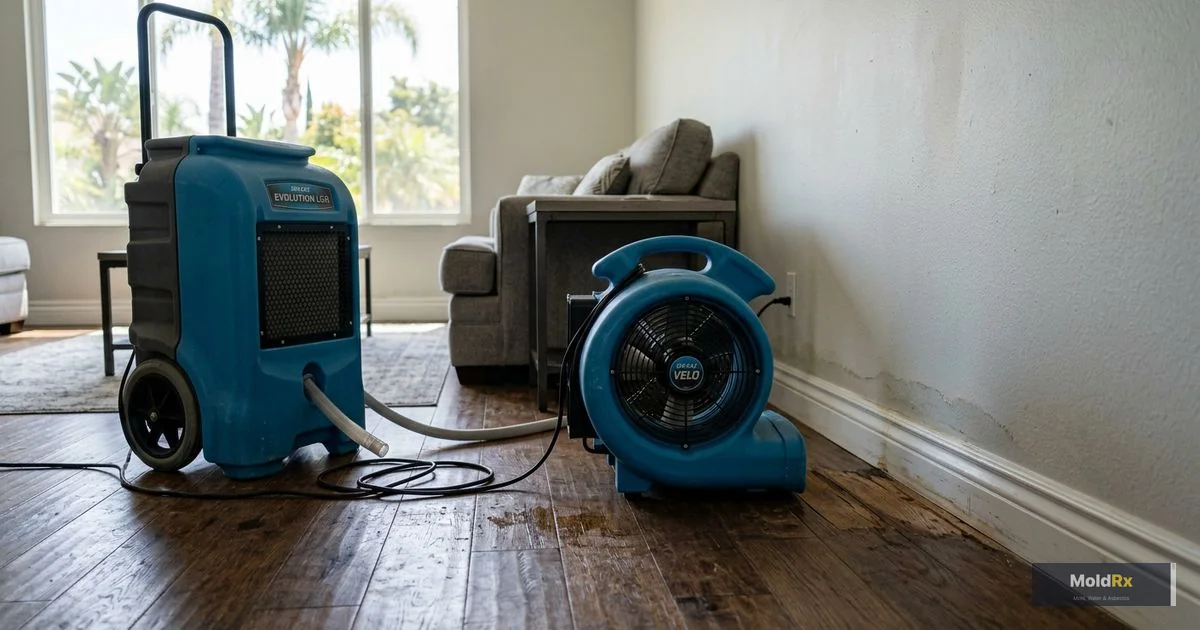
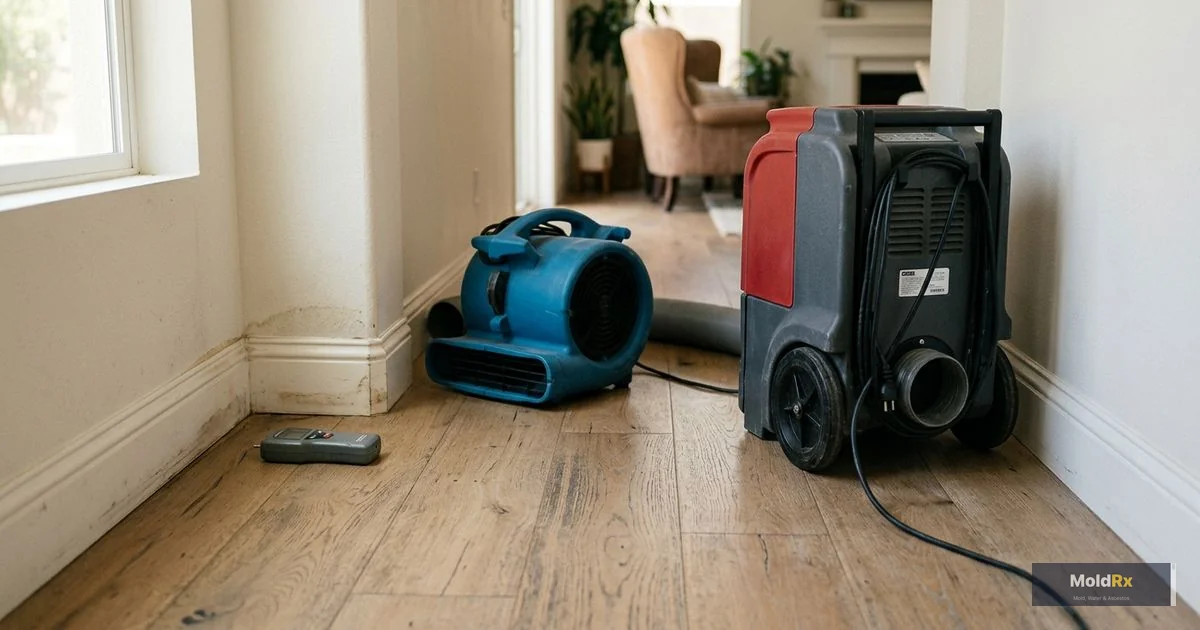
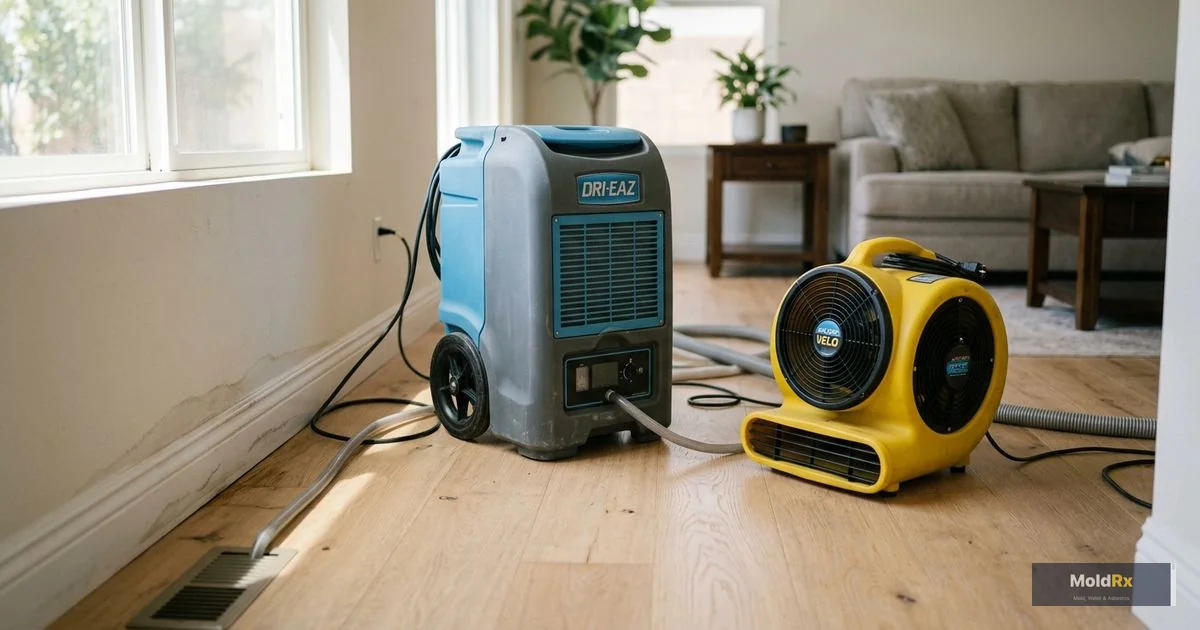
Our vetted specialists deploy commercial-grade LGR (low-grain refrigerant) dehumidifiers and high-velocity air movers in configurations calculated for each affected space. In Cypress, where humidity regularly exceeds 65% and the marine-layer season pushes it above 70%, the drying protocol must overcome ambient conditions that actively work against drying. Standard residential dehumidifiers and open windows cannot do this work.
Drying is monitored daily with calibrated moisture meters and hygrometers. The specialists document psychrometric readings to verify conditions are progressing toward IICRC S500 drying goals for each material type. Drying is not complete when the carpet feels dry. It is complete when instrument readings confirm all affected materials have returned to normal equilibrium moisture content.
In Class 4 situations -- common in Cypress where water becomes trapped in concrete slab, original hardwood, or plaster walls -- specialty techniques including desiccant dehumidification or injectidry systems may be required.
Step 4: Cleaning, Sanitization, and Antimicrobial Treatment
Once the structure is verified dry, the contamination level dictates what comes next:
- Category 1 losses: Cleaning and thorough drying may be sufficient for salvageable materials
- Category 2 losses: All affected porous materials that cannot be adequately cleaned must be removed. Semi-porous materials require antimicrobial treatment using EPA-registered products applied per label instructions.
- Category 3 losses: All affected porous materials are removed and discarded -- no exceptions. Drywall, insulation, carpet, pad, and any organic material that contacted contaminated water is gone. Structural framing is cleaned, treated, and verified before reconstruction begins. In sewage-backup scenarios involving Cypress's aging cast-iron laterals, IICRC S520 mold remediation protocols may run concurrently if microbial amplification is identified during the drying phase.
Step 5: Reconstruction and Restoration
The final phase returns your Cypress property to pre-loss condition: drywall replacement, flooring reinstallation, painting, baseboards, trim work, and any structural repairs identified during assessment and drying. Our vetted specialists coordinate this work to minimize disruption and keep the project moving toward completion.
What Category and Class Mean for Your Cypress Property
Understanding the IICRC classification system protects you from being oversold on restoration you do not need -- or undersold on restoration you critically do.
| Classification | What It Means | Common Cypress Scenarios |
|---|---|---|
| Category 1 | Clean water from a sanitary source | Burst galvanized supply line, water heater tank failure, toilet-tank crack, ice-maker line rupture |
| Category 2 | Contaminated water causing potential illness | Washing machine overflow, dishwasher backup, HVAC condensate line failure, sump pump discharge |
| Category 3 | Grossly contaminated / black water | Sewage backup through deteriorated cast-iron drain, storm-drain backflow, Carbon Creek floodwater, any stagnant water 48+ hours |
| Class 1 | Minimal absorption, small area affected | Leak caught early, limited to hard-surface flooring in one room |
| Class 2 | Significant absorption, water wicking up walls | Burst supply line in a home with carpet, water reaching adjacent rooms through wall cavities |
| Class 3 | Greatest absorption, water from overhead | Second-story bathroom leak saturating ceiling, walls, and flooring of rooms below |
| Class 4 | Specialty drying -- low-permeance materials | Slab leak with water trapped in concrete, saturated original hardwood, moisture in plaster walls |
The higher the category and class, the more complex, time-consuming, and costly the restoration. But cutting corners on a Category 3 / Class 3 loss to reduce short-term costs virtually guarantees a mold remediation project within weeks -- which will cost significantly more than doing it right the first time.
Get your free estimate now -- do not let the damage class escalate while you wait.
Cypress Neighborhoods We Serve
Our vetted water damage restoration specialists respond to emergencies throughout Cypress, including:
- Cypress Village and the Mediterranean-inspired condominium community
- Lincoln Village and the established residential neighborhoods near Cypress College
- Cottonwood and the family-oriented neighborhoods along Holder Street
- Sorento and the newer single-family and townhome developments in northwestern Cypress
- Tanglewood and the townhome communities near Nature Park in western Cypress
- Neighborhoods near Arnold Cypress Park, Cypress Civic Center, and Oak Knoll Park
- Properties along the Moody Channel, Carbon Creek, and Coyote Creek drainage corridors -- areas with elevated flood exposure during heavy winter storms
- Commercial properties along Lincoln Avenue, Katella Avenue, and Valley View Street
We cover ZIP codes 90630 and 90720, from the residential neighborhoods bordering Los Alamitos to the communities adjacent to Buena Park and Stanton.
We also respond to water damage emergencies in neighboring North Orange County cities, including La Palma to the north, Buena Park to the northeast, Stanton to the east, Garden Grove to the southeast, Westminster and Seal Beach to the south, and Los Alamitos and Hawaiian Gardens to the southwest.
Call (888) 609-8907 for immediate emergency response -- any hour, any day.
Why MoldRx -- And Why "Vetted" Is Not a Marketing Word
There are dozens of restoration companies in Orange County that will answer the phone at 2 AM. Some are excellent. Some are unlicensed, underinsured, inadequately trained, and gone before you discover the moisture they left behind your walls. You will not know which one you hired until the mold shows up -- or does not.
MoldRx exists to eliminate that gamble. We do not perform restoration ourselves. We vet the people who do, and we only send specialists who meet every one of these criteria:
- IICRC S500 certification for water damage restoration -- the industry standard that defines how extraction, drying, and restoration must be performed
- IICRC S520 certification for mold remediation -- because water damage and mold are inseparable in practice, and your specialist needs to recognize the transition when it happens
- Active CSLB contractor's license in good standing with the California State License Board
- Verified general liability and workers' compensation insurance -- protecting you from liability if an accident occurs on your property
- Documented experience with Cypress's specific building types: 1950s-1970s slab-on-grade construction, galvanized and polybutylene plumbing, high-water-table conditions, and the drainage challenges of flat terrain
- Cal/OSHA compliance for worker safety protocols, particularly critical in Category 3 / black-water scenarios involving sewage or floodwater
When we say "vetted," we mean we have verified every credential, confirmed insurance coverage, and established that these specialists do the work per IICRC S500 and EPA guidelines -- with proper documentation, honest communication, and accountability for outcomes.
Insurance and Documentation
Most Cypress homeowner policies cover sudden and accidental water damage -- a burst pipe, a failed water heater, an appliance malfunction that floods your kitchen at 3 AM. What they typically do not cover is gradual damage from deferred maintenance (the slab leak you ignored for six months), and standard policies rarely cover flood damage (which requires a separate NFIP or private flood policy -- relevant for Cypress properties near the Carbon Creek and Coyote Creek corridors or in dam-inundation zones).
Our vetted specialists produce the documentation adjusters need:
- Timestamped photo and video documentation of all affected areas before, during, and after restoration
- Moisture readings and psychrometric data confirming completion per IICRC S500 standards
- Itemized scope of work with industry-standard line items adjusters can process without pushback
- Category and class determination documented per IICRC standards -- directly affecting what your policy covers
- Material and equipment inventories supporting replacement claims
The difference between a claim that gets approved and one that gets contested comes down to documentation quality.
Frequently Asked Questions
How fast can a vetted specialist reach my Cypress property?
For active water emergencies, our goal is same-day deployment -- often within hours. Call (888) 609-8907 any time, day or night. Water damage does not observe business hours, and neither do we.
I think I have a slab leak. Is that an emergency?
Yes. Slab leaks are one of the most common and most destructive water damage scenarios in Cypress due to the city's 1950s-1970s construction, aging copper supply lines, and high water table. A slab leak may appear minor -- a warm spot on the floor, a faint musty smell, an unexplained increase in your water bill -- but beneath the concrete, water may have been migrating for weeks, saturating the subgrade and wicking into walls. The longer a slab leak runs, the higher the damage class climbs and the greater the mold risk. If you suspect a slab leak, call immediately.
What is the difference between Category 1, 2, and 3 water damage?
Category 1 is clean water from a sanitary source (supply line break, water heater failure, toilet tank). Category 2 is contaminated water that can cause illness (appliance discharge, washing machine overflow, HVAC condensate). Category 3 is grossly contaminated black water (sewage backup, floodwater, any water stagnant for 48+ hours). The category determines safety protocols, PPE requirements, and whether porous materials can be saved or must be removed. Categories are defined by the IICRC S500 standard, and they escalate over time -- Category 1 water that sits for two days becomes Category 3.
My water heater failed and flooded my garage. Is that Category 1?
Initially, yes -- Category 1 (clean water from a sanitary source). However, if the water contacted the garage floor and picked up motor oil, chemicals, soil, or pet waste, it may be reclassified as Category 2. If it has been sitting more than 48 hours, it degrades to Category 3 regardless of original source. Time is the critical variable.
Will my homeowner's insurance cover this?
Most policies cover sudden and accidental water damage -- burst pipes, appliance failures, water heater ruptures. Gradual damage from deferred maintenance is typically excluded. Flood damage from external sources requires separate flood insurance. Our vetted specialists document everything per IICRC S500 standards to support your claim with the evidence adjusters require.
How long does water damage restoration take in a typical Cypress home?
Timeline depends on the category and class of damage. A Class 1 / Category 1 loss (small area, clean water, caught early) might be dried and restored in 3-5 days. A Class 3 / Category 3 loss (extensive saturation, contaminated water, delayed response) can take 2-3 weeks or more, particularly when demolition and reconstruction are required. Slab leaks in Cypress's post-war construction often fall into Class 4 territory, requiring specialty drying techniques that extend the timeline. We will give you an honest assessment of what to expect after the initial evaluation -- not a number designed to make you feel better.
What about mold -- is it already growing?
If you can see standing water or feel dampness and it has been more than 24-48 hours, microbial amplification has likely begun -- even if you cannot see it. Mold colonizes behind walls, under flooring, and inside wall cavities where visual detection is impossible without moisture meters and invasive inspection. Cypress's average humidity of 60-65% (climbing higher in the marine-layer season) accelerates this timeline compared to drier inland communities. Our vetted specialists are dual-certified in IICRC S500 (water damage) and IICRC S520 (mold remediation) because these two problems are inseparable in practice.
Can water-damaged materials in my 1960s Cypress home be saved?
It depends on the material, the water category, and how quickly intervention begins. Original hardwood can often be saved if drying begins within 24-48 hours of a Category 1 loss. Drywall saturated above 24 inches must be replaced. Carpet exposed to Category 3 water is always removed. The plaster, lath, and textured finishes common in Cypress's mid-century homes require specialty Class 4 drying protocols -- they can be preserved, but only by specialists experienced with low-permeance materials.
Related Services in Cypress
Water damage and mold are rarely isolated problems in Cypress's older housing stock. When one appears, the other is usually close behind -- especially given the high water table and humidity conditions. MoldRx connects Cypress property owners with vetted specialists for:
- Mold Removal in Cypress
- Mold Testing in Cypress
- Asbestos Removal in Cypress
- Asbestos Testing in Cypress
-> Learn more about remediation services in Cypress
Water Is in Your Cypress Home Right Now. Here Is What to Do.
Every hour you wait, the damage class escalates. Category 1 water degrades to Category 2, then Category 3. Moisture migrates deeper into your slab, further up your walls, further into materials that become unsalvageable once saturation thresholds are crossed. Mold colonization -- invisible, behind walls, under floors -- proceeds on a biological timetable that does not care about your schedule. This is not a scare tactic. It is building science, codified in the IICRC S500 standard that every legitimate restoration professional follows.
Cypress's high water table, flat pump-dependent terrain, 50-70 year old plumbing, and concentrated winter rainfall create conditions where water damage escalates faster and hides more effectively than in most Orange County communities. You need a vetted, IICRC S500-certified specialist who knows this city's construction, understands these conditions, and will tell you exactly what your property needs -- nothing more, nothing less.
MoldRx only sends professionals who meet that standard. We built this company specifically because the alternative -- trusting your emergency to whoever answers the phone -- is a gamble you should not have to take.
Get your free estimate now -- or pick up the phone.
Call (888) 609-8907 for emergency water damage restoration in Cypress.
No runaround. No upselling. Just vetted professionals, honest answers, and the urgency this situation demands.