Asbestos Testing in Costa Mesa, CA — MoldRx
Vetted Asbestos Testing Professionals Serving Costa Mesa and Coastal Orange County
You have a renovation lined up for a 1962 Mesa Verde ranch home, a real estate closing on a Cliff May original along 20th Street, or a commercial tenant improvement somewhere off Bristol. Before a single wall is opened, before a tile is pried loose, before a ceiling is scraped, you need laboratory-confirmed answers about what is inside those building materials. Visual inspection alone cannot identify asbestos — the fibers are microscopic, odorless, and invisible to the naked eye. Only accredited laboratory analysis using Polarized Light Microscopy (PLM) or Transmission Electron Microscopy (TEM) can confirm whether asbestos is present, what type it is, and at what concentration.
Costa Mesa's residential core was constructed almost entirely between the late 1940s and the mid-1970s — the exact decades when asbestos-containing materials were standard in American construction. The median build year for local homes is approximately 1971. That single fact places the overwhelming majority of Costa Mesa properties squarely in the highest-risk category for asbestos-bearing floor tiles, ceiling textures, pipe insulation, joint compound, roofing, and duct wrapping. MoldRx only sends vetted asbestos testing professionals who understand the construction history specific to coastal Orange County and the regulatory landscape that governs renovation and demolition work here.
Request your free asbestos testing consultation or call (888) 609-8907 — we will help you determine if testing is needed before your project starts.
Why Costa Mesa Has Elevated Asbestos Risk
A City Built During the Peak Asbestos Era
Costa Mesa's development timeline tracks almost perfectly with the peak years of asbestos use in residential and commercial construction. The Santa Ana Army Air Base occupied nearly one-fifth of what is now the city during World War II, and after decommissioning in 1946, the base land was parceled into what became the Orange County Fairgrounds, Orange Coast College, and the Civic Center. The infrastructure the military installed — roads, water, electrical grids — became the backbone for postwar suburban development.
The city incorporated on June 29, 1953, with just 3.5 square miles and 16,185 residents. What followed was extraordinary growth. Orange County's population surged from 216,000 in 1950 to over 700,000 by 1960, and Costa Mesa absorbed a significant share. The GI Bill financed the first tract housing in the late 1940s and 1950s. Architect Cliff May designed his signature "atomic ranch" homes along 20th Street and Orange Avenue beginning in 1954 — post-and-beam construction, open floor plans, materials considered state of the art. The Freedom Homes tract followed in 1954, the Sunshine Homes tract between 1956 and 1962, and Mesa Verde's planned neighborhoods in the late 1950s and early 1960s, anchored by the Mesa Verde Country Club (1959). The Buccola neighborhoods came in the 1960s and early 1970s.
By the time the Segerstrom family opened South Coast Plaza in 1967 — transforming their lima bean fields into what would become one of the largest shopping centers in the nation — the residential core of Costa Mesa was largely built, and nearly all of it during the exact decades when asbestos was a default building material.
Where Asbestos Is Found in Costa Mesa Homes
Asbestos was not a single product. It was an additive mixed into dozens of different building materials because it was fireproof, chemically stable, and inexpensive. In a typical Costa Mesa home built between the late 1940s and 1980, any of the following materials may contain asbestos:
-
Popcorn ceilings and spray-applied acoustic texture. Manufacturers mixed chrysotile asbestos into ceiling spray textures starting in the 1950s. Popcorn ceilings are among the most commonly confirmed asbestos-containing materials in Costa Mesa homes, particularly across Mesa Verde, College Park, and Eastside neighborhoods.
-
Vinyl floor tiles and mastic adhesive. The classic 9x9-inch vinyl floor tile — ubiquitous in kitchens, bathrooms, and utility rooms across Costa Mesa — has a high probability of containing asbestos. The black mastic adhesive underneath is often asbestos-bearing as well, meaning pulling up old flooring can release fibers even if the tile tests negative.
-
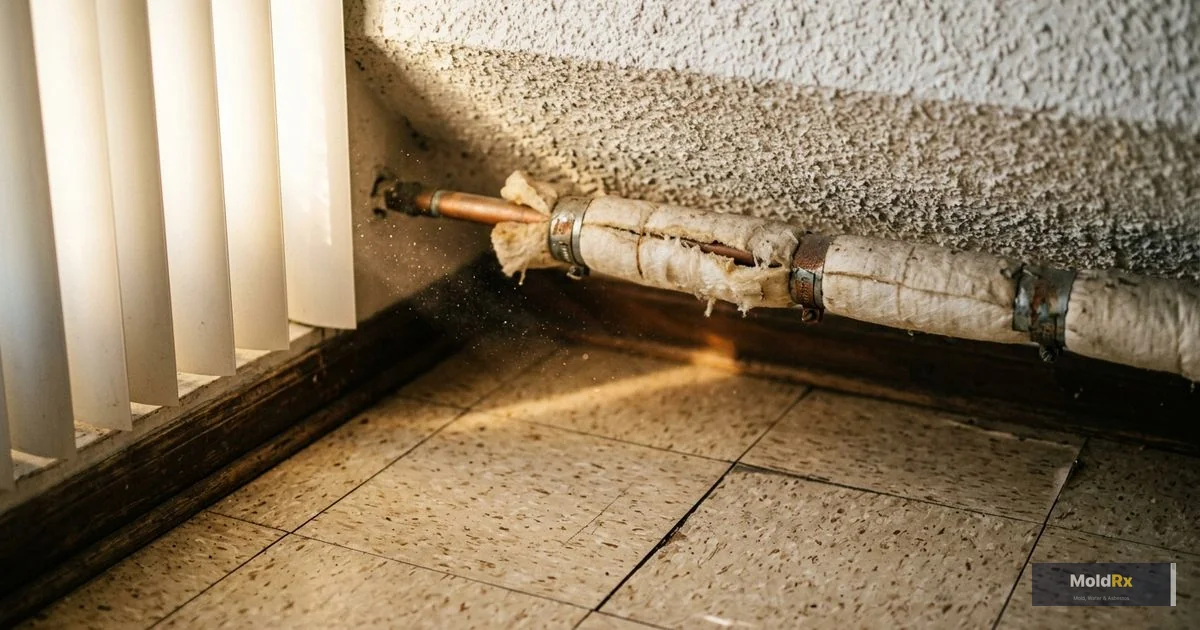
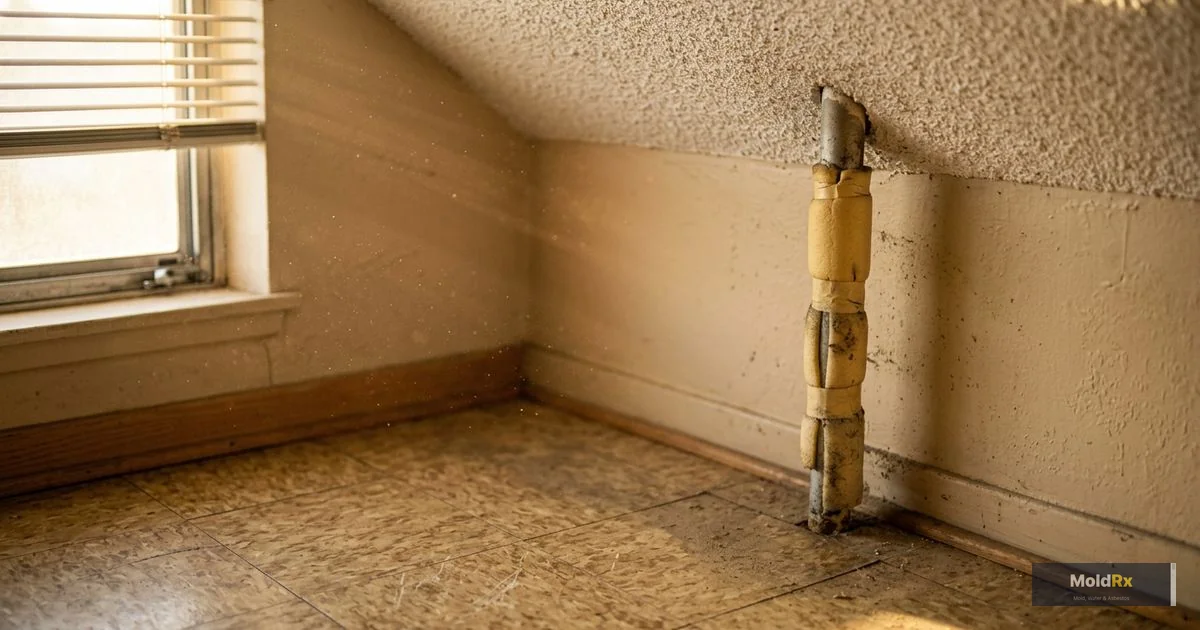
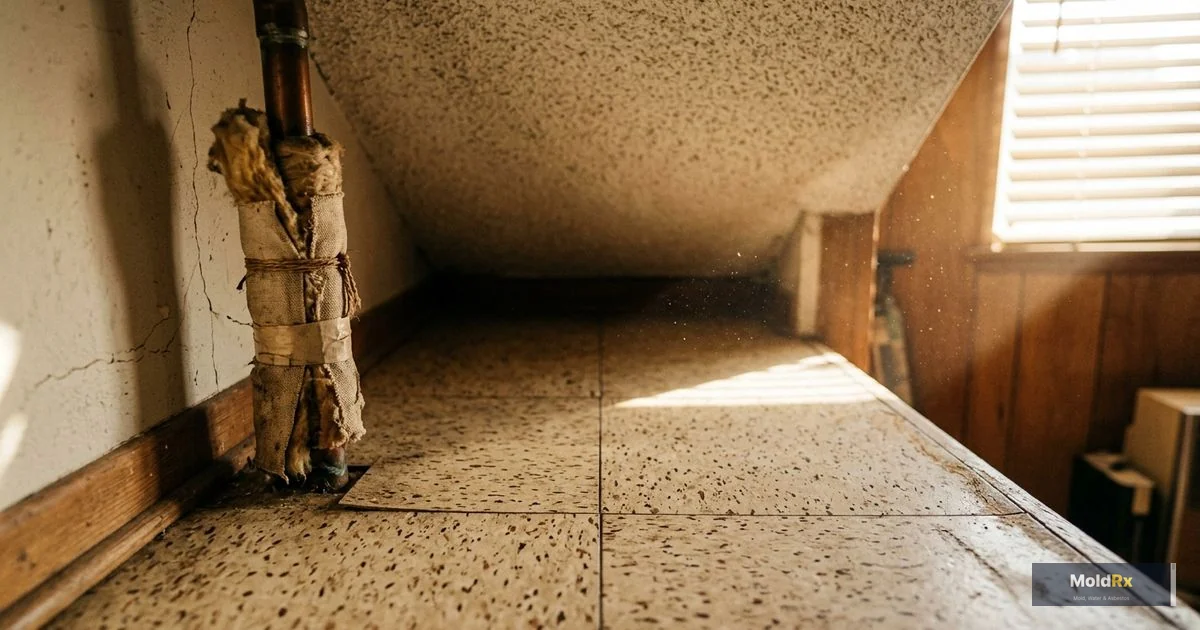
Pipe insulation and duct wrapping. The whitish, cloth-like wrapping around hot water pipes and HVAC ductwork in attics, crawl spaces, and garages is one of the most hazardous asbestos-containing materials when disturbed. Amosite asbestos is commonly identified in these applications.
-
Joint compound, taping mud, and wall texture. Drywall joint compound manufactured before 1980 frequently contained chrysotile asbestos. Sanding or scraping walls during a remodel releases fibers from material that appears completely benign.
-
Roofing shingles and cement siding. Cement-asbestos shingles and siding panels were popular along Bristol Street, Harbor Boulevard, and on residential roofs. Durable when intact, they release fibers when cut, broken, or removed.
-
Vermiculite attic insulation. Loose-fill insulation resembling small gray-brown pellets may be vermiculite contaminated with tremolite asbestos. Over 70 percent of vermiculite sold in the U.S. between 1923 and 1990 came from a Libby, Montana mine contaminated with asbestos.
-
HVAC components and furnace insulation. Older furnaces, heating ducts, and the duct tape sealing them may contain asbestos — a frequently overlooked source in homes undergoing system upgrades.
Intact Does Not Mean Safe to Disturb
Costa Mesa's Mediterranean climate — warm, dry summers and mild winters — preserves building materials well. Your original 1962 floor tile might look worn but remain structurally sound. Your popcorn ceiling might be discolored but still firmly bonded.
That preservation becomes a liability the moment renovation begins. Cutting, drilling, sanding, or demolishing asbestos-containing materials releases microscopic fibers that can remain suspended in indoor air for hours. Once inhaled, asbestos fibers lodge in lung tissue permanently. Mesothelioma, asbestosis, and asbestos-related lung cancer can develop 10 to 50 years after exposure. There is no safe exposure threshold.
This is why asbestos testing is a pre-project planning step. You need laboratory results before work begins — not during, and not after.
What California Law and Regional Regulations Require
Costa Mesa falls under one of the most regulated asbestos compliance environments in the country. Three overlapping frameworks govern renovation and demolition work on properties that may contain asbestos.
SCAQMD Rule 1403 — Asbestos Emissions From Demolition and Renovation
The South Coast Air Quality Management District enforces SCAQMD Rule 1403 across Orange, Los Angeles, Riverside, and San Bernardino counties. The rule requires:
-
A pre-project asbestos survey before any demolition or renovation, regardless of building size or age. The survey must be conducted by a California-certified asbestos consultant and documented in a signed report.
-
Written notification to SCAQMD at least 10 working days before demolition — even if no asbestos was found. Renovation projects disturbing asbestos-containing materials exceeding 100 square feet also require notification.
-
Proper abatement procedures when asbestos-containing materials are identified. A registered removal contractor must complete the work before general construction proceeds.
Non-compliance fines can exceed $20,000 per day. If negligence leads to bodily harm or environmental contamination, criminal penalties may apply.
Cal/OSHA Title 8 Section 1529 — Asbestos in Construction
Cal/OSHA Title 8 §1529 regulates asbestos exposure in all construction work, including demolition, removal, encapsulation, and renovation. Key requirements include:
-
Pre-work asbestos surveys before renovation or demolition of pre-1980 construction, conducted by a consultant who has passed a U.S. EPA-approved building inspection course.
-
Exposure classification and limits. The standard classifies asbestos work into four hazard classes, each with specific training, monitoring, and containment requirements. Permissible exposure may not exceed 0.1 fibers per cubic centimeter over an 8-hour workday.
-
Homeowner exception. Owner-occupants of residential buildings with four or fewer units may collect samples themselves, but samples must still be analyzed by an accredited laboratory and all safety requirements remain in effect.
OSHA 1926.1101 — Federal Asbestos Standard for Construction
The federal OSHA 1926.1101 standard establishes baseline requirements for asbestos exposure during construction activities nationwide. California's Cal/OSHA §1529 meets or exceeds these federal requirements, meaning compliance with Cal/OSHA satisfies the federal standard as well. Contractors working on Costa Mesa projects must comply with whichever standard is more protective — in practice, that is always the California standard.
City of Costa Mesa Building Permits
When you pull a building permit from the City of Costa Mesa for renovation or demolition work on a pre-1980 property, you may be required to provide documentation of a completed asbestos survey. Having testing completed before you apply for permits prevents delays in the permitting process and demonstrates compliance with both SCAQMD and Cal/OSHA requirements.
How Professional Asbestos Testing Works
Understanding the testing process helps you plan the timeline and logistics for your renovation project. Here is the step-by-step process from initial consultation through actionable results.
Step 1 — Pre-Inspection Scope Discussion
Before anyone enters your property, we discuss your project. Are you planning a kitchen remodel in a 1965 Eastside ranch home? Replacing flooring throughout a Mesa Verde tract house? Buying a Cliff May original on the Westside and need to know what you are inheriting? The scope of your project determines the scope of testing. A single-bathroom renovation requires focused sampling of the materials in that space. A full gut renovation calls for a comprehensive survey of the entire structure.
Step 2 — On-Site Assessment and EPA-Protocol Sample Collection
A vetted asbestos testing professional inspects your property to identify suspect materials based on age, type, condition, and location. The inspector examines obvious suspects — popcorn ceilings, floor tiles, pipe wrapping — and less visible materials including mastic under carpet, joint compound on walls, duct tape in the attic, and furnace insulation in the garage.
Samples are collected following EPA-approved protocols. Each suspect material is wetted to suppress fibers, a small representative section is extracted, and the sample is sealed in a labeled container. Each material type receives its own sample and documented location.
Step 3 — NVLAP-Accredited Laboratory Analysis
All samples are submitted to a laboratory accredited by the National Voluntary Laboratory Accreditation Program (NVLAP), administered by NIST. NVLAP accreditation ensures the lab meets rigorous proficiency testing requirements — the same standard mandated by the Asbestos Hazard Emergency Response Act (AHERA) for schools and public buildings. Two analytical methods are used:
-
Polarized Light Microscopy (PLM) — The standard method for bulk material analysis. PLM identifies asbestos fiber type (chrysotile, amosite, crocidolite, tremolite, actinolite, or anthophyllite) and determines the percentage concentration in each sample.
-
Transmission Electron Microscopy (TEM) — A higher-sensitivity method used when PLM results are inconclusive or when greater precision is needed for low-concentration materials. TEM detects asbestos at concentrations below 1%, where PLM reaches its detection limits.
Results identify whether asbestos is present, the specific mineral type, and the concentration — the information that determines your regulatory obligations and options.
Step 4 — Clear Results Report and Project-Planning Guidance
You receive a detailed report in plain language — not raw lab data. The report explains which materials tested positive, which tested negative, and what those results mean for your project. If asbestos is confirmed, your options include:
-
Leave in place. Intact materials in good condition outside your renovation footprint can remain safely undisturbed — the most common and cost-effective outcome.
-
Encapsulation. For certain flooring, roofing, or siding applications, sealing with an approved encapsulant prevents fiber release without full removal.
-
Professional abatement. When your project requires disturbing confirmed asbestos materials, a DOSH-registered, CSLB C-22 licensed abatement contractor handles removal under strict containment protocols. Your testing report provides the documentation needed to scope removal and submit SCAQMD notifications.
-
Ongoing monitoring. Materials that remain in place receive periodic condition assessments to ensure they do not become a future hazard.
Schedule your Costa Mesa asbestos testing or call (888) 609-8907 — get results before your project timeline starts.
Common Costa Mesa Projects That Require Asbestos Testing
Not every project triggers the requirement for testing, but far more situations call for it than most homeowners expect. Here are the renovation and transaction scenarios we see most frequently across Costa Mesa.
Kitchen and Bathroom Remodels
The most common renovation projects in Costa Mesa's mid-century housing stock almost always involve disturbing materials with asbestos potential — floor tiles, countertop backing, textured ceilings, pipe insulation around plumbing. Under SCAQMD Rule 1403, testing must happen before demolition begins.
Popcorn Ceiling Removal
Dry-scraping an asbestos-containing popcorn ceiling can contaminate an entire house with airborne fibers in minutes. Always test before scraping — the cost of testing is trivial compared to the cost of contamination remediation.
Flooring Replacement
Removing old carpet in a 1960s Mesa Verde home might seem straightforward until you discover 9x9-inch vinyl tiles underneath — and black mastic adhesive beneath those. Both are common asbestos carriers. Even installing new flooring over old, knowing what is beneath matters for future projects and disclosures.
Whole-House Renovation or Room Addition
Opening walls, rerouting plumbing, replacing ductwork, or adding square footage to a pre-1980 home requires a comprehensive asbestos survey. This is both a safety requirement and a regulatory prerequisite for a City of Costa Mesa building permit.
Roof Replacement
Cement-asbestos roof shingles are common on 1950s and 1960s Costa Mesa homes. Cutting or breaking them releases fibers. Your roofing contractor may require testing before bidding, and SCAQMD notification is required if shingles test positive.
HVAC System Upgrades
Replacing a furnace, upgrading ductwork, or converting to mini-splits often involves disturbing insulated ducts, pipe wrapping, and furnace components that may contain asbestos — one of the most overlooked testing triggers.
Real Estate Transactions
California does not mandate asbestos testing for sales, but buyers of pre-1980 Costa Mesa properties increasingly request it during due diligence. A documented report protects the transaction timeline for both parties.
Costa Mesa Neighborhoods and Areas We Serve
Our vetted asbestos testing professionals serve every Costa Mesa neighborhood and ZIP code. Coverage includes:
-
Mesa Verde — 1950s and 1960s tract homes surrounding the Mesa Verde Country Club represent some of the highest-probability asbestos properties in the city. Classic ranch homes built during peak asbestos years make pre-renovation testing essential.
-
Westside Costa Mesa — Home to Cliff May's original ranch designs, the Sunshine Homes tract, Freedom Homes, and 1950s bungalows. The creative transformation around SOCO, The CAMP, and The LAB has driven renovation activity that frequently triggers survey requirements.
-
Eastside Costa Mesa — Mid-century cottages, ranch homes, and increasingly remodeled properties near 17th Street. The blend of original 1950s-1960s construction and active renovation makes Eastside one of the most frequent testing areas in the city.
-
College Park — Housing stock dating to the 1950s and 1960s near Orange Coast College.
-
South Coast Metro — Commercial and mixed-use properties near South Coast Plaza, many with original mid-century materials beneath tenant improvements.
-
Halecrest, Mesa del Mar, The Lanes — Residential pockets with 1950s through 1970s construction dates.
Full coverage spans ZIP codes 92626, 92627, and 92628. Costa Mesa is bordered by Newport Beach to the south, Huntington Beach to the west, Santa Ana to the north, and Irvine to the east.
What to Expect Working With MoldRx
-
Honest scope. If materials are clearly modern or outside your project footprint, we will tell you they do not need testing. The goal is to test what genuinely warrants it based on your property's age and renovation scope.
-
Plain-language communication. You will understand exactly what was tested, what the lab found, and what your options are. When we reference SCAQMD Rule 1403 or Cal/OSHA §1529, we explain what it means in practical terms.
-
Regulatory-compliant documentation. Your report satisfies SCAQMD Rule 1403 notification, Cal/OSHA compliance, City of Costa Mesa permit applications, real estate disclosures, and contractor scoping. One report covers multiple regulatory frameworks.
-
No pressure to escalate. Finding asbestos does not automatically mean a five-figure removal bill. Many homeowners discover asbestos in materials they were never going to disturb — the right answer is often to leave it in place and renovate around it.
Frequently Asked Questions
Is asbestos testing legally required before renovating in Costa Mesa?
In most cases, yes. SCAQMD Rule 1403 requires an asbestos survey before renovation or demolition work on any building in Orange County, regardless of age or size. The only narrow exception is renovation of a single-unit dwelling disturbing less than 100 square feet of intact material. Separately, Cal/OSHA Title 8 §1529 requires surveys for pre-1980 construction before any work that may disturb building materials. The City of Costa Mesa may also require survey documentation as part of the building permit process. Skipping this step exposes you to fines exceeding $20,000 per day and potential criminal liability.
Can I collect asbestos samples myself?
California allows owner-occupants of residential buildings with four or fewer units to collect their own samples under the homeowner exception in Cal/OSHA regulations. However, the samples must still be analyzed by a NVLAP-accredited laboratory, and improper collection techniques can release fibers — creating the exact hazard you are trying to identify. Professional sample collection follows EPA containment protocols that protect your household during the sampling process.
What types of asbestos are found in Costa Mesa homes?
The most common type is chrysotile (white asbestos), found in floor tiles, ceiling textures, joint compound, roofing, and insulation products. Amosite (brown asbestos) appears in pipe insulation, cement products, and ceiling tiles. Crocidolite (blue asbestos) is less common in residential settings but may be present in certain insulation products. Less frequently, tremolite is identified in vermiculite insulation. All types are regulated as hazardous, and PLM laboratory analysis identifies the specific mineral type and concentration in each sample.
How long does asbestos testing take from start to finish?
On-site inspection and sample collection typically requires one to three hours depending on property size and the number of materials being sampled. NVLAP-accredited laboratory analysis requires three to five business days under standard turnaround. Rush processing is available for time-sensitive renovation schedules or real estate transaction deadlines.
What happens if asbestos is found?
The answer depends entirely on the material's condition and your project scope. Intact, undisturbed asbestos-containing materials in good condition can remain safely in place — this is the most common outcome for Costa Mesa homeowners who find asbestos in areas outside their renovation footprint. If your project requires disturbing the material, a DOSH-registered, CSLB C-22 licensed abatement contractor performs removal under strict containment protocols before your general contractor begins work. Your testing report provides the documentation needed to scope removal accurately and submit the required SCAQMD Rule 1403 notification.
What materials should be tested in a pre-1980 Costa Mesa home?
Any material that will be disturbed during your project warrants testing if it was installed before 1980. The most common materials sampled include: popcorn ceilings and spray texture, floor tiles and mastic adhesive, vinyl sheet flooring, pipe insulation, HVAC duct insulation and tape, joint compound and wall textures, roofing shingles, cement siding, vermiculite attic insulation, and furnace components. A qualified inspector identifies which materials in your specific property require sampling based on age, condition, and your project scope.
Does asbestos testing affect my renovation timeline?
Testing should be one of the first steps in project planning — ideally before finalizing contractor bids or applying for permits. Sample collection takes a few hours and standard lab turnaround is three to five business days. Planning for testing upfront prevents the much larger disruption that occurs when asbestos is discovered mid-demolition, which can halt construction entirely.
Related Services in Costa Mesa
In addition to asbestos testing, we also offer Mold Removal in Costa Mesa, Asbestos Removal in Costa Mesa, Water Damage Restoration in Costa Mesa, and Mold Testing in Costa Mesa services to Costa Mesa property owners.
→ Learn more about remediation services in Costa Mesa
Get Asbestos Testing in Costa Mesa
Costa Mesa's housing stock tells the story of postwar Southern California — the Cliff May ranches, the planned Mesa Verde neighborhoods, the Sunshine Homes tracts, the rapid growth from a small agricultural community of 16,000 into a coastal Orange County city of over 110,000. That same construction history means asbestos is embedded in the building materials of thousands of local properties. It is not a crisis. It is a planning variable — one that belongs at the front of your renovation timeline, not at the back.
If you are about to start a remodel, close on a mid-century home, or pull permits for demolition work, asbestos testing is the step that protects your project schedule, your permit approvals, your legal standing, and your health. Our vetted professionals know Costa Mesa's construction patterns, understand the overlapping requirements of SCAQMD Rule 1403, Cal/OSHA §1529, and OSHA 1926.1101, and give you straight answers about what is in your property and what to do about it.
No scare tactics. No unnecessary sampling. Just accurate, NVLAP-accredited laboratory results so you can plan your project with confidence.
Get your free asbestos testing estimate or call (888) 609-8907 — vetted Costa Mesa specialists ready to help you plan safely.