Asbestos Testing in Colton, CA — MoldRx
Vetted Asbestos Testing Specialists Serving Colton and the Inland Empire
Colton sits at the geographic center of the Inland Empire, occupying roughly 16 square miles of valley floor and hillside terrain in western San Bernardino County. With a population of approximately 55,000 residents spread across ZIP codes 92324 and 92313, the city has carried the nickname "Hub City" since the late 1800s — a name earned at the crossing point of two transcontinental railroads that shaped every neighborhood, industry, and generation of construction that followed.
That heritage produced a housing stock with asbestos risk factors unlike almost any other Inland Empire community. Between the railroad worker cottages of South Colton, the post-war tract homes, and the cement-dust legacy of one of the longest-operating plants in the western United States, Colton properties deserve informed attention before any renovation, transaction, or demolition.
Why Colton's Construction History Makes Asbestos Testing Essential
Railroads, Cement, and the Decades That Built Hub City
The Southern Pacific Railway pushed through Colton in 1875 on its way to Los Angeles, and a formal town was laid out around the junction. When the Atchison, Topeka and Santa Fe Railway arrived shortly after, Colton became a rare western town at the intersection of two transcontinental lines. That dual-railroad status drew workers, switching yards, and the residential neighborhoods built to house them.
The California Portland Cement Company — later CalPortland — was incorporated in 1891 and established its original plant at Slover Mountain in Colton. Commercial production began in 1894. By the early 1900s, Colton cement was being used in projects that defined the region: the Hoover Dam, Los Angeles City Hall, and countless miles of highways and foundations. The plant operated for over a century, employing hundreds of Colton residents at its peak, before ceasing production in November 2009.
Both industries were among the heaviest users of asbestos in the 20th century. Railroad buildings, switching stations, and rolling stock were insulated with asbestos. The cement plant used asbestos in gaskets, kiln insulation, pipe wrapping, and industrial equipment. And workers from both industries built homes in Colton during the exact decades when residential construction relied on the same asbestos-containing products.
Residential Construction Eras and What They Mean for Asbestos
Colton's housing developed in distinct phases, each carrying different asbestos implications.
Pre-1940s construction. The oldest homes in Colton cluster near the downtown core and in South Colton, the historically significant neighborhood south of the railroad tracks where generations of railroad families established a thriving community. Some early South Colton residents constructed homes using disassembled wooden railroad shipping crates as framing, supplemented with commercial products of the era — plaster, pipe insulation, and roofing materials that commonly contained asbestos. These structures are now well over 80 years old, and original materials have had decades to deteriorate.
1940s through late 1970s. Colton's primary residential expansion period. The post-war housing boom, followed by the construction of Interstate 10 and Interstate 215 through the city, attracted transportation industries and workers. Housing tracts were developed throughout Colton to meet demand. Materials from this era routinely contain asbestos in floor tiles, popcorn ceilings, pipe and duct insulation, roofing, siding, joint compound, and HVAC components. This window represents the largest share of Colton's current housing stock.
Late 1970s through mid-1980s. California's 1977 ban applied to new materials, but contractors used existing inventory for months or years afterward. Properties built between 1978 and roughly 1985 may still contain asbestos-era products. Testing remains advisable.
Post-1985 construction. Newer developments like Cooley Ranch were built after the asbestos era and carry significantly lower risk, though renovations that open walls or ceilings should proceed with awareness rather than assumption.
Common Asbestos-Containing Materials in Colton Properties
In homes and commercial buildings constructed before 1980, the following materials frequently contain asbestos fibers:
- 9x9-inch vinyl floor tiles and black mastic adhesive — Among the most commonly identified materials in Inland Empire homes
- Popcorn or acoustic ceiling texture — Sprayed-on stipple coatings from the late 1950s through early 1980s; chrysotile asbestos was a standard ingredient
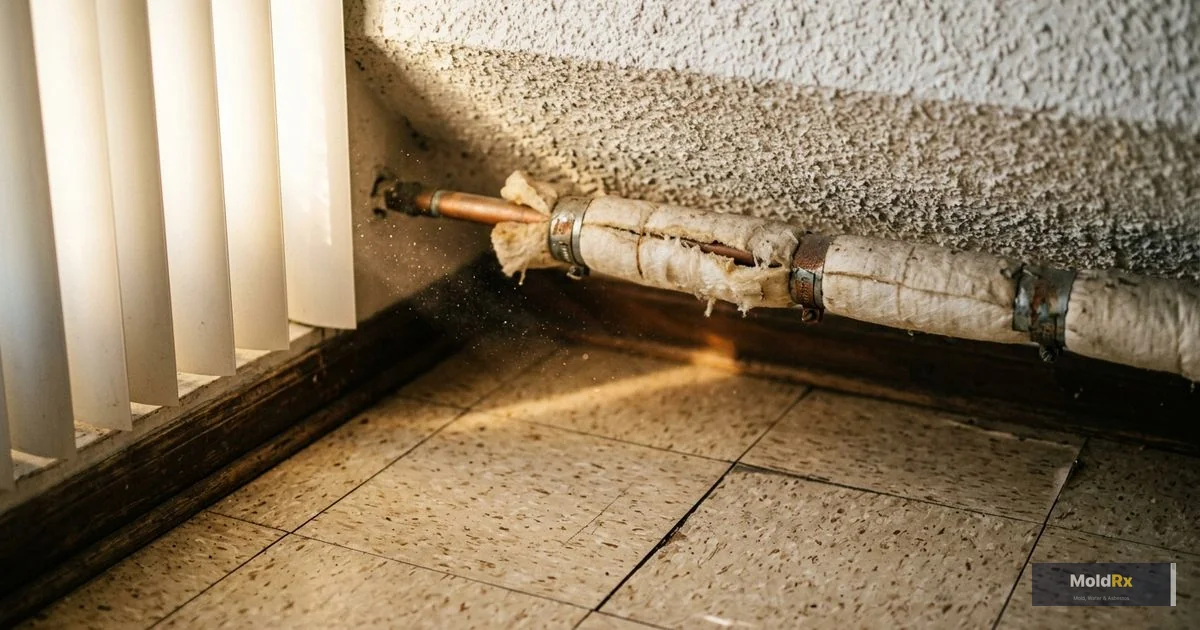
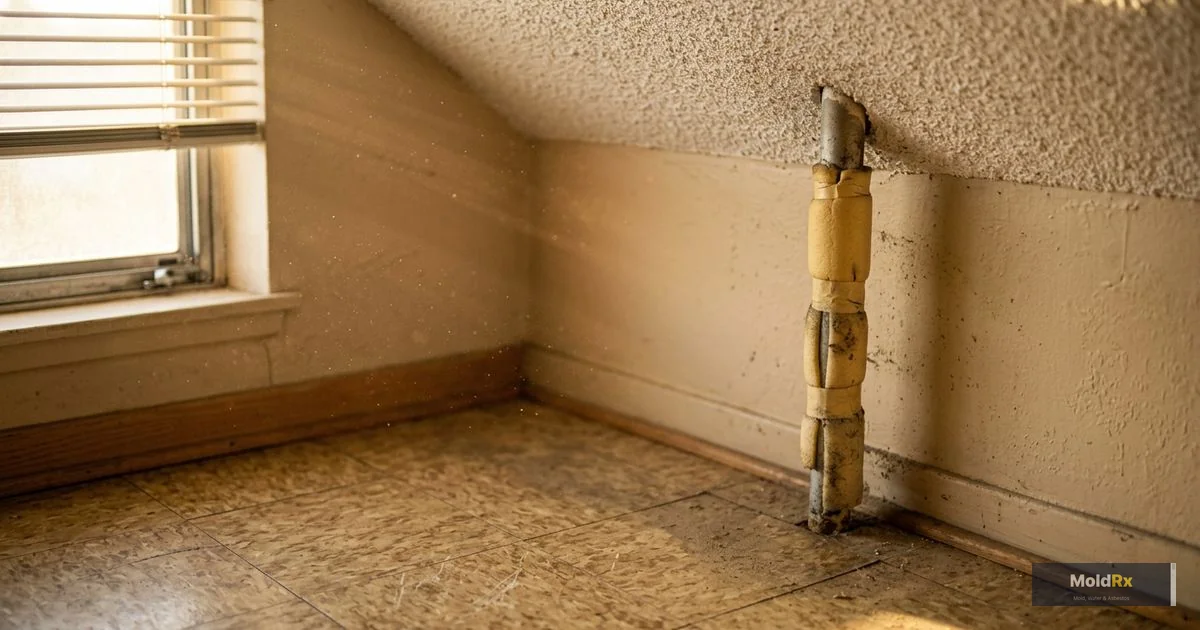
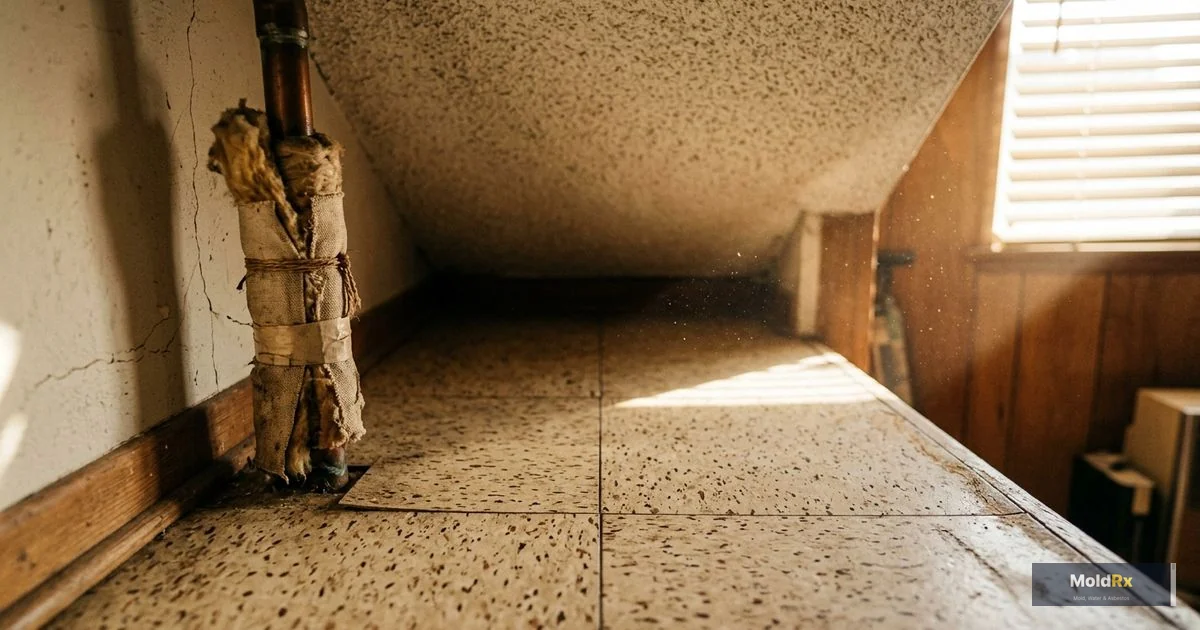
- Pipe insulation and wrapping — Corrugated insulation around hot water pipes, boiler connections, and heating components
- HVAC duct insulation and tape — Cloth-like tape and paper-backed insulation in older forced-air systems
- Roofing shingles and felt underlayment — Asbestos-cement shingles and tar-impregnated felt valued for heat resistance
- Cement siding and exterior panels — Fiber-cement products common on mid-century Colton homes
- Vermiculite attic insulation — Loose-fill insulation, some sourced from the contaminated Libby, Montana mine
- Drywall joint compound and textured coatings — Pre-1980 formulations frequently contained asbestos
- Window glazing putty and exterior caulking — Older sealants that become brittle and crumble with age
- Original plaster walls — In pre-1940s homes, particularly in South Colton, plaster was often reinforced with asbestos fibers
The critical fact: none of these materials can be identified as asbestos-containing or asbestos-free by visual inspection. Only laboratory analysis provides a definitive answer.
Colton's Climate and Material Deterioration
Colton's semi-arid Inland Empire climate accelerates the aging of older building materials in ways that matter for asbestos risk. At an elevation of roughly 1,004 feet, the city sees summer temperatures that regularly push into the mid-90s to low 100s with only about 15 inches of annual rainfall.
- Extreme heat cycles stress roofing and siding. Asbestos-cement shingles and fiber-cement panels expand and contract with daily temperature swings. Over 50+ years, this thermal cycling creates microfractures that allow fibers to separate from the material matrix.
- HVAC systems run constantly. Older heating and cooling systems with asbestos-containing duct insulation and tape operate heavily during Colton's extended hot season, circulating air past deteriorating materials month after month.
- Persistent dryness makes materials brittle. Low humidity causes adhesives, caulking, insulation, and joint compounds to dry out and crumble faster than they would in coastal environments — accelerating the transition from stable to friable.
- Santa Ana winds create pressure differentials. When hot, dry winds sweep through the San Bernardino Valley, they can draw fibers from deteriorating materials in attics, wall cavities, and crawl spaces into occupied living areas.
The Health Case for Testing Before Disturbing Materials
Asbestos fibers are microscopic — up to 700 times thinner than a human hair. When materials containing these fibers are cut, sanded, scraped, drilled, or broken, the fibers become airborne and can remain suspended in indoor air for hours. Once inhaled, they lodge deep in lung tissue where the body cannot expel or dissolve them.
The health consequences develop over 20 to 50 years: mesothelioma (an aggressive and almost universally fatal cancer of the lung or abdominal lining), asbestosis (irreversible scarring of lung tissue), lung cancer (significantly elevated risk, compounded by smoking), and pleural thickening (permanent changes to the lung lining causing chronic pain and breathing restriction).
The long latency period is what makes asbestos uniquely dangerous. A Colton homeowner who tears out old flooring or scrapes a popcorn ceiling without testing can inhale a concentrated dose of fibers and feel perfectly fine for decades before disease manifests. Testing before disturbance is the only reliable prevention.
Regulatory Requirements That Apply to Colton Properties
Colton falls under overlapping federal, state, and regional asbestos regulations. Understanding these requirements before you begin a project protects you from both health hazards and legal liability.
AHERA (Asbestos Hazard Emergency Response Act). Originally enacted in 1986 to address asbestos in schools, AHERA established the inspector accreditation standards and laboratory protocols that now apply across all professional asbestos testing work. AHERA requires that laboratories analyzing bulk asbestos samples hold accreditation through the NIST National Voluntary Laboratory Accreditation Program (NVLAP).
OSHA 29 CFR 1926.1101. The federal construction asbestos standard, OSHA 1926.1101, requires building owners to identify asbestos-containing materials before any construction, renovation, or demolition. It sets a permissible exposure limit of 0.1 f/cc over an 8-hour time-weighted average and mandates competent-person oversight for all asbestos-related work.
Cal/OSHA Title 8, Section 1529. California's parallel standard, Cal/OSHA Title 8 §1529, mirrors and in several areas exceeds federal requirements. It mandates identification of asbestos-containing materials before any work that may disturb them, classifies asbestos work into four classes by risk level, and requires specific training and medical surveillance for workers. Enforcement applies to all Colton properties.
SCAQMD Rule 1403. Colton falls within the South Coast Air Quality Management District. SCAQMD Rule 1403 governs asbestos emissions from demolition and renovation activities and requires:
- An asbestos survey before any demolition or renovation, regardless of building age or project scope
- Written notification to SCAQMD at least 10 working days before projects involving 100+ square feet of asbestos-containing material or any demolition
- Wet removal methods, proper containment, and approved disposal
- Violations carry fines reaching tens of thousands of dollars and potential project shutdown
CSLB C-22 licensing. When testing reveals asbestos that requires abatement, California law mandates removal by a contractor holding a CSLB C-22 (Asbestos Abatement) license from the Contractors State License Board. C-22 licensees must maintain active DOSH registration and meet ongoing training requirements under Cal/OSHA Title 8 §1529. MoldRx only sends vetted professionals who understand the full regulatory chain from initial testing through final clearance.
Get your free estimate for asbestos testing in Colton -- call (888) 609-8907 or schedule online.
How Professional Asbestos Testing Works in Colton
Step 1: Property Assessment and Sample Planning
A qualified specialist visits your Colton property to identify every material that may contain asbestos. This goes beyond obvious suspects — pipe insulation, floor tiles, ceiling texture — to include adhesives, window glazing putty, electrical panel backing, roofing components, and original plaster in older homes.
For properties near downtown and in South Colton, the assessment accounts for unique construction methods in the city's oldest neighborhoods. For post-war tract homes, the inspector draws on knowledge of product lines common to 1950s-1970s Inland Empire construction.
Step 2: Safe Sample Collection
Samples are collected following EPA NESHAP and Cal/OSHA protocols specifically designed to prevent fiber release:
- Each suspect material is wetted before sampling to suppress fiber dispersal
- Samples are cut or collected using specialized tools with minimal disturbance
- Each sample is sealed in a labeled container with documented location, material description, and condition assessment
- Chain-of-custody documentation tracks each sample from collection through laboratory delivery
Improper sampling — scraping a ceiling with a putty knife, snapping a tile, or dry-cutting into insulation — can release fibers into your living space and transform a contained material into an active airborne hazard. Professional collection prevents this.
Step 3: NVLAP-Accredited Laboratory Analysis
Samples are submitted to a laboratory holding NVLAP accreditation for bulk asbestos analysis. The primary analytical method is polarized light microscopy (PLM), which identifies:
- Whether asbestos fibers are present in the sampled material
- The specific asbestos mineral type — chrysotile, amosite, crocidolite, tremolite, anthophyllite, or actinolite
- The estimated fiber concentration — materials at or above 1% are regulated as asbestos-containing under both federal and California standards
- The fiber condition — tightly bound within a material matrix or potentially friable (easily crumbled by hand pressure)
PLM is the standard method for bulk material samples. For situations requiring greater analytical sensitivity — such as air monitoring during or after abatement work — transmission electron microscopy (TEM) provides detection at much lower fiber concentrations and is the method specified by AHERA for post-abatement clearance in school buildings.
Standard PLM results are typically available within 3 to 5 business days. Rush processing can deliver results within 24 hours for time-sensitive projects.
Step 4: Report Delivery and Honest Next-Steps Guidance
Your report provides a material-by-material breakdown with laboratory results, condition assessments, and clear recommendations:
- Materials confirmed asbestos-free — Cleared for work without asbestos-specific precautions
- Asbestos-containing materials in good condition — Can be managed in place through periodic monitoring
- Damaged or soon-to-be-disturbed asbestos materials — Require abatement by a CSLB C-22 licensed contractor before other trades begin
- Regulatory documentation satisfying SCAQMD Rule 1403, Cal/OSHA Title 8 §1529, and OSHA 1926.1101 for your project file and property records
Not every positive result requires immediate removal. Honest guidance means telling you when management in place is the right approach and when abatement is genuinely necessary.
When Colton Property Owners Need Asbestos Testing
Before Any Renovation or Demolition
If your Colton home or commercial building was constructed before 1980, California regulations require asbestos identification before work that could disturb suspect materials. This includes kitchen and bathroom remodels, flooring replacement, ceiling scraping, wall removal, window replacement, HVAC upgrades, electrical rewiring that opens walls, plumbing repairs that disturb pipe insulation, and any full or partial demolition. SCAQMD Rule 1403 requires a survey regardless of the project's size, with limited exceptions for minor residential work under 100 square feet of intact material.
Before Buying or Selling Property
Buyers planning renovations on a pre-1980 Colton property need test results before committing to a project budget. Sellers benefit from proactive testing that documents property condition and satisfies California disclosure requirements. In a city where most housing falls within the asbestos-era construction window, testing results are a practical asset in any transaction.
When You Discover Damaged Materials
Crumbling ceiling texture, cracked floor tiles, fraying pipe insulation, or deteriorating roofing in a pre-1980 Colton home should prompt testing. Damaged asbestos materials can actively release fibers into occupied spaces without renovation disturbance.
After Water Damage, Fire, or Seismic Events
Flooding, fire damage, or seismic activity can disturb previously stable asbestos materials. If your older Colton property has experienced damage, asbestos testing should be part of the assessment before restoration begins.
Properties Near Historical Industrial Areas
Homes in South Colton, near the former CalPortland/Slover Mountain site, or adjacent to the railroad corridor may carry additional considerations from both residential materials and proximity to historical industrial operations. Professional testing identifies what is actually present in your specific property.
Colton Areas We Serve
MoldRx only sends vetted asbestos testing professionals to properties throughout Colton, covering ZIP codes 92324 and 92313:
- Historic downtown Colton — The oldest structures in the city, some dating to the late 1800s
- South Colton — The historically significant railroad worker neighborhood, homes from the early 1900s through mid-century
- Cooley Ranch — Mixed residential and commercial area along the Santa Ana River corridor
- La Loma Hills — Hillside properties in the Peninsular Range foothills
- Reche Canyon — Rural and semi-rural properties on the city's eastern edge
- Properties near Arrowhead Regional Medical Center
- Areas along the I-10 and I-215 corridors
We also serve San Bernardino, Rialto, Grand Terrace, Loma Linda, Fontana, and all neighboring Inland Empire communities.
What to Expect Working With MoldRx in Colton
- Honest assessment. If testing is not necessary for your situation, we tell you. We do not push unnecessary services.
- Clear communication. You will know what is being tested, why each sample matters, and when to expect results. Plain language, straight answers.
- Complete documentation. Your report meets the requirements of Cal/OSHA Title 8 §1529, SCAQMD Rule 1403, OSHA 1926.1101, and AHERA laboratory standards — a permanent record for your property files, permit applications, and disclosures.
- Next-steps guidance without an agenda. Not every positive result demands immediate removal. We explain when management in place is the responsible approach and when abatement is genuinely necessary.
- Reasonable timeline. On-site collection in a single visit, typically one to three hours. Standard NVLAP-accredited PLM results in 3 to 5 business days, with rush processing available.
Related Services in Colton
In addition to asbestos testing, we also offer Mold Removal in Colton, Asbestos Removal in Colton, Water Damage Restoration in Colton, and Mold Testing in Colton services to Colton property owners.
→ Learn more about remediation services in Colton
Frequently Asked Questions
When is asbestos testing required before renovation in Colton?
Under SCAQMD Rule 1403 and Cal/OSHA Title 8 §1529, an asbestos survey is required before any renovation or demolition that might disturb materials, with limited exceptions for minor residential work under 100 square feet of intact material. Given Colton's construction history from the late 1800s through the 1970s, this applies to a substantial majority of the city's housing stock.
What materials should be tested in a Colton home?
Common asbestos-containing materials include popcorn ceilings, 9x9-inch floor tiles with black mastic, pipe and duct insulation, HVAC tape, roofing shingles and felt, cement siding, joint compound, textured coatings, vermiculite insulation, window putty, and original plaster. Less obvious materials like electrical panel backing and stucco brown coats also test positive. The only certainty comes from NVLAP-accredited PLM or TEM analysis.
Does Colton's industrial history increase asbestos risk?
Colton's century-long cement production at CalPortland and its dual-railroad heritage placed the city at the intersection of two industries that used asbestos extensively. Workers from those industries built homes in Colton during the same decades when residential construction also relied on asbestos-containing products. Properties in South Colton and near Slover Mountain may carry layered risk. Professional testing determines exactly what is present in your specific property.
What happens if asbestos is found in my property?
It depends on the material's condition and your plans. Intact, undisturbed materials in good condition can often be managed in place through periodic monitoring — an approach endorsed by the EPA that avoids the cost and disruption of removal. Materials that are damaged, friable (easily crumbled), or in the path of planned renovation must be removed by a CSLB C-22 licensed abatement contractor before other trades begin work. Your report identifies each positive material, its condition, and the recommended action for your specific situation.
Can I collect asbestos samples myself?
California allows homeowners to collect samples from their own residential property. However, improper technique can release fibers into your living space and produce unreliable results. Professional collection follows EPA NESHAP and Cal/OSHA protocols designed to prevent fiber dispersal. Regardless of who collects the sample, analysis must be performed by an NVLAP-accredited facility using approved PLM or TEM methods.
How long does the entire process take?
On-site collection takes one to three hours depending on property size. Standard NVLAP-accredited PLM results arrive in 3 to 5 business days, with rush processing available within 24 hours. Most Colton residential projects are completed from initial contact to final report within one week.
What is the difference between PLM and TEM analysis?
PLM (polarized light microscopy) is the standard method for analyzing bulk material samples — pieces of tile, ceiling texture, insulation, or other collected building products. It identifies asbestos fiber type and estimates concentration. TEM (transmission electron microscopy) provides higher sensitivity and is used primarily for air samples during or after abatement, or when PLM results are inconclusive. AHERA specifically requires TEM for post-abatement air clearance in school buildings.
How does SCAQMD Rule 1403 affect my Colton renovation project?
SCAQMD Rule 1403 requires an asbestos survey before any demolition or renovation within the South Coast AQMD jurisdiction, which includes all of Colton. If asbestos-containing materials will be disturbed, written notification must go to SCAQMD at least 10 working days before work begins on projects involving 100+ square feet of regulated material or any demolition. All identified asbestos must be properly removed before renovation activities proceed. Violations carry substantial fines and potential project shutdown.
Schedule Asbestos Testing in Colton
Colton earned its Hub City identity on the backs of two industries — railroads and cement — that used asbestos more heavily than almost any other sector of the 20th-century economy. The workers from those industries built homes and raised families in Colton's neighborhoods during the same decades when residential construction depended on asbestos-containing materials. The result is a city with layered asbestos exposure potential across virtually every neighborhood and construction era from the 1890s through the late 1970s.
If you are planning renovation, buying or selling property, or have discovered damaged materials in a pre-1980 Colton home, professional testing is the responsible first step. MoldRx only sends vetted asbestos testing specialists who follow the protocols required by Cal/OSHA Title 8 §1529, SCAQMD Rule 1403, and OSHA 1926.1101 to deliver accurate, documented, actionable results.
No guesswork. No runaround. Contact MoldRx to schedule asbestos testing for your Colton property -- call (888) 609-8907 or request your free estimate online.