Water Damage Restoration in Coachella, CA — Emergency Response Now
24/7 Emergency Water Damage Restoration Serving Coachella and the Eastern Coachella Valley — Call (888) 609-8907 Immediately
Water is inside your property right now. It is not waiting for morning. It is not waiting for a callback. Right now it is wicking upward through drywall from the bottom plate, saturating insulation inside wall cavities you cannot see, pooling beneath flooring, seeping through slab cracks, and migrating along framing members into rooms you think are dry. Subfloor assemblies are warping. Structural connections are weakening. And the biological clock is already running: mold colonies begin germinating within 24 to 48 hours of moisture exposure — and in Coachella, where summer temperatures inside wall cavities exceed 100 degrees, that window can collapse to 12 to 18 hours.
Coachella sits roughly 70 feet below sea level in the eastern Coachella Valley. A shallow water table fed by decades of agricultural irrigation. Monsoon thunderstorms that dump inches of rain onto hardpan desert soil that absorbs nothing. Aging plumbing in rapidly built housing stock failing without warning. Flash flooding that has forced evacuations, breached toxic dump site berms, and triggered multiple Riverside County emergency declarations since 2023. Every hour without professional extraction pushes you closer to a catastrophic structural rebuild instead of a manageable restoration.
This is an emergency. Treat it like one.
MoldRx only sends vetted water damage restoration professionals who follow IICRC S500 standards — the national benchmark for water damage inspection, extraction, drying, and restoration. Our teams arrive with commercial-grade equipment, document everything for your insurance claim from minute one, and do not leave until moisture readings confirm your property is dry and safe.
Call now — (888) 609-8907. Emergency extraction and drying. Every hour you wait costs you.
Why Water Damage in Coachella Is a Life-Safety Emergency
Coachella is home to approximately 47,000 residents in the eastern Coachella Valley, Riverside County — up more than 11 percent from the 42,007 recorded in the 2020 census. The city sits at an elevation approximately 70 feet below sea level, one of the lowest inhabited points in the Coachella Valley outside the Salton Sea basin. Summer highs routinely exceed 115 degrees. Annual rainfall averages 3 to 4 inches. Those numbers create the most dangerous false assumption in the desert: that water damage is not a local problem. That assumption costs Coachella property owners millions of dollars collectively.
Moisture trapped behind drywall, beneath slab foundations, and inside sealed wall cavities does not care how dry the outdoor air reads. Without professional extraction and controlled structural drying, you are facing mold colonization, structural compromise, and costs that multiply by the day.
Below Sea Level: The Water Table Problem
At roughly 70 feet below sea level, gravity works against every Coachella property. The city sits in a basin once beneath a freshwater lake, leaving behind an aquifer system the Coachella Valley Water District (CVWD) now manages. The eastern valley water table is shallower than in western communities. Decades of agricultural irrigation — over 37,400 acres irrigated through CVWD's system with Colorado River water delivered via the Coachella Canal — have elevated groundwater levels in surrounding soil.
Slab foundations here sit closer to the water table than in most valley communities. During wet seasons, after monsoon storms, or when irrigation saturates surrounding soil, moisture migrates upward through concrete slabs via capillary action — slowly, invisibly, relentlessly. By the time you notice warped flooring, musty odors, or efflorescence on foundation walls, the slab has been absorbing moisture for weeks. This is a Class 4 drying scenario under IICRC S500 — specialty drying of low-permeability materials — requiring professional equipment and sustained dehumidification that no amount of fans or open windows can replicate.
Housing Stock Built Fast, Now Failing Fast
Coachella's population doubled between 2000 and 2010. The city expanded from its historic core near Pueblo Viejo outward into large-scale subdivisions consuming former agricultural land. That growth story is now a plumbing failure story. Homes from the late 1990s through mid-2000s boom — the largest share of housing stock — sit on plumbing systems 20 to 30 years old. Builder-grade water heaters past expected lifespan. CPVC connections brittle from extreme thermal cycling. Polybutylene supply lines in pre-1995 homes that fail catastrophically without warning. Copper lines corroded by mineral-heavy valley water.
Older homes in the Pueblo Viejo district and Harrison Street corridor date to the 1940s through 1970s, with original galvanized steel and cast iron pipes now 50 to 80 years old. These systems fail all at once — at 2 AM, while you are at work, or behind a wall you cannot see.
Coachella's mobile home parks and manufactured housing communities are especially vulnerable. Particleboard subflooring, vinyl-over-particleboard cabinetry, and minimal insulation absorb water rapidly and degrade within hours. A supply line failure in a manufactured home can cause irreversible structural damage before you finish a single phone call.
Agricultural Irrigation: The Water Source No One Talks About
Irrigation infrastructure surrounds Coachella residential neighborhoods on all sides. More than 60 percent of CVWD agricultural acreage uses drip or micro-irrigation, and over two-thirds of local farmland is irrigated with Colorado River water delivered through the Coachella Canal. Agricultural runoff saturates soil adjacent to housing year-round. CVWD's underground tile drainage system was designed for farming, not residential flood protection.
Properties adjacent to active farmland face compounding risk: soil already saturated from irrigation has zero absorption capacity when rain arrives. Flash flood runoff that might drain in 30 minutes on dry soil can pool for hours against foundations sitting on waterlogged ground, migrating inward through slab cracks, slab-to-wall junctions, and any gap in the building envelope.
Monsoon Flooding: Coachella's Recurring Catastrophe
Most of eastern Coachella Valley is classified as a Special Flood Hazard Area (SFHA) on FEMA flood maps. CVWD has confirmed that rural areas from Oasis to Salton City do not currently have flood protection. This is not theoretical — it happens repeatedly:
August 2023 — Tropical Storm Hilary hit the valley with record rainfall. Riverside County sustained over $126 million in total storm damage. Floodwater, mud, and debris surged through eastern communities. Interstate 10 was closed.
September 2023 — Flash Floods and Toxic Breach. Nearly three inches of rain fell on eastern communities in a short span. Riverside County proclaimed a local emergency. Flooding breached a retaining berm at the toxic Lawson Dump near Thermal — the largest toxic dump site in California — inundating three mobile home parks with water and unknown materials. Evacuation warnings were issued.
February 2025 — The season's biggest storm brought flooding and road closures across the valley. Mobile home communities were surrounded by floodwater.
August 2025 — Flash Flood Warning. Winds approaching 50 mph and half-inch hail. The National Weather Service issued a flash flood warning for eastern Coachella Valley including Coachella, Thermal, and Mecca. Several roadways were completely washed away. Nearly three inches of rain fell on the southeastern valley.
Flash flood water is almost always Category 2 or Category 3 under IICRC S500 — carrying road debris, agricultural chemical runoff, sewage, and bacterial contamination. There is no drying Category 3 carpet or pad. It gets removed. If floodwater entered your home, you need professional extraction now.
The 24-to-48-Hour Mold Window
Both the EPA and IICRC S520 confirm mold colonization begins within 24 to 48 hours of moisture exposure. In Coachella, where summer wall cavity temperatures reach 90 to 100 degrees, germination can begin in 12 to 18 hours. Stachybotrys chartarum can colonize within 48 to 72 hours on saturated drywall. Agricultural soil around Coachella properties carries organic matter and microbial loads that accelerate biological growth when introduced into structures by floodwater.
The dry outdoor air is irrelevant. Relative humidity inside a saturated wall assembly can exceed 90 percent while outdoor humidity sits at 10 percent. Opening windows in summer raises interior temperatures and accelerates mold growth. Running fans spreads contaminated moisture. Professional extraction and controlled structural drying with commercial-grade equipment is the only effective response.
The clock is running. Get emergency help now — (888) 609-8907.
Water Damage Categories and Classes
The IICRC S500 standard classifies water damage by contamination level and scope:
Category 1 (Clean Water) — Broken supply line, water heater inlet, faucet failure. Not immediately hazardous but degrades to Category 2 or 3 within 48 to 72 hours without extraction. In Coachella's summer heat, degradation accelerates significantly.
Category 2 (Gray Water) — Washing machine overflow, dishwasher discharge, HVAC condensate, toilet overflow with urine. Requires antimicrobial treatment. Porous materials typically require removal — especially problematic in manufactured housing where particleboard is standard construction.
Category 3 (Black Water) — Sewage, monsoon floodwater, agricultural drainage overflow. The September 2023 flooding that breached the Lawson Dump berm was Category 3. Full PPE required. All contacted porous materials must be removed.
Scope classification: Class 1 (minimal absorption, small area), Class 2 (significant absorption with wall wicking — common in Coachella supply line failures), Class 3 (overhead water saturating walls, ceilings, insulation, and floors — typical in HVAC failures and monsoon leaks), and Class 4 (specialty drying of low-permeability materials like concrete slabs — frequent in Coachella's below-sea-level slab moisture scenarios).
Our Water Damage Restoration Process
Every job follows the IICRC S500 protocol. No shortcuts.
1. Emergency Response and Assessment — Technicians classify water category (Category 1 through 3) and damage class (Class 1 through Class 4), then map full moisture extent using thermal imaging and penetrating meters — including water behind walls and beneath flooring you cannot see. In Coachella's boom-era housing, moisture routinely migrates far beyond the visible damage zone.
2. Water Extraction — Standing water removed immediately with truck-mounted and portable units. Submersible pumps for deep monsoon flooding. For slab moisture intrusion, extraction targets the slab-flooring interface. Every gallon removed in the first hours directly reduces drying time.
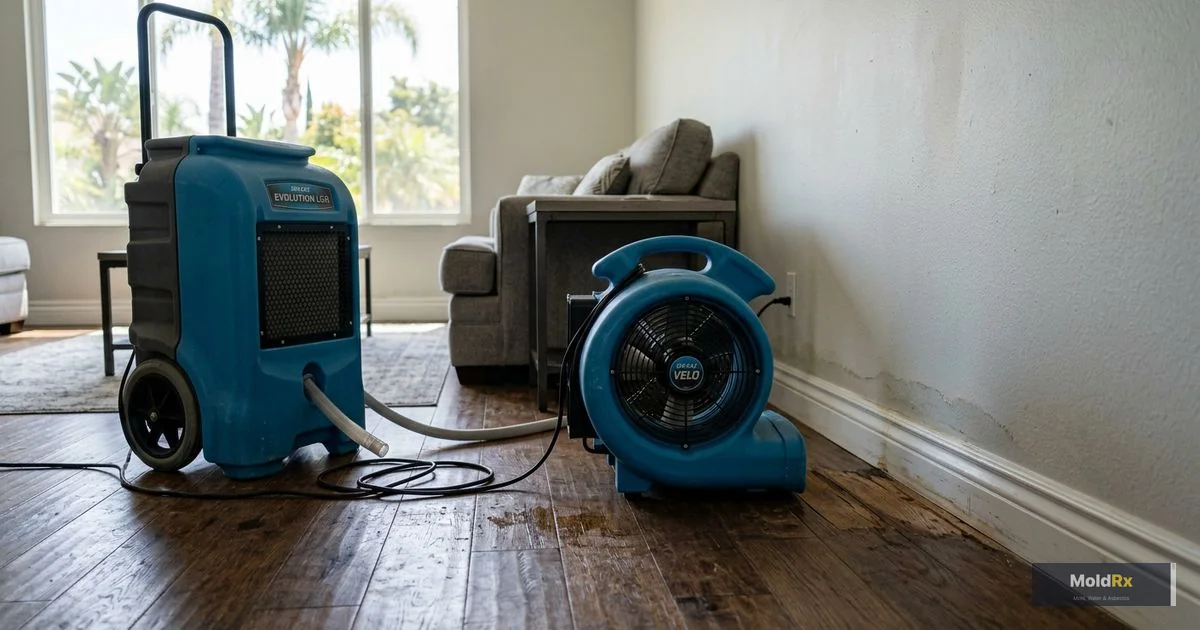
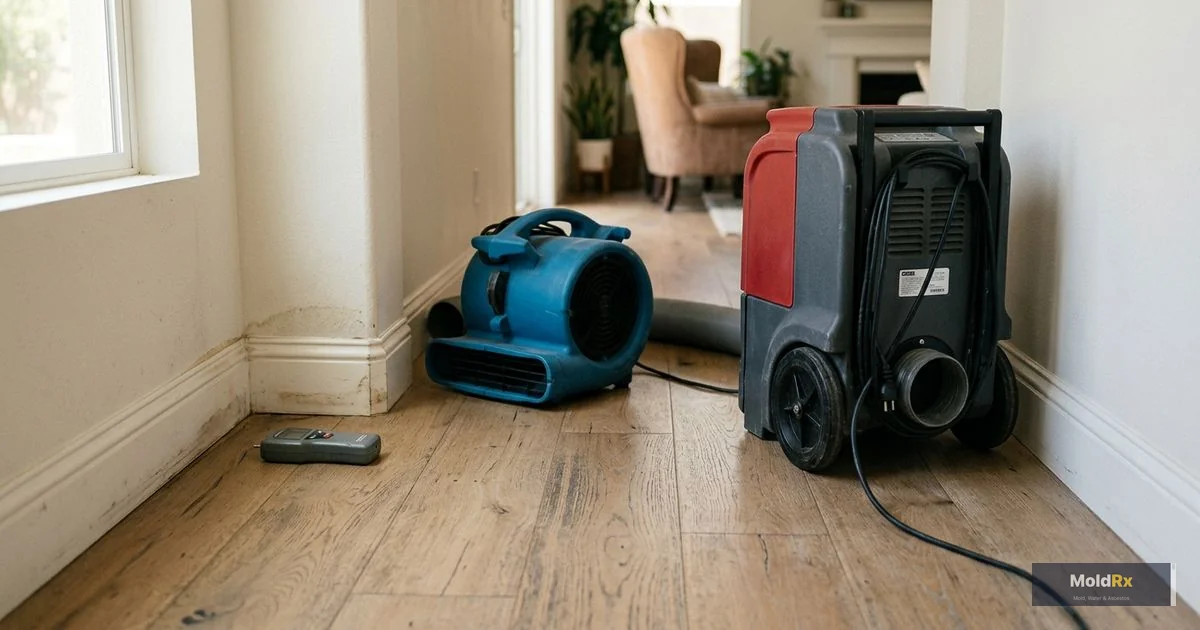
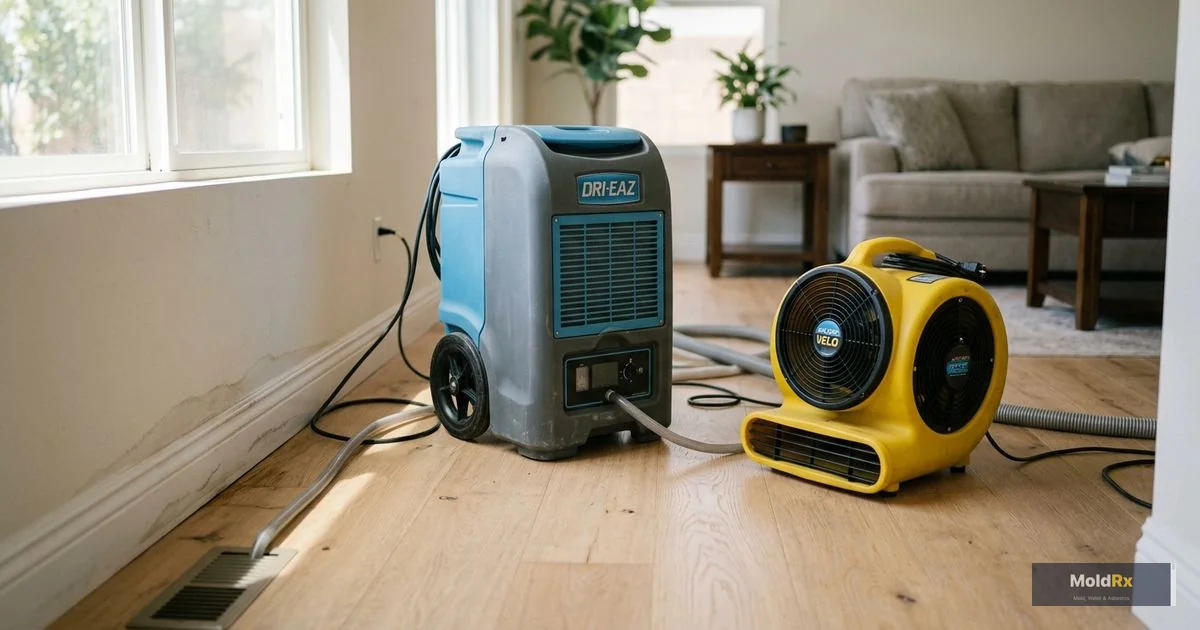
3. Structural Drying and Dehumidification — Commercial-grade dehumidifiers and high-velocity air movers positioned using psychrometric calculations calibrated for Coachella's desert conditions. Wall cavities receive directed airflow through injection drying systems. Slab drying requires sustained dehumidification to counteract ongoing capillary moisture from the shallow water table.
4. Moisture Monitoring and Documentation — Daily readings using pin-type and pinless meters, thermo-hygrometers, and thermal imaging. Every reading logged and timestamped for your insurance adjuster per IICRC S500 standards.
5. Cleaning, Sanitizing, and Antimicrobial Treatment — Category 2 and Category 3 losses require antimicrobial application. HEPA air scrubbers run throughout drying. All protocols comply with Cal/OSHA safety requirements, EPA guidelines, and IICRC S500 / IICRC S520 standards.
6. Restoration and Rebuild — All rebuild by CSLB-licensed professionals. In pre-1980 Coachella properties, material removal requires asbestos awareness — testing before disturbance is standard protocol under Cal/OSHA and EPA regulations.
What to Do Right Now
- Shut off the water source if safely reachable. For slab leaks, turn off main supply at the meter.
- Turn off electricity to affected areas at the breaker panel. Do not touch the panel if standing in water.
- Do not walk through standing water near electrical connections.
- If floodwater entered your home, avoid contact without protection — eastern valley runoff carries sewage, agricultural chemicals, and bacterial contamination.
- Document everything with timestamped photos and video before moving anything.
- Do not use a household vacuum on standing water — shock hazard.
- Do not run fans or HVAC — you risk spreading contaminated moisture through ductwork.
- Do not open windows in summer — desert heat accelerates mold in saturated materials.
Then call (888) 609-8907 immediately.
What Sets MoldRx Apart
- Emergency response speed. The difference between a four-hour response and a 24-hour response can be the difference between saving your home and gutting it.
- IICRC S500 and IICRC S520-certified professionals only. Every technician holds current IICRC certification and CSLB licensing — trained specialists who understand below-sea-level drying dynamics, not general handymen.
- Complete insurance documentation from minute one. Every step documented per IICRC S500 standards.
- Psychrometric drying science calibrated for Coachella's specific desert conditions — not coastal assumptions applied to a below-sea-level city.
- We only send vetted professionals. MoldRx does not operate as a lead aggregator. Every professional vetted for licensing, certification, insurance, and work quality. If something is not right, you call us directly.
Coachella Areas We Serve
- Pueblo Viejo / Downtown Coachella — 1940s-1970s homes with end-of-life galvanized and cast iron plumbing. Slab leaks and supply line failures are the primary emergency calls.
- Harrison Street Corridor — Mixed residential and commercial properties with older plumbing and railroad corridor drainage challenges.
- Post-2000 Subdivisions — Largest share of housing stock. Builder-grade plumbing now 20-30 years old. CPVC, water heater, and appliance failures increasing every year.
- La Entrada Specific Plan Area — 2,200-acre master-planned community. Newer construction but squarely in the Special Flood Hazard Area with monsoon and agricultural drainage exposure.
- Mobile Home Parks — Repeatedly impacted by flooding, most recently February and August 2025. Particleboard construction requires specialized rapid response.
- Agricultural-Adjacent Areas — Year-round elevated soil moisture compounds damage during every rain event.
Coverage includes ZIP code 92236 and neighboring communities: Indio, Thermal, Mecca, and Vista Santa Rosa.
Related Services
- Mold Removal in Coachella — If the mold window has closed, IICRC S520 remediation is the next critical step.
- Mold Testing in Coachella — Air quality and surface sampling to confirm whether colonization has begun.
- Asbestos Testing in Coachella — Pre-1980 homes require testing before material removal.
- Asbestos Removal in Coachella — Licensed abatement under Cal/OSHA and EPA regulations.
-> Learn more about remediation services in Coachella
Frequently Asked Questions
How fast do you respond to water damage emergencies in Coachella?
We treat every call as the emergency it is. There is no non-urgent water damage call. Every hour of delay increases damage scope, cost, and mold risk exponentially. The 24-to-48-hour mold colonization window confirmed by the EPA and IICRC S520 is not negotiable, and in Coachella's below-sea-level heat it compresses to as little as 12 to 18 hours. Once that biological clock runs out, your water damage restoration becomes a combined water-plus-mold remediation project — dramatically different in scope, duration, and cost. Call (888) 609-8907 the moment you discover water.
What should I do first when I discover water damage?
Stop the water source if you safely can. Turn off electricity to affected areas at the breaker panel — do not touch the panel if you are standing in water. If floodwater entered your home, avoid direct contact without protection — eastern Coachella Valley storm runoff carries agricultural chemicals, sewage, bacterial contamination, and potentially toxic materials. Then call (888) 609-8907 immediately. Do not attempt to dry the area yourself with fans or by opening windows — in Coachella's heat, these actions accelerate mold germination inside saturated wall cavities rather than prevent it.
Does homeowner's insurance cover water damage restoration?
Most policies cover sudden and accidental water damage — burst pipes, failed appliances, water heater ruptures, HVAC condensation failures. Flood damage from external sources like monsoon storm runoff, agricultural drainage overflow, or flash flooding typically requires separate flood insurance through the National Flood Insurance Program or a private flood policy. In Coachella, where most of the city falls within a FEMA Special Flood Hazard Area, separate flood coverage is required for federally backed mortgages. We document every aspect of the restoration per IICRC S500 standards from minute one. Delayed mitigation is one of the most common reasons insurers deny or reduce claims — professional response within hours protects both your property and your coverage.
How long does water damage restoration take?
A contained Category 1 event in a single room may reach dry standard in three to five days. A major event involving multiple rooms, Category 2 or Category 3 water, or slab moisture intrusion can require one to three weeks of active drying and monitoring. Coachella's low outdoor humidity accelerates drying when properly managed with commercial-grade equipment, but the below-sea-level water table means slab drying requires sustained dehumidification to ensure moisture is not being reintroduced from below — a complication unique to this elevation. We do not rush the process and we do not cut it short. Incomplete drying leads to mold. Period.
Is my Coachella home at risk for mold even in the desert?
Yes. This is the most dangerous misconception in the Coachella Valley and it costs homeowners thousands of dollars every year. The dry outdoor climate is completely irrelevant once water enters concealed building cavities. A saturated wall assembly creates its own sealed microclimate — relative humidity inside that wall can exceed 90 percent while outdoor air sits at 10 percent. Combined with Coachella's extreme below-sea-level heat — the most intense in the valley — conditions inside a wet wall cavity are ideal for rapid mold colonization. The EPA confirms the 24-to-48-hour germination window. Professional extraction and controlled drying are the only reliable countermeasures. Desert air cannot save you.
What is the difference between water damage categories?
Category 1 is clean water from a sanitary source — not immediately hazardous but degrades rapidly without extraction. Category 2 is gray water carrying biological or chemical contaminants that can cause illness — HVAC condensate, washing machine discharge, agricultural irrigation water. Category 3 is black water — sewage, monsoon floodwater, agricultural drainage overflow, or grossly contaminated water like the runoff from the September 2023 Lawson Dump breach. All categories are defined by the IICRC S500 standard with different safety protocols, equipment, and material handling procedures for each. Category escalation occurs with time — a Category 1 event left unaddressed becomes Category 2 or 3.
Why is Coachella's elevation a factor in water damage?
Coachella sits approximately 70 feet below sea level. The water table is shallower than in most Coachella Valley communities, meaning slab foundations are in closer contact with subsurface moisture year-round. Gravity directs all surface water toward Coachella rather than away from it — every monsoon storm, every agricultural drainage event, every overflow concentrates in the basin where this city sits. Slab foundations absorb moisture from below via capillary action, compounding any water damage event from above. This creates Class 4 drying conditions under IICRC S500 requiring specialized equipment and extended monitoring.
Will you work with my insurance adjuster?
Yes. We provide complete technical documentation — timestamped photographs, moisture readings at every monitoring point, daily drying logs, equipment placement and runtime records, water category and damage class classification, and final verification data — directly to your adjuster. Our documentation follows IICRC S500 standards, the framework most insurers use to evaluate water damage claims. Professional documentation from minute one is your strongest protection against claim reduction or denial.
Do I need mold testing after water damage?
If professional drying began within the first 24 hours and moisture readings confirm dry standard throughout all affected materials, testing may not be necessary. But if response was delayed beyond 24 hours, if musty odors persist after drying, or if Category 2 / Category 3 water was involved, we strongly recommend post-restoration mold testing to confirm no colonization occurred. In Coachella, where agricultural soil carries elevated organic and microbial loads, any floodwater event warrants testing even when drying response was prompt. Confirming the absence of mold is always less disruptive and less costly than discovering an active colony weeks later behind a wall you thought was dry.
Your Property Is Taking Damage Right Now
Water damage compounds every hour. Materials are absorbing water. Mold spores are finding moisture. Structural elements are weakening. Whether it is a burst supply line in Pueblo Viejo, a slab leak in a post-2000 subdivision, an HVAC failure soaking your attic, agricultural drainage flooding your foundation, a water heater rupture in your manufactured home, or monsoon floodwater forcing through your doors — every minute you wait is a minute the damage gets worse.
MoldRx only sends vetted water damage restoration professionals who follow IICRC S500 standards, carry current CSLB licensing, and understand Coachella's unique below-sea-level desert conditions. Every technician complies with Cal/OSHA safety standards and EPA guidelines.
Every hour matters. The clock does not stop. Neither should you.