Emergency Water Damage Restoration in Chino Hills, CA — MoldRx
24/7 Emergency Water Damage Restoration Serving Chino Hills and the West San Bernardino County Foothills — Immediate Response, Day or Night
Water is destroying your Chino Hills home right now — and every minute you spend reading this page instead of calling is a minute the damage gets worse. Water does not wait. It does not pause while you think about it. It wicks through drywall at an inch per hour. It migrates under flooring, pooling in places you cannot see. It saturates insulation, swells subfloor materials, and begins corroding metal fasteners and connectors inside your walls. And within 24 to 48 hours, it creates the conditions for mold — the secondary catastrophe that can turn a $5,000 water extraction job into a $25,000 remediation project.
If your Chino Hills home is experiencing water damage from any source — a burst pipe, a failed water heater, a slab leak, an appliance failure, storm flooding, hillside runoff — you need professional intervention now. Not a handyman with a shop vac. Not fans from your garage aimed at the wet carpet. You need commercial-grade extraction, industrial drying, moisture verification, and professionals who understand exactly how water damage behaves in Chino Hills homes.
MoldRx coordinates vetted, IICRC-certified water damage restoration specialists who respond to Chino Hills emergencies 24 hours a day, 7 days a week. Our professionals know this city's housing stock, its hillside drainage challenges, and the specific construction vulnerabilities that make Chino Hills properties uniquely susceptible to catastrophic water damage.
Why Chino Hills Properties Face Elevated Water Damage Risk
Chino Hills is not just another Inland Empire suburb. It is a city built into rolling foothills, on slopes, against ridgelines, and across terrain that actively works against homeowners when water is involved. The combination of the city's topography, its housing age, its construction era, and its climate creates a water damage risk profile that is significantly more severe than most homeowners realize.
Hillside Topography: Water Runs Downhill — Straight at Your Foundation
The defining feature of Chino Hills is its terrain. The city sits in the rolling foothills where the San Gabriel Valley transitions into the Inland Empire, with elevation changes of several hundred feet across the residential footprint. This landscape is what makes Chino Hills attractive — the views, the sense of separation from the flat valley floor, the mature hillside lots. But it is also what makes Chino Hills properties dangerously vulnerable to water intrusion.
Water follows gravity. On flat terrain, water from a storm event disperses relatively evenly. In Chino Hills, water concentrates. It flows downhill along natural drainage paths, across hardscaped surfaces, along driveways, and directly toward the foundations of downslope homes. Yards graded toward the house — whether by original design or by soil settling over decades — funnel storm runoff against foundation walls. Retaining walls that have shifted or cracked create channels that direct water into concentrated streams rather than dispersing it.
During the December 2025 atmospheric river that triggered a state of emergency across San Bernardino County, Chino Hills neighborhoods experienced exactly this pattern. Four to eight inches of rain fell across the Inland Empire in a matter of days, and the city's hillside terrain concentrated that water into flows that overwhelmed residential drainage systems, saturated soils around foundations, and forced water into homes through foundation cracks, window wells, and below-grade entries.
The city's own emergency planning acknowledges these risks. The Los Serranos Flood Protection Project — a $1 million federal investment specifically for Chino Hills — is installing new storm drain infrastructure to mitigate flood risks in neighborhoods where existing drainage capacity is insufficient. The Carbon Canyon Channel project, an $18 million undertaking by San Bernardino County, is replacing an undersized earthen channel that runs from Pipeline Avenue to Peyton Drive specifically because the existing channel cannot handle major storm events without flooding surrounding properties.
These infrastructure projects are necessary — but they are not complete. Until they are, Chino Hills homeowners remain exposed to storm-driven water damage every rainy season.
Housing Age: The 1980s-1990s Construction Crisis
The vast majority of Chino Hills homes were built during the city's rapid expansion between the early 1980s and the late 1990s, with continued development through the 2000s. The city incorporated in 1991, but residential development was well underway a decade before that. This means the average Chino Hills home is 30 to 45 years old — and that age puts it squarely in the danger zone for multiple types of plumbing failure.
Polybutylene piping is the headline risk. Between 1978 and 1995, polybutylene was the pipe material of choice for residential construction across Southern California — and Chino Hills was built during the peak of that era. An estimated 6 to 10 million American homes contain polybutylene pipes, and a disproportionate number of those homes are in communities like Chino Hills that were developed during the 1980s and early 1990s. The problem with polybutylene is well-documented: oxidants in public water supplies, particularly chlorine, cause the pipe material to become brittle and flake from the inside. The degradation is invisible until the pipe fails — and when polybutylene fails, it fails suddenly, often at joints and fittings, releasing water at full supply pressure into wall cavities, under floors, and throughout the home.
Polybutylene failures in Chino Hills are not hypothetical. They are happening in homes across the city, often with zero warning. A homeowner goes to work in the morning and comes home to a house with water pouring through the ceiling. A family wakes up at 2 AM to the sound of water rushing inside a wall. These are not rare anecdotes — they are the predictable consequence of 35-to-40-year-old plastic pipes that were manufactured with a known defect.
Original water heaters and appliances add to the risk. Water heaters have a typical lifespan of 8 to 12 years, and many Chino Hills homes are on their third or fourth unit. Each replacement introduces new connection points that can fail, and homeowners who defer replacement on aging units are gambling with a 40-to-80-gallon tank of water sitting inside their home. Washing machine supply hoses, dishwasher connections, and refrigerator ice maker lines — all of them degrade over time, and all of them are capable of producing significant water damage when they fail.
Slab leaks represent a particularly insidious threat. Chino Hills' clay-heavy soil expands when wet and contracts when dry, creating a cycle of pressure on foundation slabs and the water lines running beneath them. Southern California's hard water accelerates corrosion in copper supply lines, and the combination of soil movement and internal corrosion produces pinhole leaks in sub-slab piping that can release water for weeks or months before any visible sign appears inside the home. By the time a homeowner notices warm spots on the floor, unexplained increases in the water bill, or the faint smell of mildew, the damage beneath the slab is already extensive.
The Mold Timeline: Why 48 Hours Is Your Hard Deadline
Mold does not require an invitation. Mold spores are present in every home, in every room, on every surface — dormant and waiting for moisture. When water damage provides that moisture, the biological clock starts immediately.
0-24 hours: Water saturates building materials. Humidity levels inside wall cavities and under flooring spike to levels that support microbial growth. Bacterial activity begins in standing water and saturated organic materials like carpet padding and drywall paper facing.
24-48 hours: Mold spores begin germinating on wet surfaces. Colonies establish themselves first in hidden areas — behind drywall, inside wall cavities, under carpet padding, in the spaces between subfloor and finished flooring — where air circulation is minimal and moisture levels are highest.
48-72 hours: Visible mold growth can appear on exposed surfaces. Hidden colonies behind walls begin producing mycotoxins and releasing spores into the home's air circulation system. Health effects — respiratory irritation, allergic reactions, headaches, fatigue — can begin for sensitive individuals.
One week and beyond: Mold colonies spread through wall systems, into HVAC ductwork, across ceiling cavities, and throughout any connected airspace. Remediation at this stage requires containment, demolition of affected materials, HEPA air scrubbing, and verification testing — a process that costs multiples of what the original water damage restoration would have required.
This timeline is not negotiable. It does not extend because you are busy, or because you are hoping the area will dry on its own, or because you are waiting for your insurance company to send an adjuster. The mold clock is running, and the only way to stop it is to get the water out and the structure dry before colonization begins.
Emergency Water Damage Restoration Process for Chino Hills
MoldRx's vetted professionals follow an aggressive, systematic protocol specifically adapted for the challenges of Chino Hills properties.
Phase 1: Emergency Dispatch and Rapid Assessment (Hours 0-4)
When you call, a restoration team mobilizes immediately to your Chino Hills home. On arrival, the first priorities are:
Identify and stop the water source. A burst polybutylene joint requires shutting off the main water supply. A failed water heater requires isolation of the unit. Storm intrusion may require emergency tarping or barrier installation. Our specialists know where to look in Chino Hills homes — the polybutylene connections in 1980s-1990s construction, the supply lines beneath slab foundations, the roof penetrations and flashing failures common in hillside homes exposed to wind-driven rain.
Categorize the water. Category 1 (clean water from a supply line), Category 2 (gray water from an appliance discharge or overflow), and Category 3 (black water from sewage, storm flooding, or long-standing contamination) each require fundamentally different handling protocols. In Chino Hills, storm-related water intrusion is frequently Category 3 due to contact with soil, hillside debris, and organic material carried by runoff — requiring the most aggressive extraction and sanitization response.
Begin extraction immediately. Commercial-grade truck-mounted extractors and portable pumps remove standing water at rates of hundreds to thousands of gallons per hour. Weighted extraction tools pull water from carpet and padding. In hillside Chino Hills homes where water may have pooled against a downslope foundation wall and penetrated at multiple points, extraction often requires simultaneous work across several rooms and along the entire affected wall line.
Phase 2: Comprehensive Moisture Mapping (Hours 4-12)
The visible water is only part of the problem — and often not the worst part. Water travels through wall cavities, along the bottom plates of framed walls, beneath flooring, and through any available path. In Chino Hills homes where water enters from a hillside-facing wall, moisture can migrate entirely through the structure and emerge on the opposite side of the house.
Thermal imaging cameras detect temperature differentials caused by moisture in walls, ceilings, and floors — revealing the true extent of water migration that is invisible to the naked eye. Pin-type and pinless moisture meters provide precise readings of moisture content in drywall, framing, concrete, and other building materials. The result is a comprehensive moisture map that guides every subsequent decision about drying equipment placement, material removal, and restoration scope.
In Chino Hills' hillside construction, this phase often reveals moisture paths that follow the slope of the terrain beneath the home — water that entered at the upslope wall and traveled through or beneath the slab toward the downslope side. Missing this pattern leads to incomplete drying, hidden mold growth, and a restoration that fails months later.
Phase 3: Industrial Drying and Dehumidification (Days 1-5)
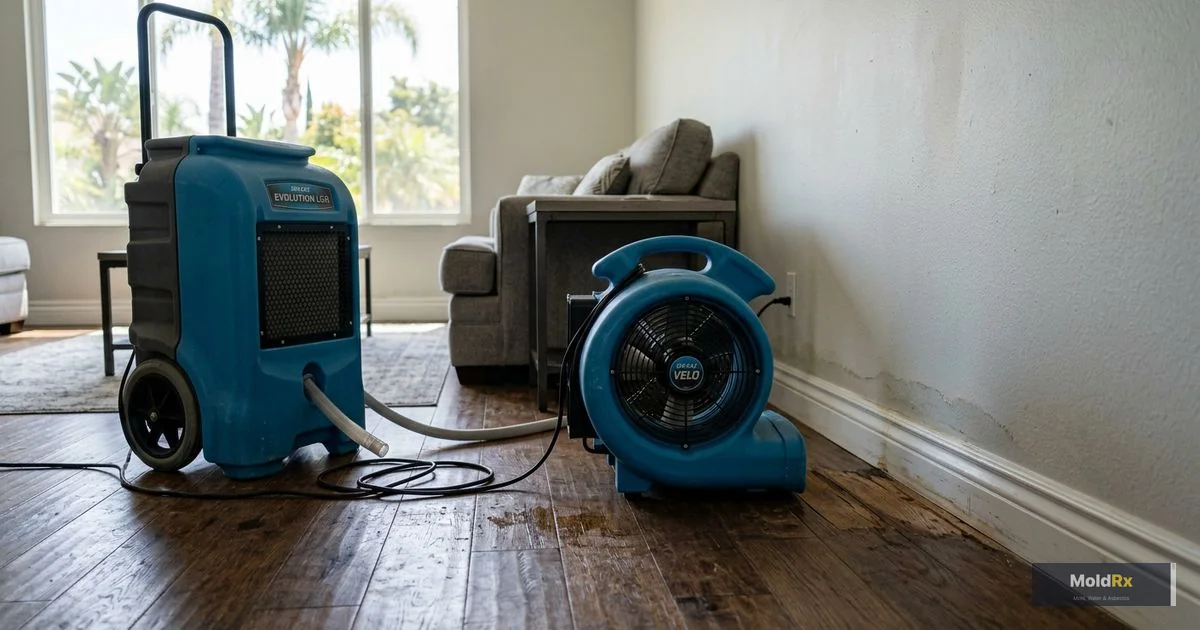
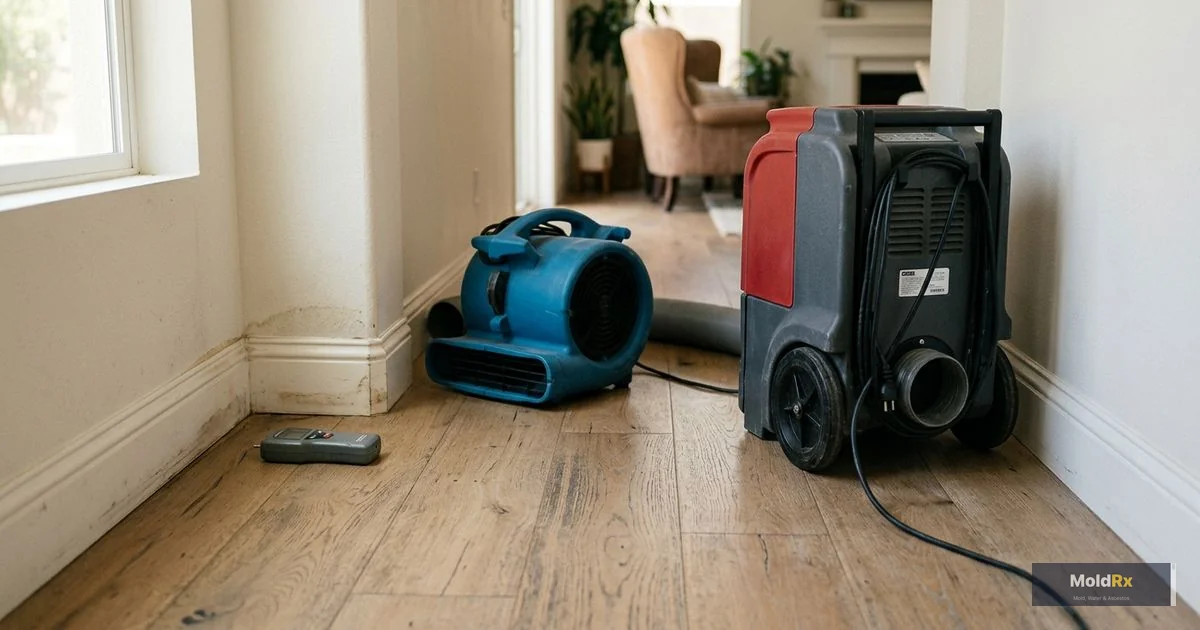
Industrial air movers and commercial dehumidifiers are deployed throughout the affected area, creating a controlled drying environment that pulls moisture from building materials at rates far beyond what natural evaporation can achieve.
Chino Hills properties require specific attention during this phase:
- Multi-level homes on slopes — common in Chino Hills — may have different moisture conditions on each level, requiring independent drying zones with separate equipment and monitoring
- Stucco exterior walls trap moisture between the exterior cladding and interior drywall, requiring extended drying times and careful monitoring to confirm interior wall cavities reach safe levels
- Concrete slab foundations absorb and retain moisture, releasing it slowly over days — floors that appear dry on the surface may still have dangerously elevated moisture levels in the slab beneath
- Below-grade spaces in hillside construction — rooms partially built into the slope — present unique drying challenges due to limited air circulation and continued moisture migration from surrounding soil
Moisture readings are documented twice daily, tracking the drying curve for every affected material and area. Equipment is repositioned as drying progresses to ensure maximum efficiency. The structure is cleared only when verified readings confirm all materials are at or below safe moisture levels — typically below 15% for wood framing and drywall, and below manufacturer specifications for flooring materials.
Phase 4: Sanitization, Antimicrobial Treatment, and Mold Prevention (Days 3-6)
Depending on the water category, affected areas receive EPA-registered antimicrobial treatment. All Category 2 and Category 3 events require sanitization of affected structural surfaces. Porous materials exposed to contaminated water — carpet padding, insulation, particleboard, and similar materials — are removed and properly disposed of when they cannot be effectively decontaminated.
In Chino Hills homes where hillside storm runoff introduced soil and organic debris, sanitization protocols are more extensive. Surfaces are cleaned, treated, and verified before any enclosure or restoration work begins. Our professionals monitor for any signs of microbial activity throughout the drying process, and any indication of mold growth triggers immediate containment and remediation — catching the problem at its earliest stage rather than allowing it to develop into a larger contamination event.
Phase 5: Restoration and Structural Repair (Days 5-14+)
With the structure verified dry and sanitized, restoration work returns your Chino Hills home to its pre-damage condition. The scope ranges from targeted repairs — replacing sections of drywall, reinstalling baseboards, repainting affected walls — to comprehensive reconstruction of severely damaged areas including flooring replacement, cabinetry repair, insulation replacement, and structural framing repairs.
Our vetted professionals also advise on prevention: addressing the drainage grade that directed water toward your foundation, recommending repiping for homes with polybutylene, identifying the water heater that is two years past its expected lifespan, and suggesting the slab leak detection service that could catch the next problem before it becomes an emergency.
What to Expect When You Call MoldRx
Immediate response. Not a voicemail. Not a callback in the morning. When you call MoldRx for water damage in your Chino Hills home, you reach a live coordinator who dispatches a restoration team immediately — 2 AM on a Tuesday, noon on Christmas, midnight during a storm. Water does not respect business hours, and neither do we.
Honest, unflinching assessment. Our vetted professionals tell you exactly what they find. If the damage is less severe than you feared, you hear that. If it is worse than it looks, you hear that too — with a clear explanation of what needs to happen, why it needs to happen, and what the alternatives are. No upselling. No inflated scopes. No manufactured urgency beyond the very real urgency that already exists.
Complete insurance documentation. From the moment our team arrives, every step is documented — timestamped photographs, moisture readings at every stage, equipment deployment logs, material removal inventories, and comprehensive final reports. This documentation is specifically structured to support your insurance claim and provide your adjuster with the evidence needed for proper claim resolution.
Verified completion. The restoration is not complete when things look dry. It is not complete when equipment is removed. It is complete when documented moisture readings confirm that every affected material has reached safe levels. This verification is what separates professional restoration from the kind of "good enough" work that leads to mold problems three months later.
Chino Hills Neighborhoods and Areas We Serve
MoldRx coordinates emergency water damage restoration across every neighborhood and community in Chino Hills, including:
- Los Serranos — Historic neighborhood with mixed-era homes where mature tree root systems invade sewer laterals and aging storm drainage is being upgraded through the $1M federal flood protection project
- Rolling Ridge — Hillside homes with significant slope-related water intrusion risk during storm events
- Butterfield Ranch — Established 1990s-era development with homes now reaching the age where polybutylene and original plumbing components fail
- The Vellano Country Club area — Larger homes on hillside lots where complex roof systems and multi-level construction create multiple water intrusion pathways
- Village at the Park — Residential area where drainage from surrounding terrain concentrates during heavy rainfall
- Carbon Canyon — Properties along the canyon corridor affected by the undersized channel that San Bernardino County's $18M upgrade project is addressing
- Woodview and South Chino Hills — Neighborhoods with 1980s-era construction entering peak plumbing failure age
We serve all of ZIP code 91709 and respond to emergencies throughout surrounding communities including Chino to the north, Diamond Bar and Pomona to the west, Brea to the southwest, and Yorba Linda to the south.
Related Services in Chino Hills
Water damage and its consequences require coordinated response. MoldRx provides:
- Mold Removal in Chino Hills — When water damage has persisted beyond 48 hours or mold is already visible
- Mold Testing in Chino Hills — Professional assessment to determine whether water damage has led to mold growth
- Asbestos Removal in Chino Hills — Required when restoration work in pre-1990 homes may disturb asbestos-containing materials
- Asbestos Testing in Chino Hills — Testing before demolition or reconstruction in older homes
- Water Damage Restoration in Chino Hills — This page: 24/7 emergency response
-> Learn more about remediation services in Chino Hills
Frequently Asked Questions
How quickly do I need to act on water damage in my Chino Hills home?
You needed to act the moment the water appeared. If you have not called yet, call now. Water damage in Chino Hills homes escalates faster than in most communities because of the hillside construction, the slab foundation challenges, and the hidden moisture pathways created by multi-level homes on slopes. Mold begins colonizing within 24 to 48 hours. Structural materials begin degrading within days. The restoration cost curve rises steeply with every hour of delay. Our emergency team responds 24/7.
What does water damage restoration cost in Chino Hills?
The cost depends on variables specific to your situation: the water category (clean, gray, or black), the affected area, the depth of saturation, the materials involved, and whether secondary damage like mold has already begun. What we can tell you with certainty is that restoration costs always go up with time — the same incident that costs $4,000 to resolve on day one can cost $15,000 or more if left untreated for a week. Contact us immediately for a transparent assessment of your specific situation.
Does homeowner's insurance cover water damage in Chino Hills?
Most homeowner's policies cover sudden and accidental water damage — burst pipes, water heater failures, appliance malfunctions. Gradual damage from neglected maintenance, slow leaks that developed over time, and external flood damage typically require separate coverage or may be excluded entirely. Our specialists provide comprehensive documentation — photos, moisture readings, equipment logs, and professional reports — designed to support your claim and facilitate the most favorable resolution with your insurance carrier.
How long will the restoration process take?
A contained clean-water incident in a single room can be fully restored in 3 to 5 days. A multi-room event with contaminated water and structural saturation typically takes 10 to 14 days. Storm-related events that involve hillside runoff, foundation intrusion, and multi-level damage can extend beyond two weeks. Our professionals provide a realistic timeline after the initial assessment and update you throughout the process as conditions become clearer during drying.
What makes water damage in Chino Hills different from other cities?
Three factors: topography, housing age, and drainage infrastructure. Chino Hills' hillside terrain concentrates water flow toward downslope foundations in ways that flat-terrain cities do not experience. The concentration of 1980s-1990s construction means a disproportionate number of homes contain polybutylene piping at peak failure age. And the city's storm drainage infrastructure — currently undergoing major upgrades — has historically been insufficient for extreme rain events, leaving neighborhoods exposed during atmospheric river storms.
What should I do right now while waiting for your team?
Turn off the water supply if the source is a plumbing failure — the main shutoff valve is typically near your water meter or where the supply line enters the house. Do not enter standing water if there is any possibility of electrical contact — water and electricity are a lethal combination. Move valuables away from the water if you can do so safely. Take photos of the damage for insurance documentation. And most importantly — do not attempt to dry the area yourself with household fans or space heaters, which can spread contamination and create fire risk without effectively addressing the moisture inside your walls and floors.
Water Is Destroying Your Chino Hills Home Right Now — Call MoldRx Immediately
If you are dealing with water damage in your Chino Hills home, the situation is getting worse while you read this. Water does not stop. It does not wait for a convenient time. It spreads, it saturates, it destroys — and then mold takes over and multiplies the damage, the cost, and the risk to your family's health.
MoldRx coordinates the vetted water damage restoration professionals that Chino Hills homeowners need in an emergency. Specialists who understand polybutylene failures in 1980s construction. Who know how hillside runoff patterns create multi-point water intrusion. Who recognize the hidden moisture paths in slab-on-grade homes built on expansive clay soil. Who will not leave until every moisture reading confirms your home is safe.
Your Chino Hills home is not going to dry itself. The mold clock is ticking. Pick up the phone and call MoldRx now — before hours of delay turn a manageable water emergency into a catastrophic restoration project.