Emergency Water Damage Restoration in Cathedral City, CA — MoldRx
24/7 Emergency Water Damage Restoration for Cathedral City and the Entire Coachella Valley — Call Now
Right now, somewhere inside your property, water is doing what water does. It is migrating through drywall at roughly one inch per hour. It is wicking upward through concrete slab foundations that most Cathedral City homeowners assume are impenetrable. It is saturating the fiberglass insulation in your attic — doubling and tripling its weight until the ceiling assembly below it begins to sag and fail. It is pooling beneath engineered hardwood and LVP flooring where you cannot see it, cannot hear it, and will not smell it until mold colonies have already taken root. And it will not stop. Not while you sleep. Not while you search for a contractor. Not while you hope it dries on its own.
It will not dry on its own. Not in the desert. Not anywhere. The dry outdoor air Cathedral City is known for cannot reach moisture trapped inside sealed wall cavities, beneath slab foundations, or within HVAC ductwork and attic assemblies. A saturated wall cavity in a Cathedral City home creates its own sealed microclimate — relative humidity inside that wall can exceed 90 percent while outdoor humidity sits at 10 percent. The EPA and IICRC S520 confirm that mold colonization begins within 24 to 48 hours of moisture exposure. In Cathedral City, where interior wall cavity temperatures routinely exceed 90 degrees in summer, germination can begin in as little as 12 hours.
Every hour without professional extraction is an hour closer to structural compromise, biological contamination, and a restoration scope that doubles or triples in cost.
MoldRx only sends vetted water damage restoration professionals who hold current IICRC S500 certification — the national standard for water damage inspection, extraction, drying, and restoration. Every technician carries verified CSLB licensing, meets Cal/OSHA safety requirements, and follows EPA guidelines for contaminated water handling. Our teams arrive with commercial-grade extraction and drying equipment, begin insurance documentation from the first minute on-site, and do not leave until moisture readings confirm your property is dry and safe.
Get emergency help now — request your free estimate or call (888) 609-8907. We respond 24/7.
Why Cathedral City Faces Elevated Water Damage Risk
Cathedral City sits in the heart of the Coachella Valley in Riverside County — home to roughly 53,000 residents across ZIP codes 92234 and 92235. Summer highs now routinely shatter records. In July 2024, nearby Palm Springs recorded 124 degrees Fahrenheit — the highest temperature in the city's recorded history. In March 2025, the eastern valley hit triple digits months ahead of schedule. In August 2025, Extreme Heat Warnings pushed projected highs to 118 degrees across the Coachella Valley.
Those numbers matter for water damage. Extreme heat accelerates every phase of the damage timeline — faster pipe degradation from thermal cycling, faster mold germination in saturated materials, faster Category 1 water degrading to Category 2 or Category 3. Meanwhile, annual rainfall averages just 5 to 6 inches. That number creates a dangerous false sense of security. Most Cathedral City homeowners assume water damage does not happen in the desert. That assumption leads to delayed response, which is the single most costly mistake you can make when water enters your home.
Cathedral City has at least four major water damage vectors that operate year-round, and a catastrophic fifth — monsoon flooding — that has already proved it can strike with devastating force.
Aging Plumbing Systems Reaching Catastrophic Failure
Cathedral City's residential construction spans nearly a century. The earliest neighborhoods — including Cathedral City Cove — contain homes dating from the 1930s through the 1960s with original galvanized steel drain pipes, cast iron waste lines, and copper supply systems now 60 to 90 years old. Galvanized steel corrodes from the inside out. By the time water pressure drops noticeably, the pipe walls have thinned to the point where a single pressure spike — or just one more thermal expansion cycle in 115-degree heat — causes total joint failure behind a wall or beneath a slab.
The largest share of Cathedral City housing was built during the explosive growth period from the 1970s through the 1990s — subdivisions along the Date Palm Drive corridor, neighborhoods around Panorama, developments in Dream Homes (built 1958 to 1966), and communities toward Rio Del Sol. That construction window places the majority of Cathedral City homes on 30-to-50-year-old plumbing. Copper supply lines fatigued by decades of extreme thermal cycling between 40-degree winter nights and 120-degree summer attic temperatures. Water heaters well past their rated lifespan. Brittle CPVC connections that snap without warning. And in homes built between roughly 1978 and 1995 — polybutylene supply lines, a material known industry-wide for sudden, catastrophic failure. Polybutylene degrades from the inside when exposed to chlorine and oxidants in municipal water. It does not leak gradually. It ruptures. One moment the pipe is intact; the next, your home is flooding.
Slab leaks are endemic in Cathedral City. The city's older foundations sit on desert soil subject to seasonal expansion and contraction. Copper pipes running through or beneath those slabs develop pinhole leaks at stress points, silently saturating the concrete and surrounding soil for days or weeks. By the time you notice a warm spot on the floor, a spike in your water bill, or the sound of running water with every fixture closed, hundreds of gallons may have already migrated through your foundation and into structural framing.
These plumbing failures do not announce themselves. They happen at 2 AM, while you are traveling, or behind walls where no visible sign appears until structural damage is already advanced.
HVAC Condensation — The Coachella Valley's Most Underestimated Water Damage Source
In Cathedral City, air conditioning is not seasonal infrastructure. It runs 8 to 10 months per year at near-maximum capacity — and in recent record-setting summers, at maximum capacity for weeks without interruption. That relentless operation generates enormous volumes of condensation, and the infrastructure tasked with removing that moisture is the weakest mechanical link in most Cathedral City homes.
Condensate drain lines clog with mineral scale deposited by the Coachella Valley's notoriously hard water. They clog with algae growth encouraged by the warm, wet conditions inside the drain pan. Secondary overflow lines — the safety backup — are frequently routed improperly during system replacements or were never installed in older homes. Drain pans crack from thermal stress after years of cycling between extreme heat and the cold temperatures of the evaporator coil.
When any of these components fail, water enters your attic. It saturates fiberglass insulation. It drips onto ceiling drywall. It follows electrical wiring channels and framing members downward into wall cavities. A clogged condensate drain in a Cathedral City home running AC 16 hours a day through a 118-degree August can introduce 2 to 5 gallons of water per day into concealed building cavities. This can continue for weeks — sometimes months — before any visible stain, odor, or ceiling sag appears on the living side of the assembly.
HVAC condensation failures are uniquely dangerous because they introduce water at the highest point of the structure. Gravity ensures it migrates downward through every material it contacts. By the time the damage becomes visible, you are frequently looking at a Class 3 water damage event — overhead saturation affecting walls, ceilings, insulation, and floors simultaneously — combined with active mold colonization in concealed spaces you cannot access without opening walls.
Pool and Spa Equipment Failures
Pools and spas are standard features across Cathedral City — from Desert Princess Country Club to Rio Del Sol to virtually every single-family neighborhood built since the 1960s. Every pool relies on supply lines, return lines, filter housings, pump seals, heater connections, and automation valves that endure the same extreme thermal cycling and mineral corrosion that destroys household plumbing.
Equipment pad failures flood patios, garages, and adjacent rooms. Underground pool plumbing develops leaks that saturate soil against foundations, forcing moisture upward through slab floors in the same pattern as a supply line slab leak — but with chemically treated water. A cracked filter housing, failed pump seal, or corroded heater connection can discharge hundreds of gallons before anyone notices the water level dropping.
Pool and spa water is chemically treated, classifying it as Category 2 water under IICRC S500. Category 2 water contains significant contamination that can cause illness. All contacted porous materials — carpet pad, particleboard subflooring, unsealed drywall — typically require removal rather than drying. The longer Category 2 water sits, the faster it degrades toward Category 3 — especially in Cathedral City's extreme heat.
Monsoon Flooding — Proved Catastrophic, and It Will Happen Again
Cathedral City learned what monsoon flooding means on August 20, 2023. Tropical Storm Hilary struck the Coachella Valley and dumped over 3.6 inches of rain on the Cathedral Canyon weather station in a matter of hours — more precipitation than Cathedral City normally receives in an entire year. The results were devastating.
The Panorama neighborhood was hit by a wall of mud and floodwater that reached four feet deep in some structures, destroying everything down to the framing. Approximately 50 mobile homes flooded at the Canyon Mobile Home Community. Across Cathedral City, at least 60 homes sustained direct flood damage. Fire department crews rescued 62 residents in a 24-hour stretch. The City of Cathedral City declared a local emergency. Businesses along the affected corridors did not reopen for eight months or longer. The city ultimately spent over $6 million on public infrastructure repair and debris removal — including a $4.56 million contract to remove more than 150,000 cubic yards of mud and debris from the Panorama neighborhood alone. Road reconstruction was not completed until mid-2024, more than a year after the storm.
This was not a one-time anomaly. In August 2025, heavy rains again flooded the Canyon Mobile Home Community — the same neighborhood devastated by Hilary two years earlier. Residents reported that the storm was a stark reminder of how vulnerable their homes remain.
Cathedral City's topography makes certain areas permanently high-risk. The alluvial fan at the base of the San Jacinto Mountains funnels runoff directly through Cathedral Canyon and the Panorama neighborhood. Desert hardpan soil has near-zero absorption capacity. When monsoon-season thunderstorms arrive between July and September — or when Pacific tropical moisture events push inland — water sheets across the landscape, concentrates in washes and against foundations, and enters structures through garage door seals, foundation cracks, sliding door tracks, and saturated soil forcing moisture upward through slab floors.
First Street Foundation data confirms that approximately 71 percent of buildings in Cathedral City are at risk of flooding, and the risk level is classified as high.
Flash flood water is almost always Category 3 — the most hazardous classification under IICRC S500. It carries road debris, raw sewage overflow, desert sediment, bacterial contamination, and chemical runoff. Every porous material it contacts — carpet, pad, drywall, insulation, particleboard, upholstered furniture — requires removal. There is no drying Category 3 carpet. There is no saving Category 3 drywall. It gets removed, the structure gets sanitized, and the rebuild begins.
The 24-to-48-Hour Mold Window Is Not Negotiable
The EPA and IICRC S520 — the national standard for mold remediation — both confirm that mold colonization begins within 24 to 48 hours of sustained moisture exposure. That timeline is a maximum, not an average. In Cathedral City, where wall cavity temperatures during summer routinely exceed 90 degrees Fahrenheit and can reach well over 100 degrees in attic spaces, conditions for mold germination are accelerated. Stachybotrys chartarum — the species commonly called black mold — can begin colonizing saturated drywall and cellulose insulation within 48 to 72 hours.
The desert's dry outdoor air does not protect you. Open your windows in August, and you introduce 115-degree air into a home with saturated walls. That heat accelerates mold germination inside the wall cavities while doing nothing to dry them — because moving air across the surface of a sealed wall assembly cannot extract moisture from inside it. Box fans, oscillating fans, ceiling fans — none of them can dry a wall cavity, a subfloor assembly, or structural framing saturated behind a vapor barrier.
Professional extraction and controlled structural drying within the first 24 hours is the single most effective mold prevention measure that exists. Once that 24-to-48-hour window closes, your project scope expands from water damage restoration to combined water damage restoration plus IICRC S520 mold remediation — a dramatically larger, longer, and more disruptive process.
Do not wait — request your free estimate now or call (888) 609-8907. The mold clock is already running.
Water Damage Categories and Damage Classes — What You Need to Know
The IICRC S500 standard classifies every water damage event by two variables: contamination level (Category) and physical scope (Class). These classifications are not academic. They determine what safety protocols your restoration team must follow, what equipment is required, which materials in your home can be saved, and which must be removed.
Water Contamination Categories
Category 1 (Clean Water) — Originates from a sanitary source: a broken supply line, water heater inlet failure, ice maker connection, or faucet supply line. Not an immediate health threat at the time of loss. However — and this is critical — Category 1 water degrades to Category 2 within 48 to 72 hours if not extracted. In Cathedral City's extreme summer heat, this degradation timeline accelerates substantially. A clean supply line break that sits unaddressed over a weekend can become a gray water event by Monday.
Category 2 (Gray Water) — Contains significant contamination capable of causing illness. Sources include washing machine overflow, dishwasher discharge, HVAC condensate overflow, toilet overflow containing urine, pool and spa equipment failures, and aquarium ruptures. Requires antimicrobial treatment of all contacted structural surfaces. Porous materials that absorb Category 2 water — carpet pad, particleboard, unsealed drywall below the flood line — typically require removal.
Category 3 (Black Water) — The most hazardous classification. Includes raw sewage backups, septic system failures, monsoon floodwater, desert wash overflow, rising groundwater, and any standing water that has remained long enough to support pathogenic organisms. The August 2023 Tropical Storm Hilary flooding was Category 3 across the board — mud, sewage, road debris, chemical contamination, and bacterial load mixed into every gallon. Category 3 events require full personal protective equipment, removal of all contacted porous materials without exception, and thorough structural sanitization. There is no saving Category 3 carpet, pad, or drywall. It all comes out.
Damage Scope Classes
Class 1 — Minimal water absorption affecting a small area. A single room with water on hard-surface flooring and limited wall wicking. The least common class in Cathedral City emergencies, where aging plumbing systems tend to produce large-volume failures.
Class 2 — Significant water absorption across a full room or multiple rooms, with wall wicking reaching 12 to 24 inches. This is the most common classification for Cathedral City supply line failures, water heater ruptures, and pool equipment events where water spreads across slab flooring and is absorbed by baseboards, lower drywall, and subfloor materials.
Class 3 — Water from overhead, saturating walls, ceilings, insulation, subfloor assemblies, and flooring simultaneously. The most common class in HVAC condensation failures, second-story plumbing failures, and any event where water enters from above and migrates downward through the structure. Class 3 events require the most extensive drying equipment deployment and the longest monitoring periods.
Class 4 — Specialty drying situations involving materials with low permeability: concrete slab foundations, hardwood flooring, plaster walls in mid-century homes, stone, and dense structural lumber. Requires specialty drying techniques including desiccant dehumidification, heat injection, and extended drying times. Extremely common in Cathedral City slab leak scenarios where moisture has migrated through older concrete foundations over days or weeks before discovery.
How Our Vetted Professionals Restore Your Property
Every water damage event is different, but the IICRC S500 protocol provides the systematic framework that our vetted restoration professionals follow on every Cathedral City job — from a single-room supply line break to a multi-structure monsoon flood event.
Step 1: Emergency Response and Damage Assessment
Technicians arrive, identify the water source, and immediately classify the event by water category (Category 1 through Category 3) and damage class (Class 1 through Class 4). The full extent of moisture intrusion is mapped using thermal imaging cameras and penetrating moisture meters — identifying water you cannot see behind walls, beneath flooring, and inside ceiling assemblies.
In Cathedral City's mid-century and 1970s-era housing, hidden moisture migration pathways through original framing, plaster walls, and aging insulation mean water routinely travels far beyond the visible damage zone. A supply line failure behind a bathroom wall can saturate framing and insulation three rooms away before any surface sign appears. The assessment catches what your eyes cannot.
Step 2: Rapid Water Extraction
Standing water is removed immediately using truck-mounted and portable extraction units rated for high-volume commercial work. Submersible pumps handle deep standing water from monsoon flood events. Weighted extraction tools pull water from carpet and pad. For HVAC condensation failures, extraction targets saturated attic insulation, ceiling cavities, and interior wall assemblies. For pool equipment failures, extraction extends to patios, garages, and every room where water migrated.
Every gallon removed in the first hours directly reduces total drying time, limits secondary damage, and narrows the window for mold colonization. Speed here is not a preference — it is the single most consequential variable in the entire restoration process.
Step 3: Structural Drying and Dehumidification
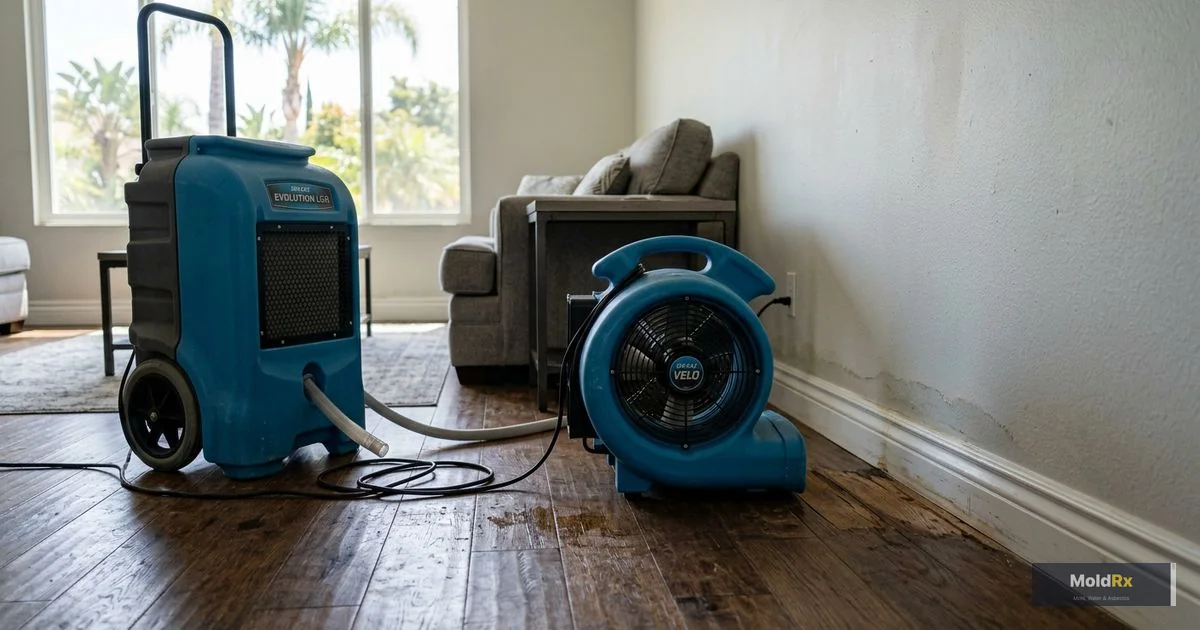
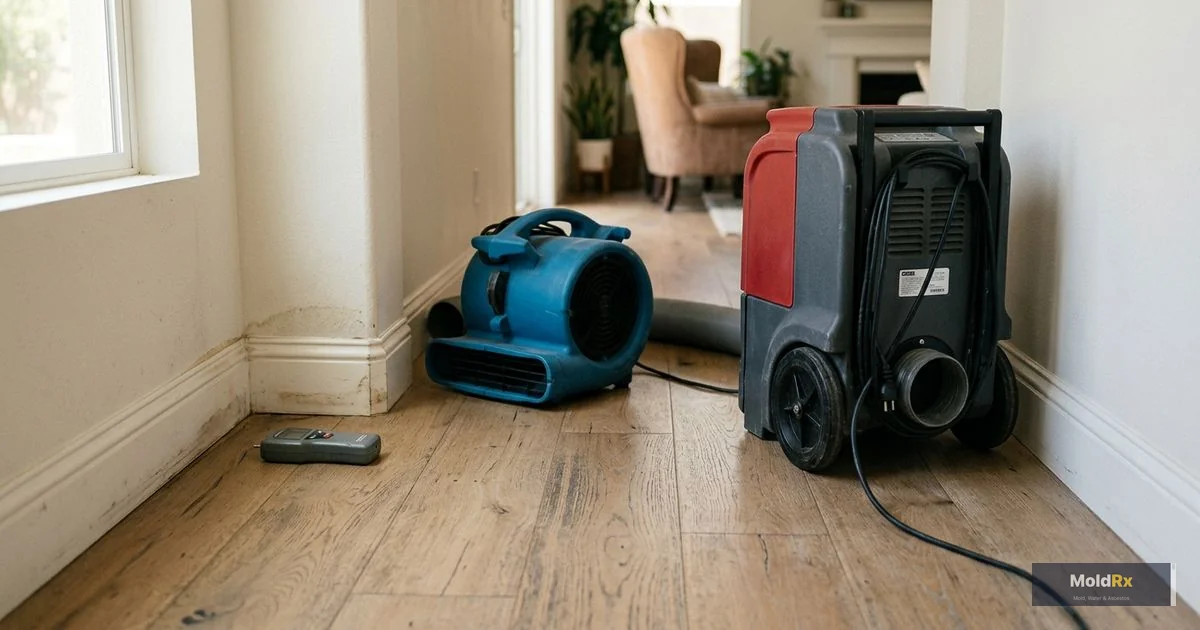
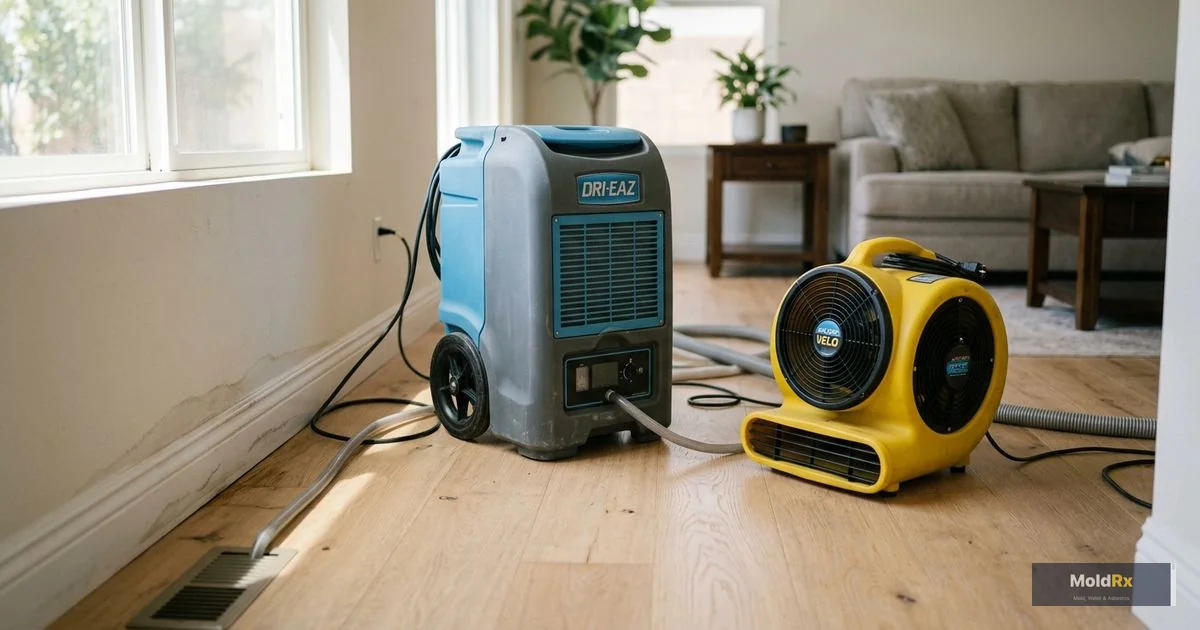
Commercial-grade LGR (low-grain refrigerant) dehumidifiers and high-velocity air movers are positioned according to psychrometric calculations calibrated specifically for Coachella Valley conditions. Cathedral City's desert environment creates unique drying dynamics. Extremely low outdoor humidity combined with extreme heat means drying can proceed faster than in coastal environments when equipment is placed correctly — but improper technique risks overdrying, secondary cracking, and material damage.
Wall cavities receive directed airflow through injection drying systems that force conditioned air behind drywall and into framing bays. Slab drying employs surface-mounted drying mats or targeted heat-injection systems to drive moisture from dense concrete. The goal is reaching dry standard — the equilibrium moisture content for the specific materials in your home — throughout all affected assemblies without introducing new damage.
Step 4: Continuous Moisture Monitoring and Insurance Documentation
Daily moisture readings using pin-type meters, pinless meters, thermo-hygrometers, and thermal imaging cameras. Every reading is logged with timestamps, locations, and equipment identifiers. This documentation serves two purposes: it verifies that drying is proceeding correctly and on schedule, and it provides your insurance adjuster with the evidence trail required to validate your claim under IICRC S500 standards.
In Cathedral City homes with older plaster-and-lath walls, dense structural materials, and concrete slab foundations, monitoring is especially critical. These materials retain moisture longer than modern drywall-and-stud assemblies, and premature equipment removal leads to rebound moisture events that restart the mold clock.
Step 5: Cleaning, Sanitizing, and Antimicrobial Treatment
Category 2 and Category 3 losses require antimicrobial application to all contacted structural materials remaining in place. HEPA-filtered air scrubbers run continuously to capture airborne particulates, microbial fragments, and contaminants released during material removal. All protocols comply with Cal/OSHA worker safety requirements, EPA guidelines for antimicrobial application, and IICRC S500 and IICRC S520 standards.
For monsoon flood events involving desert sediment, mud, and debris — the kind of material that buried the Panorama neighborhood under four feet of contamination in August 2023 — physical removal of contaminated material must precede chemical treatment. You cannot sanitize through mud. The material comes out first, then the structure is treated.
Step 6: Restoration and Rebuild
The final phase: reinstalling baseboards, replacing drywall, insulation, flooring, cabinetry, and any structural members that were removed or that failed moisture-content verification. All rebuild work is performed by CSLB-licensed contractors.
In Cathedral City properties with pre-1980 construction, any material removal must account for potential asbestos-containing materials in vinyl flooring, pipe insulation, joint compound, popcorn ceilings, and textured wall coatings. Testing before disturbance is standard protocol under Cal/OSHA and EPA regulations. Our teams coordinate asbestos testing and, if required, licensed abatement before reconstruction begins.
What to Do Right Now — Before Our Team Arrives
If you are reading this during an active water emergency, take these steps immediately:
- Shut off the water source if you can reach the shutoff safely. For slab leaks or unknown source locations, turn off the main supply at the meter box. For HVAC condensation failures, shut off the system at both the thermostat and the breaker. For pool equipment, close the isolation valves at the equipment pad.
- Turn off electricity to all affected areas at the breaker panel. Do not walk through standing water near active outlets, electrical connections, or appliances. If you cannot safely reach the breaker panel without crossing standing water, leave the home and call the fire department.
- Move irreplaceable items to dry ground. Documents, photographs, electronics, medications, and anything that cannot be replaced. Move them to an unaffected room or into your vehicle.
- Document everything with your phone — photos and video — before moving anything. Walk the entire affected area and record what you see. This footage is critical evidence for your insurance claim.
- Do not use a household vacuum on standing water. Standard vacuums are not sealed for water and present an electrocution hazard.
- Do not run fans, open windows, or turn on your HVAC system. Fans cannot dry wall cavities. Open windows in Cathedral City's summer heat will raise interior temperatures and accelerate mold germination inside saturated materials. Running your HVAC system can spread contaminated moisture through ductwork into every room of your home.
- Do not attempt to pull up flooring or cut into walls yourself. Without moisture mapping, you risk spreading contamination, disturbing potential asbestos-containing materials in older Cathedral City homes, and creating conditions that complicate professional restoration.
Then call (888) 609-8907 immediately. Do not wait until morning. Do not wait until Monday. Water damage is an active emergency every minute it remains unaddressed.
Insurance Documentation — We Handle It From Minute One
Insurance claims for water damage live or die on documentation quality and response timing. Delayed response can result in denied claims — insurers may argue that secondary damage, including mold growth, resulted from failure to mitigate rather than the original water event. Professional documentation beginning the moment technicians arrive establishes the timeline, classifications, and mitigation evidence your adjuster needs.
Most homeowner's insurance policies cover sudden and accidental water damage: burst pipes, failed water heaters, appliance line ruptures, HVAC condensation failures, and pool equipment malfunctions. Flood damage from external sources — monsoon storm runoff, desert wash overflow, rising groundwater — typically requires separate flood insurance through FEMA's National Flood Insurance Program or a private flood policy. Given that 71 percent of Cathedral City buildings face high flood risk, flood insurance is not optional for most properties in this city.
Our documentation package for every job includes:
- Timestamped arrival and initial assessment photographs
- Water category and damage class classification with supporting evidence
- Thermal imaging scans showing moisture migration beyond visible damage
- Daily moisture meter readings at every monitoring point
- Equipment placement logs with dehumidifier and air mover positions
- Drying progress reports showing moisture content trending toward dry standard
- Final verification readings confirming all materials have reached target moisture levels
- Complete photographic record of material removal, treatment, and rebuild
This documentation follows IICRC S500 standards — the framework most insurance adjusters use to evaluate water damage claims. When your adjuster receives our file, they get a complete technical narrative that supports your claim from first contact through final verification.
What Makes MoldRx Different
- We only send vetted professionals. MoldRx is not a lead aggregator. We do not sell your information to five contractors and let you figure out which one to trust. When we dispatch a team to your Cathedral City home, that team has been vetted for current IICRC S500 certification, verified CSLB licensing, active insurance coverage, and documented work quality. Our reputation is on the line with every job. If something is not right, you call us directly — not a call center, not a voicemail tree.
- IICRC S500 protocol on every job. No shortcuts. No skipped steps. Every event is classified by category and class. Every affected area is mapped with instruments, not guesses. Every drying setup follows psychrometric science calibrated for Coachella Valley desert conditions. Every reading is documented.
- Emergency-speed response. The Coachella Valley is our primary service territory. We understand that water damage restoration is the most time-critical service in the restoration industry. The difference between a 4-hour response and a 24-hour response can be the difference between saving your flooring and replacing your entire subfloor assembly.
- Desert-calibrated drying science. Cathedral City's extreme heat and low humidity create drying conditions that differ dramatically from coastal or humid-climate environments. Proper management of these conditions means faster drying times and fewer complications — but only when the restoration team understands desert psychrometrics. Improper technique in this climate leads to overdrying damage, material cracking, and false-dry readings that leave trapped moisture behind.
- Complete insurance documentation from minute one. We do not hand you a folder of photos at the end and wish you luck with your adjuster. Documentation is built into every phase of the process, structured to the standards adjusters use to evaluate claims.
Cathedral City Neighborhoods We Serve
MoldRx provides emergency water damage restoration across every neighborhood in Cathedral City and throughout the Coachella Valley.
- Cathedral City Cove — The city's oldest residential area, with homes from the 1930s through the 1960s. Spanish-style and Mid-Century Modern construction with original galvanized and cast iron plumbing at end-of-life. Slab leaks, supply line failures, and water heater ruptures are the dominant emergency calls. Potential asbestos-containing materials in pre-1980 construction require awareness during any material removal.
- Dream Homes — Ranch-style homes built 1958 to 1966 on large lots with mountain views. Original plumbing systems in this neighborhood are 60+ years old. Copper supply line ruptures, water heater failures, and pool equipment events are increasingly common as these systems reach catastrophic failure age.
- Date Palm Drive Corridor — Mixed residential and commercial properties spanning multiple construction eras. This corridor handles the bulk of Cathedral City's north-south drainage during monsoon storms and remains vulnerable to flooding during high-intensity rainfall events.
- Panorama — Ground zero for Tropical Storm Hilary's devastating mudflow in August 2023. Properties along the alluvial fan suffered four feet of Category 3 contamination. The city spent over $6 million on cleanup and infrastructure repair, with road reconstruction not completed until mid-2024. This neighborhood remains at elevated risk for flash flood events during every monsoon season.
- Cathedral Canyon — The weather station here recorded 3.61 inches of rain during Hilary. Gated communities and residential properties at the base of the San Jacinto foothills face direct exposure to wash runoff and flash flooding. Pool-heavy properties add year-round equipment failure risk.
- Rio Del Sol — 218-home community near Date Palm Drive and Gerald Ford Drive, built 1984 to 2007. Properties on Indian lease land. Pool-related water damage and 1980s-to-1990s-era plumbing failures — including potential polybutylene supply lines — are primary concerns.
- Desert Princess Country Club — Resort-style community with extensive pool, spa, and water feature infrastructure. Densely built condo and townhome units make HVAC condensation failures especially damaging, as water from one unit's mechanical failure can migrate into adjacent units through shared wall assemblies.
- Canyon Mobile Home Community — Flooded during Tropical Storm Hilary in August 2023, with approximately 50 homes damaged. Flooded again during heavy rains in August 2025. Mobile home construction is acutely vulnerable to water intrusion due to lower foundation profiles, limited crawl space ventilation, and materials that absorb water rapidly.
- Downtown Cathedral City / Highway 111 Corridor — Older commercial and mixed-use properties with aging plumbing, flat-roof construction prone to ponding, and limited drainage infrastructure. Commercial water damage events affect business operations, inventory, and revenue in addition to the structure itself.
Full coverage across all Cathedral City ZIP codes: 92234 and 92235. We also serve neighboring communities including Palm Springs, Rancho Mirage, Palm Desert, Thousand Palms, Desert Hot Springs, Indian Wells, and La Quinta.
Related Services in Cathedral City
- Mold Removal in Cathedral City — When the 24-to-48-hour mold window has closed, IICRC S520-compliant remediation is the necessary next step. Do not delay.
- Mold Testing in Cathedral City — Post-water-damage air quality and surface sampling to determine whether mold colonization has begun in concealed spaces.
- Asbestos Testing in Cathedral City — Pre-1980 Cathedral City homes may contain asbestos in flooring, insulation, joint compound, and textured coatings. Any water damage restoration requiring material removal should include testing first.
- Asbestos Removal in Cathedral City — Licensed abatement required under Cal/OSHA and EPA regulations whenever asbestos-containing materials must be disturbed during restoration work.
-> Learn more about remediation services in Cathedral City
Frequently Asked Questions
How fast does MoldRx respond to water damage emergencies in Cathedral City?
We treat every water damage call as the emergency it is. The Coachella Valley is our primary service territory, and Cathedral City is at the center of it. The critical variable is not our response time — it is how quickly you make the call. Extraction that begins within the first few hours preserves exponentially more material than extraction that starts the next day. The EPA and IICRC S520 confirm that the 24-to-48-hour mold colonization window is biological reality, not a guideline. In Cathedral City's extreme heat, that window may be even shorter. Every hour you wait narrows the gap between a manageable restoration and a full-scale remediation project.
What is the first thing I should do when I discover water damage?
Stop the water source if you safely can. Turn off electricity to affected areas at the breaker panel. Do not walk through standing water near active electrical connections. Do not attempt to dry the area with fans — in Cathedral City's heat, this can accelerate mold growth inside saturated wall cavities rather than prevent it. Document what you see with photos and video. Then call (888) 609-8907 immediately. Not in the morning. Not after you call a friend. Now.
Does homeowner's insurance cover water damage restoration?
Most standard homeowner's policies cover sudden and accidental water damage — burst pipes, failed water heaters, appliance line failures, HVAC condensation events, pool equipment malfunctions. Flood damage from external sources like monsoon runoff or desert wash overflow typically requires separate flood insurance. Given Cathedral City's documented flood history and the fact that 71 percent of the city's buildings face high flood risk, we strongly recommend confirming your flood coverage before monsoon season arrives. Our teams document every aspect of your restoration per IICRC S500 standards to provide the evidence trail your adjuster needs.
How long does water damage restoration take in Cathedral City?
Timeline depends on water category, damage class, and the materials involved. A contained Category 1, Class 2 event in a single room may reach dry standard in three to five days. A major event involving multiple rooms, Category 3 water, overhead saturation, or slab moisture intrusion can require one to three weeks of active drying and monitoring. Cathedral City's low outdoor humidity can accelerate drying when managed with professional equipment and desert-calibrated psychrometric calculations — but the process is never rushed. Premature equipment removal leads to rebound moisture and mold.
Can I dry water damage myself with fans and dehumidifiers from a hardware store?
No. Consumer-grade dehumidifiers remove a fraction of the moisture that commercial LGR units extract. Box fans and oscillating fans move air across surfaces but cannot dry wall cavities, subfloor assemblies, or structural framing concealed behind vapor barriers and drywall. In Cathedral City, opening windows and running fans introduces extreme heat that accelerates mold germination inside saturated materials while doing nothing to extract moisture from sealed cavities. Professional-grade equipment, instrument-guided placement, and daily monitoring are the only reliable path to verified dry standard.
What is the difference between water damage categories?
Category 1 is clean water from a sanitary supply source. Category 2 is gray water containing contaminants — HVAC condensate, pool water, washing machine discharge, dishwasher overflow. Category 3 is black water — sewage, monsoon floodwater, septic overflow, or any water contaminated enough to cause serious illness. Each category is defined by the IICRC S500 standard and requires progressively more aggressive safety protocols, equipment, and material handling. Category 1 water left unaddressed degrades to Category 2 within 48 to 72 hours — faster in Cathedral City's heat — and Category 2 degrades to Category 3 with continued time and temperature exposure.
Is my Cathedral City home at risk for mold after water damage, even in the desert?
Yes — and this is the single most dangerous misconception in the Coachella Valley. The dry outdoor climate is completely irrelevant once water enters concealed building cavities. A saturated wall assembly is a sealed system. Relative humidity inside that wall can sit at 90 percent or higher while the air outside your home is at 10 percent. Combined with Cathedral City's extreme interior temperatures — wall cavities in summer can exceed 100 degrees in attic-adjacent spaces — you have ideal conditions for rapid mold colonization. The EPA confirms it. The IICRC S520 confirms it. The biology does not care about your ZIP code. Professional extraction and controlled drying are the only countermeasures that work.
Why should I worry about HVAC condensation causing water damage?
Cathedral City air conditioning systems run at high capacity for the vast majority of the year. That continuous operation produces substantial condensation — and the components designed to manage it (drain lines, drain pans, overflow safety switches) degrade over time from mineral buildup, thermal stress, and biological growth. When they fail, water enters your attic and ceiling assembly, often for weeks before any visible sign appears. By the time you see a ceiling stain or smell something musty, you may already be facing a Class 3 water damage event combined with active mold growth in spaces you cannot see without opening the ceiling.
Will MoldRx work with my insurance adjuster?
Yes. We provide complete technical documentation — timestamped photographs, moisture readings, drying logs, equipment placement records, category and class classification, and final verification data — structured to the IICRC S500 framework your adjuster uses to evaluate claims. Our documentation is designed to support your claim, not complicate it.
Should I get mold testing after water damage?
If professional drying began within 24 hours of the water event and final moisture readings confirm dry standard throughout all affected materials, post-restoration testing may not be necessary. But if response was delayed beyond 24 hours, if musty odors persist after drying, if Category 2 or Category 3 water was involved, or if moisture was present in concealed spaces for an unknown duration, we recommend post-restoration mold testing to confirm no colonization occurred. Catching mold early — or confirming its absence — is always less costly and less disruptive than discovering an established colony months later.
What makes Cathedral City water damage different from other areas?
Four factors converge in Cathedral City to create uniquely severe water damage conditions: (1) An aging housing stock with plumbing systems from the 1950s through the 1990s reaching simultaneous end-of-life failure across entire neighborhoods. (2) HVAC systems that run at near-maximum capacity 8 to 10 months per year, generating massive condensation volumes that overwhelm aging drain infrastructure. (3) Extreme heat that accelerates every biological and chemical degradation timeline — mold germinates faster, Category 1 water degrades faster, materials deteriorate faster. (4) Documented catastrophic monsoon flood risk, with Tropical Storm Hilary in 2023 and repeated flooding in 2025 proving that the desert is not immune to devastating water events. This combination means water damage in Cathedral City escalates faster and reaches greater severity than in moderate-climate regions.
Your Property Is Getting Worse Right Now — Act Immediately
Water damage does not plateau. It does not stabilize. It does not wait for a convenient time. Right now, the water inside your walls, beneath your floors, or above your ceilings is actively migrating further into your home's structure. Materials are absorbing more moisture. Subflooring is swelling. Drywall is losing structural integrity. And somewhere in the warm, dark, wet spaces you cannot see, mold spores are finding exactly the conditions they need to germinate.
Whether it is a burst polybutylene supply line in a 1985 home off Date Palm Drive, an HVAC condensation failure that has been silently saturating your attic insulation for weeks, a pool equipment rupture flooding your garage at Desert Princess, a slab leak migrating through the foundation of your Cathedral City Cove mid-century home, or monsoon floodwater forcing through your doors the way it engulfed Panorama in August 2023 — every hour you wait increases the damage, expands the scope, and makes the restoration harder, longer, and more disruptive.
MoldRx only sends vetted water damage restoration professionals who follow IICRC S500 standards, carry current CSLB licensing, and understand Cathedral City's Coachella Valley desert conditions. Every technician complies with Cal/OSHA safety requirements and EPA guidelines for contaminated water handling. We document everything for your insurance claim from the first minute we arrive.
Every hour matters. The mold clock is running. Your property is not getting better on its own.
Call MoldRx now — (888) 609-8907 or request your free estimate here. Do not wait another hour.