Asbestos Testing in Canyon Lake, CA — MoldRx
Vetted Asbestos Testing Specialists Serving Canyon Lake and the Temecula Valley
Canyon Lake is one of the most distinctive residential communities in Southern California — a private, gated city of approximately 11,000 residents built around a 383-acre reservoir in southwestern Riverside County (ZIP 92587). The Corona Land Company platted 4,801 residential lots here beginning in 1968, and the housing that defines Canyon Lake today was constructed primarily during the 1970s and 1980s, with a secondary wave of building extending into the 1990s. That construction timeline places a large share of Canyon Lake's housing stock squarely within the decades when asbestos-containing materials were standard in American residential construction.
If you are planning a renovation, preparing a property for sale, or noticing deteriorating materials in an older Canyon Lake home, professional asbestos testing is the only reliable method for determining whether hazardous materials are present. Visual inspection cannot identify asbestos. Only laboratory analysis can confirm it or rule it out. This page explains why Canyon Lake homes carry specific asbestos risks, what the testing process involves from start to finish, and how to use your results to plan your project safely and in full compliance with California law.
Ready to schedule testing for your Canyon Lake property? Request your free estimate or call (888) 609-8907 to speak with a specialist who understands gated-community logistics and Temecula Valley construction history.
Why Canyon Lake Homes Carry Asbestos Risk
The Development Timeline
Canyon Lake's story begins in 1927, when a dam was constructed across Railroad Canyon to create a freshwater reservoir for recreation and water storage. For decades the area served as open land for camping, fishing, and hunting. Then, in October 1967, Riverside County approved the Canyon Lake master-planned community project. The Corona Land Company took possession of the land on February 15, 1968, broke ground on infrastructure, and sold the first residential lot on March 31, 1968. The Canyon Lake Property Owners Association (POA) was incorporated on May 5, 1968, and by November 1970 it had assumed responsibility for commonly owned facilities including the golf course, lodge, amphitheater, launch ramp, campground, and stable.
What followed was roughly three decades of residential construction. Understanding when your Canyon Lake home was built is the single most useful piece of information for framing its asbestos risk, because the availability and use of asbestos-containing building products changed significantly across those decades.
1968 through 1978 — Highest Risk
The first homes built after Canyon Lake opened were constructed during the final decade of unrestricted asbestos use in residential construction. During this era, asbestos was not considered hazardous — it was a premium ingredient valued for fire resistance, thermal insulation, tensile strength, and durability. Builders used it in dozens of products without hesitation. Homes from these earliest development phases, particularly those in the original platted sections nearest the lake, have a high probability of containing asbestos in ceiling textures, flooring, insulation, roofing, pipe wrapping, and drywall joint compound. If your Canyon Lake home was built between 1968 and 1978, testing should be treated as mandatory before any renovation work.
1979 through 1986 — Transitional Risk
California banned asbestos in most construction products in 1977, and federal agencies followed with additional restrictions. However, the transition was gradual. Manufacturers reformulated products over several years, and older products containing asbestos remained on supplier shelves and in builder inventories well into the mid-1980s. This is the era that causes the most confusion for homeowners: a home built in Canyon Lake in 1983 might contain asbestos in its ceiling texture but not its floor tiles, or vice versa. There is no way to tell visually — asbestos-containing and asbestos-free versions of the same product look identical. Laboratory analysis is the only path to certainty.
Late 1980s through 1990s — Lower but Non-Zero Risk
By the late 1980s, the vast majority of mainstream residential products had been reformulated without asbestos. Homes built during Canyon Lake's later development phases are generally lower risk. However, specialty products, imported materials, and older stock pulled from warehouse inventories mean the risk never drops to zero. For renovation projects in homes from this era, testing is advisable whenever original materials will be disturbed, particularly ceiling textures, flooring, and HVAC components.
The Renovation Factor Inside a Gated Community
Canyon Lake is not a community where homes sit unchanged for decades. The Canyon Lake POA maintains aesthetic and maintenance standards across the community's 37 miles of private roads. Combined with the desirability of lakefront, golf-course-adjacent, and equestrian-area properties, renovation activity in Canyon Lake is consistently high. Homeowners update kitchens and bathrooms, replace flooring, remove popcorn ceilings, expand living spaces, upgrade aging HVAC systems, and add outdoor living areas to take advantage of the Southern California climate.
Each of these projects has the potential to disturb original building materials from the 1970s and 1980s. Removing popcorn ceiling texture is one of the most common asbestos-exposure scenarios in residential renovation. Pulling up old vinyl floor tiles and their adhesive is another. Modifying ductwork in a forced-air system is a third. These are everyday renovation activities that become serious health hazards when the materials involved contain asbestos.
Riverside County requires building permits prior to construction, and all plans must comply with current California Building Codes. For projects involving exterior work — reroofing, grading, retaining walls, or other exterior modifications — the Canyon Lake POA requires separate approval before the county will issue a permit. Asbestos testing fits naturally into this planning sequence: it is a foundational step that should happen before contractors are scheduled, permits are pulled, and materials are ordered.
Climate and Long-Term Material Degradation
Canyon Lake sits at approximately 1,502 feet of elevation in the Temecula Valley, where the semi-arid Mediterranean climate delivers summer highs routinely in the mid-90s to low 100s and mild, relatively dry winters. HVAC systems run extensively — air conditioning for six or more months of the year, heating during cooler periods — and have likely been serviced, repaired, or replaced multiple times over the decades. Each service event on an older system could have disturbed asbestos-containing duct insulation, pipe wrapping, or furnace components without anyone recognizing the hazard.
The intense UV radiation and daily thermal cycling also affect exterior materials. Roofing, siding, and exterior trim exposed to years of this stress can become brittle and begin to crack or flake. When those materials contain asbestos, deterioration creates a pathway for fiber release. Lakefront properties may experience additional moisture exposure that accelerates this degradation cycle. Canyon Lake homes with original roofing or exterior materials from the 1970s or early 1980s should be evaluated for condition as part of any asbestos assessment.
What Asbestos Is and Why It Matters
The Material
Asbestos refers to a group of six naturally occurring fibrous silicate minerals. Of these, three were widely used in construction: chrysotile (white asbestos, the most common by far), amosite (brown asbestos), and crocidolite (blue asbestos). All are classified as known human carcinogens. The construction industry valued asbestos because it offered a combination of properties no other material could match: fire resistance, heat resistance, chemical stability, tensile strength, flexibility, and low cost. Manufacturers incorporated asbestos fibers into an estimated 3,000 different products — floor tiles, roofing, pipe insulation, ceiling textures, drywall compound, siding, gaskets, caulking, and many others. A home built during the peak asbestos era might contain the mineral in a dozen or more different materials.
How Exposure Causes Disease
Asbestos-containing materials that remain intact and undisturbed pose minimal risk to occupants. The danger emerges when materials are cut, drilled, sanded, scraped, broken, sawed, or allowed to deteriorate to the point where fibers escape the binding matrix and become airborne.
Individual asbestos fibers are microscopic — many times thinner than a human hair and completely invisible without laboratory magnification. They have no odor and no taste. A person can inhale a significant quantity of fibers during a renovation activity and have no immediate awareness that exposure has occurred. There are no immediate symptoms — no coughing, no irritation, no detectable effect at the time.
Once inhaled, asbestos fibers lodge in lung tissue and the mesothelial lining of the chest and abdominal cavities. The body cannot break them down, dissolve them, or expel them. They remain permanently embedded. Over periods of 10 to 50 years, these embedded fibers cause chronic inflammation, progressive tissue scarring, and cellular mutations that can lead to:
- Mesothelioma — an aggressive cancer of the chest or abdominal lining, caused almost exclusively by asbestos exposure, with a poor prognosis
- Lung cancer — asbestos exposure significantly elevates lung cancer risk, and the risk multiplies in combination with tobacco use
- Asbestosis — chronic, progressive scarring of lung tissue that permanently reduces breathing capacity
- Pleural disease — thickening and scarring of the lung lining that restricts breathing
There is no known safe threshold of exposure. Even brief but intense exposures — such as a weekend spent scraping a popcorn ceiling without testing first — can produce disease decades later. Because the latency period between exposure and symptom onset is measured in decades, the connection between a renovation project and a subsequent diagnosis is often not recognized until long after the fact.
Common Asbestos-Containing Materials in Canyon Lake Homes
Homes built in Canyon Lake during the primary development decades of the 1970s and 1980s may contain asbestos in the following materials:
- Popcorn and textured ceiling coatings — Spray-applied acoustic textures were among the most common residential asbestos applications. They were used extensively in Southern California homes of all types, from tract builds to custom lakefront properties.
- Vinyl floor tiles and mastic adhesive — Both the tiles themselves (especially 9-inch and 12-inch formats) and the black adhesive used to bond them to the subfloor frequently test positive.
- Drywall joint compound — Taping mud and textured wall coatings used for wall and ceiling finishing through the early 1980s commonly contained chrysotile asbestos.
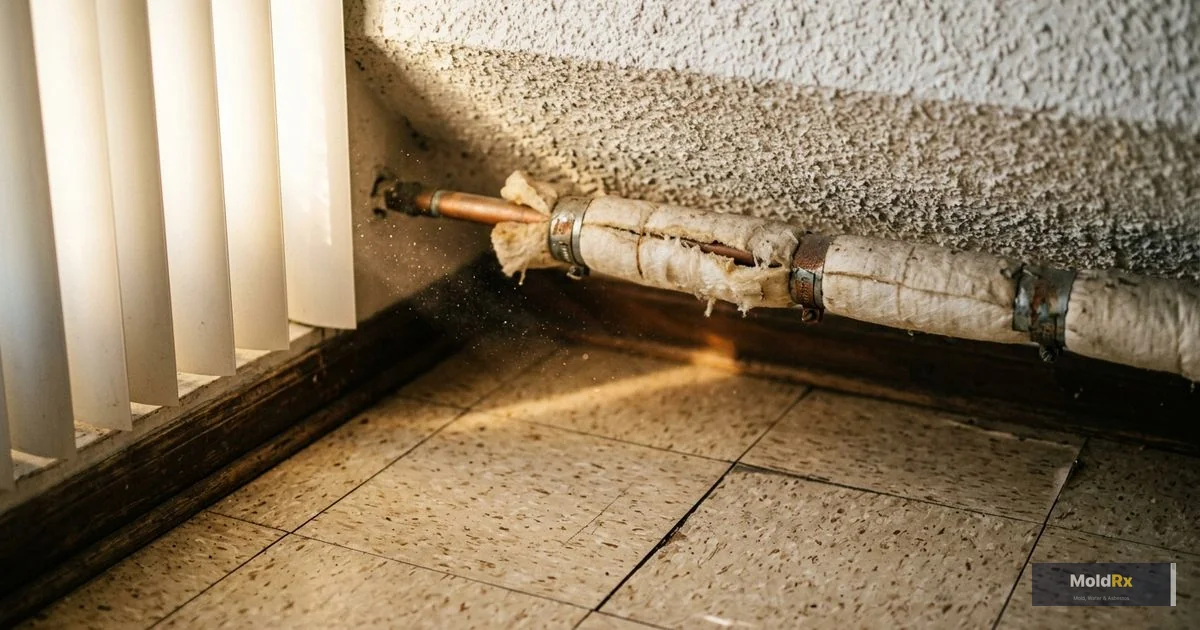
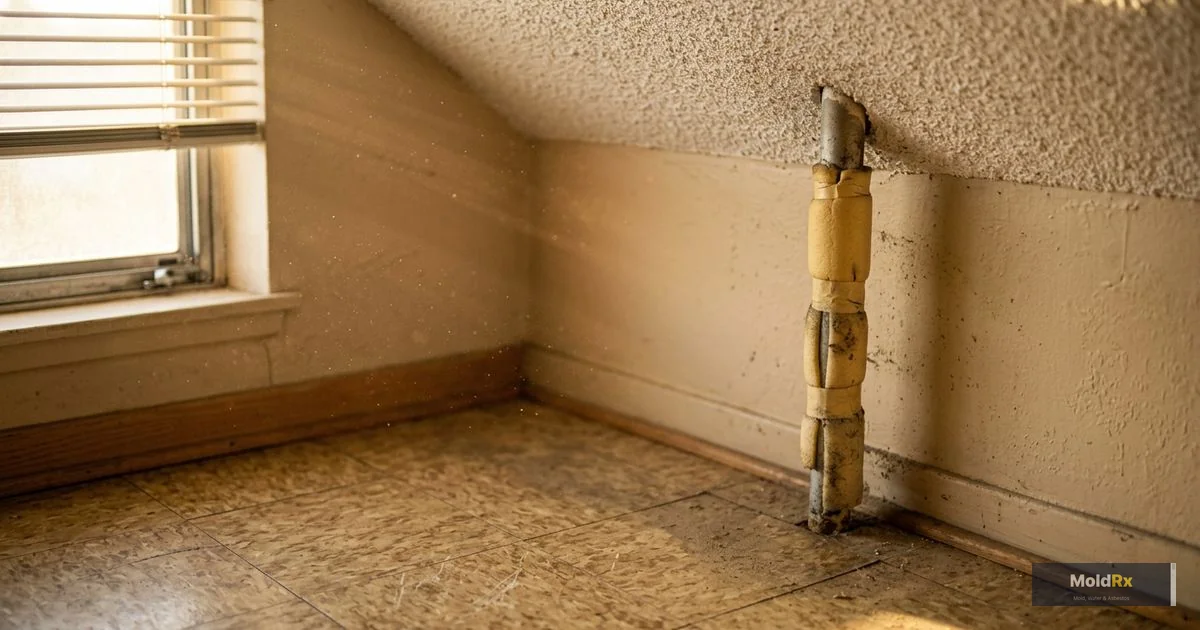
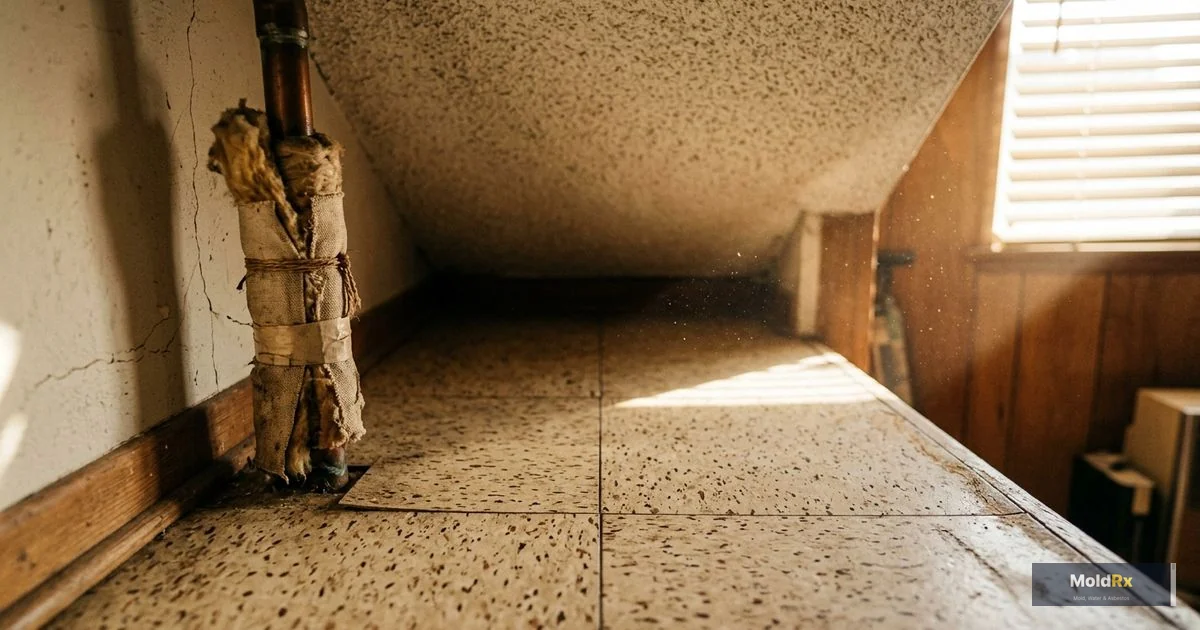
- Pipe insulation and wrapping — On hot water pipes, water heater connections, and plumbing runs throughout the home.
- Duct insulation and duct tape — In forced-air HVAC systems, which are used heavily given the Temecula Valley climate. The cloth tape used to seal ductwork joints is a frequent asbestos source.
- Roofing materials — Cement-asbestos shingles, asphalt shingles, roof felt underlayment, flashing, and roofing cement from pre-1990 installations.
- Caulking and glazing compounds — Around windows, tubs, showers, and sinks.
- Cement siding and stucco additives — Some exterior finish materials from this construction era incorporated asbestos for strength and fire resistance.
- Fireplace components — Heat shields, fireproof boards, and gasket materials in homes with fireplaces or wood-burning stoves.
- Vermiculite attic insulation — Loose-fill, pebble-shaped insulation that may contain tremolite asbestos, particularly if sourced from the contaminated Libby, Montana mine.
Regulatory Requirements That Apply in Canyon Lake
California's asbestos regulations apply in full within Canyon Lake's gates. The POA's community governance does not replace or supersede state and federal asbestos law. Understanding these requirements before you begin a project helps you stay compliant, avoid fines, and protect everyone involved.
Cal/OSHA Title 8, Section 1529
Cal/OSHA Title 8 §1529 is California's primary workplace asbestos standard. It requires laboratory-confirmed identification of asbestos-containing materials before renovation or demolition of structures built before 1980. For Canyon Lake homes built between 1968 and 1980, this means testing is legally required before renovation work begins. The regulation governs permissible exposure limits, work practices, medical surveillance, and record-keeping for any work that may disturb asbestos.
OSHA 1926.1101
The federal OSHA 1926.1101 standard applies to all construction activities where asbestos may be present. It classifies asbestos work into four categories based on the type and scale of disturbance, sets permissible exposure limits, and mandates specific engineering controls, personal protective equipment, and air monitoring. Contractors working in Canyon Lake homes must comply with both the federal standard and the more stringent California provisions.
SCAQMD Rule 1403
SCAQMD Rule 1403 governs asbestos emissions from demolition and renovation activities throughout the South Coast Air Quality Management District, which includes all of Riverside County. Key requirements include:
- An asbestos survey conducted by a qualified inspector is required before any demolition project, regardless of building age
- Written notification to SCAQMD must be postmarked at least 10 working days before demolition begins
- Specific work practices are mandated for the removal of all friable and certain non-friable asbestos-containing materials
- Penalties for non-compliance can reach $20,000 per day or criminal prosecution if negligence leads to bodily or environmental harm
The only limited exemption under Rule 1403 is for renovation activity on residential single-unit dwellings where less than 100 square feet of intact material is removed. For most renovation projects in Canyon Lake, the survey requirement applies.
AHERA
The Asbestos Hazard Emergency Response Act (AHERA) is a federal regulation primarily aimed at schools, but it established the inspection protocols, analyst qualifications, and management plan requirements that became the industry standard for all asbestos assessments. AHERA-trained inspectors follow standardized sampling procedures that ensure defensible, legally compliant results — whether the inspection takes place in a school, a commercial building, or a Canyon Lake residence.
CSLB C-22 Licensing
If testing reveals asbestos-containing materials that need to be removed, California law requires that abatement be performed by a contractor holding an active CSLB C-22 (Asbestos Abatement) license. This is a specialty license issued by the California Contractors State License Board. General contractors, handymen, and unlicensed workers are not permitted to remove asbestos. Your testing report will identify which materials require professional abatement, giving you a clear scope to present to licensed C-22 contractors for competitive bids.
How MoldRx Asbestos Testing Works in Canyon Lake
MoldRx only sends vetted, certified asbestos testing specialists to Canyon Lake properties. Every inspector follows EPA and Cal/OSHA sampling protocols. Here is the process from start to finish.
Step 1 — Consultation and Scope Definition
We begin by discussing your property's specifics: its approximate construction date, its location within the Canyon Lake community, and the nature of your planned project. A homeowner replacing flooring in a 1974 lakefront home has different testing needs than someone planning a full kitchen and bathroom renovation of a 1985 golf-course property. A homeowner preparing a property for sale needs a comprehensive survey, while someone addressing a single damaged material may need only a targeted test. We tailor the sampling scope to what your situation actually requires — no unnecessary samples, no missed materials.
Step 2 — Professional Sample Collection
Vetted asbestos specialists arrive at your Canyon Lake property and systematically collect samples of every suspect material within the project scope. Each material is wetted to suppress fiber release during collection. A small, representative sample is extracted with specialized tools and sealed in a labeled container with full chain-of-custody documentation.
We coordinate with Canyon Lake's gate-access procedures to ensure smooth arrival and efficient scheduling. Provide us with the necessary guest-list or gate-code information when booking, and our team handles the logistics from there. Our specialists are experienced with gated-community access requirements.
The number of samples depends on the number of different materials present and the scope of your project. A typical Canyon Lake home inspection involves 5 to 20 samples, depending on the home's age, the materials involved, and the extent of the planned work.
Step 3 — NVLAP-Accredited Laboratory Analysis
All samples are analyzed at a laboratory accredited through the National Voluntary Laboratory Accreditation Program (NVLAP), which is administered by the National Institute of Standards and Technology (NIST). NVLAP accreditation means the laboratory has demonstrated technical competence, undergone proficiency testing, and operates under a quality management system that meets international standards.
The primary analytical method is polarized light microscopy (PLM), which identifies with certainty whether asbestos is present, determines the specific fiber type (chrysotile, amosite, crocidolite, or others), and quantifies the concentration percentage.
Transmission electron microscopy (TEM) is available for situations requiring greater analytical sensitivity, including air clearance testing following abatement, analysis of materials at very low asbestos concentrations, or situations where layered materials require more detailed characterization.
Step 4 — Clear Results and Actionable Guidance
Your report identifies each tested material by description and specific location within your home. For every sample, the report states whether asbestos was detected and, if positive, the asbestos type and concentration. The report then provides practical, project-specific guidance:
- Which materials can be safely left undisturbed
- Which materials require professional removal by a licensed CSLB C-22 abatement contractor before your renovation proceeds
- Which materials can be managed through encapsulation or enclosure as an alternative to removal
- What the next steps are for coordinating abatement, SCAQMD notification, and project sequencing
The documentation meets all requirements for Cal/OSHA compliance, SCAQMD Rule 1403 notification, real estate transaction disclosure, POA coordination, and contractor planning.
Have questions about your Canyon Lake property? Request your free estimate or call (888) 609-8907 to discuss your project scope.
What to Expect During the Process
-
Timeline. Sample collection takes two to four hours for a typical Canyon Lake home. Standard laboratory results arrive within 3 to 5 business days. Rush processing is available for urgent timelines, time-sensitive renovations, or closing-deadline real estate transactions.
-
Gate access. We coordinate with Canyon Lake's security and access requirements. Provide guest-list details or gate-code information when scheduling, and we handle the rest. Our team is experienced with gated-community logistics across the Temecula Valley.
-
Minimal disruption. The sampling process involves removing very small pieces of material and does not require special preparation from homeowners. There is no need to move furniture, clear rooms, or vacate the home. Homeowners are welcome to be present during the entire visit.
-
Documentation. Reports are formatted for multiple uses — contractor coordination, POA inquiries, real estate transactions, SCAQMD compliance, and personal records. They meet all California regulatory requirements and are accepted by licensed C-22 abatement contractors for bid preparation.
-
Honest assessment. If your home's construction date and materials suggest low asbestos risk, we will tell you. If certain materials do not warrant testing based on your project scope, we will not recommend unnecessary sampling. Our goal is accurate information for informed decisions.
Canyon Lake Neighborhoods and Areas We Serve
MoldRx sends vetted asbestos testing specialists throughout Canyon Lake's residential neighborhoods, including Holiday Harbor, East Port, Vacation Village, Canyon Lake North, Canyon Lake South, Canyon Lake Hills, and the Golf Course and Country Club areas. We serve all properties within the community gates in the 92587 ZIP code.
Our coverage extends throughout the Temecula Valley and southwestern Riverside County, including neighboring communities such as Lake Elsinore to the north, Menifee to the east, Wildomar to the south, and Murrieta and Temecula to the southwest.
Frequently Asked Questions
When is asbestos testing legally required in Canyon Lake?
Cal/OSHA Title 8 §1529 requires laboratory-confirmed asbestos identification before renovation or demolition that may disturb materials in structures built before 1980. For Canyon Lake homes built between 1968 and 1980, this makes testing a legal prerequisite before renovation work begins. SCAQMD Rule 1403 requires an asbestos survey before any demolition project regardless of building age. Even when not strictly mandated by law, testing is strongly recommended for homes built through the mid-1980s, because asbestos-containing products continued to circulate through supply chains for years after California's 1977 ban.
My Canyon Lake home was built in 1984. Should I still test?
Yes, if you are planning renovation work that will disturb original materials. The phase-out of asbestos in building products was gradual — California's ban took effect in 1977, but products manufactured before the ban continued to circulate through supply chains for years afterward. Homes built through the mid-1980s may contain asbestos in specific materials, particularly ceiling textures, floor tiles, joint compound, and duct insulation. PLM laboratory analysis provides certainty that visual inspection cannot.
Does the Canyon Lake POA require asbestos testing?
The Canyon Lake Property Owners Association manages aesthetic standards, community amenities, and maintenance requirements, but asbestos compliance is a state and federal regulatory matter — not a POA governance issue. Cal/OSHA, OSHA 1926.1101, and SCAQMD Rule 1403 apply within Canyon Lake's gates the same as everywhere else in Southern California. Riverside County requires building permits for construction projects, and for exterior work, POA approval must be obtained before the county issues the permit. Incorporating asbestos testing into this planning sequence ensures you meet all applicable requirements before work begins.
What happens if asbestos is found in my Canyon Lake home?
A positive result does not mean your home is immediately dangerous or that you need to evacuate. Intact, undisturbed asbestos-containing materials in good condition can be monitored and managed in place indefinitely — this is a recognized management strategy under AHERA guidelines. The issue arises only when materials will be disturbed by renovation, deterioration, or damage. Materials that your planned project will disturb must be professionally removed by a contractor holding an active CSLB C-22 license before other work begins. Your report will provide specific recommendations for each material, including whether removal, encapsulation, or monitoring is appropriate, giving you and your contractor a clear plan of action.
How does lakefront location affect asbestos risk?
The lakefront location does not change what materials are inside your home, but it can affect the condition of exterior materials over time. Properties closer to the water may experience elevated moisture exposure, which accelerates the deterioration of asbestos-containing roofing, siding, and exterior caulking. Additionally, lakefront homes in Canyon Lake are among the oldest in the community — built during the first phase of development in the late 1960s and early 1970s — placing them in the highest-risk construction era. If you own a lakefront property and are planning any renovation or repair, testing is strongly recommended.
What analytical methods are used on my samples?
The standard method is polarized light microscopy (PLM), performed at an NVLAP-accredited laboratory. PLM identifies whether asbestos is present, determines the specific fiber type, and measures concentration. For situations requiring higher sensitivity — such as air clearance testing following abatement or analysis of materials at very low concentrations — transmission electron microscopy (TEM) provides resolution at the individual-fiber level. Both methods produce legally defensible results that satisfy Cal/OSHA, OSHA, and SCAQMD requirements.
Can I collect my own samples?
Homeowners can legally collect their own samples in California for personal knowledge purposes. However, self-collected samples are not accepted for regulatory compliance, real estate disclosure, or contractor planning in most circumstances. Professional sampling follows chain-of-custody protocols, uses proper wetting and containment techniques to prevent fiber release, and produces documentation that meets Cal/OSHA Title 8 §1529 and SCAQMD Rule 1403 requirements. For any project that involves permits, contractors, or property transactions, professional sampling is the standard.
How do I coordinate gate access for the testing team?
When you schedule your appointment, provide us with the gate-access procedure — whether that involves adding our team to your guest list, providing a gate code, or meeting us at the entrance. Our specialists are experienced with gated-community logistics throughout the Temecula Valley and will arrive with identification and a clear schedule for the visit.
Related Services in Canyon Lake
In addition to asbestos testing, MoldRx also sends vetted specialists for Mold Removal in Canyon Lake, Asbestos Removal in Canyon Lake, Water Damage Restoration in Canyon Lake, and Mold Testing in Canyon Lake.
Learn more about remediation services in Canyon Lake
Schedule Asbestos Testing for Your Canyon Lake Property
Canyon Lake's development timeline — beginning with the first lot sold on March 31, 1968, and building through three decades of residential construction — places a significant share of its housing stock within the era when asbestos-containing materials were routinely used. Whether you are renovating a lakefront home from the original development phase, updating a property near the golf course, preparing a home for sale, or addressing aging materials in a home you plan to live in for years to come, professional testing provides the factual basis for safe, compliant decisions.
MoldRx only sends vetted asbestos testing specialists who understand Canyon Lake's construction history, its gated-community logistics, and the specific materials used in homes from each development phase. Every sample is analyzed at an NVLAP-accredited laboratory. Every report meets Cal/OSHA, OSHA 1926.1101, SCAQMD Rule 1403, and AHERA standards. You get clear, actionable results — not ambiguity.
Request your free estimate or call (888) 609-8907 to schedule asbestos testing for your Canyon Lake property.