Asbestos Testing in Calimesa, CA
MoldRx Only Sends Vetted Asbestos Testing Specialists to Calimesa and the Western San Gorgonio Pass
Calimesa is a small Riverside County city of roughly 10,000 residents perched at approximately 2,400 feet in the foothills where the western Inland Empire transitions into the San Gorgonio Pass. The city incorporated on December 1, 1990, but its residential neighborhoods are considerably older than that date suggests. Housing spread through the San Timoteo Canyon corridor and along what is now the Interstate 10 frontage beginning in the early 1960s, and the decades that followed filled the area with a distinctive mix of single-family ranch homes, small commercial buildings, and mobile home parks that together define Calimesa's built environment today.
That timeline is the reason this page exists. The majority of Calimesa's housing was constructed during the 1960s, 1970s, and early 1980s — the peak era for asbestos use in American building materials. Roughly 30 percent of the city's housing units are classified as mobile or manufactured homes, a proportion far higher than the Riverside County average. Mobile homes built before 1980 carry a concentrated asbestos risk that is materially different from the risk in conventionally framed houses. Whether your property is a 1972 singlewide in one of Calimesa's established parks or a 1967 stucco ranch off Calimesa Boulevard, professional asbestos testing is the only way to know what is in your walls, floors, ceilings, and ductwork before any renovation, repair, or property transaction moves forward.
California law requires it. Cal/OSHA Title 8, Section 1529 mandates that asbestos-containing materials be identified through laboratory analysis before any work that could disturb them in structures built before 1980. SCAQMD Rule 1403 extends the survey requirement to all structures regardless of age before demolition and certain renovation activities. The penalties for non-compliance are steep — fines up to $20,000 per day and potential criminal liability — but the health consequences of uncontrolled asbestos exposure are worse.
If you are planning a project on a Calimesa property, the information below will help you understand what needs to happen before the first nail is pulled.
Ready to get started? Request your free estimate or call (888) 609-8907 to speak with someone today.
How Asbestos Entered Calimesa's Housing Stock
Asbestos is a naturally occurring fibrous mineral that was incorporated into more than 3,000 commercial building products during the twentieth century. Its heat resistance, tensile strength, chemical stability, and low cost made it a standard ingredient in everything from floor tiles to roof shingles. In residential construction, asbestos use peaked between approximately 1940 and 1978, then declined as federal and California state regulations took hold. The state banned asbestos in most construction applications in 1977, but products manufactured before the ban remained in supplier inventories and on job sites for years afterward. Homes built in Calimesa as late as the mid-1980s may contain asbestos-containing materials (ACM).
Before the City: The Stagecoach Trail to Subdivision Era
Before Calimesa was a city — before it was even an unincorporated census-designated place — the San Timoteo Canyon corridor was cattle grazing land crossed by stagecoach trails running from Redlands through Singleton Canyon and into Cherry Valley. The Calimesa Improvement Association formed in the 1940s to promote development, but the area remained sparsely populated until the completion of U.S. Route 99 (the predecessor to Interstate 10) brought reliable access and commercial interest to the San Gorgonio Pass.
Residential construction accelerated through the 1960s and 1970s. Tract homes appeared along Calimesa Boulevard, Singleton Road, and Avenue L. Mobile home parks were established to serve retirees and working families attracted by the area's lower land costs and cooler foothill temperatures. By the time Calimesa incorporated in 1990, its neighborhoods were already 20 to 30 years old.
The builders and manufacturers who constructed these homes were not deliberately choosing asbestos. They were purchasing the materials that distributors stocked and building codes accepted: spray-on acoustic ceiling texture, 9-inch and 12-inch vinyl floor tiles, black mastic adhesive, joint compound, pipe insulation, roofing felt, and cement-asbestos siding. Asbestos was a routine manufacturing ingredient across all of these products during the 1960s and 1970s. It was not a defect — it was the standard.
The Manufactured Housing Factor: Calimesa's Distinctive Risk
What separates Calimesa from most Inland Empire cities is its unusually high proportion of mobile and manufactured homes. Of the city's approximately 4,156 housing units, around 30 percent are mobile or manufactured homes. The city maintains multiple mobile home parks subject to its Mobile Home Rent Stabilization Ordinance, including established communities such as Californian Mobile Estates (a 55-and-older community with approximately 130 sites on California Street), Ponderosa Mobile Estates, Big Oak Gardens, The Colony, Sharondale, South Mesa, Las Palomas Estates, Villa Calimesa, and Rancho Calimesa.
Mobile homes manufactured before 1980 present a concentrated asbestos risk that differs from the risk in site-built houses in three important ways.
First, the materials themselves are different. Manufactured housing of the 1960s and 1970s used lightweight, fire-resistant products throughout the unit that frequently contained chrysotile asbestos:
- Vinyl sheet flooring and felt backing — Kitchen, bathroom, and hallway flooring was commonly chrysotile-containing sheet vinyl, with asbestos-laden felt paper beneath it
- Ceiling panels and tiles — Lightweight interior ceiling panels used chrysotile for fire resistance and acoustic dampening
- Exterior siding panels — Cement-asbestos siding was a standard manufactured housing exterior: lightweight, durable, and fire-resistant
- Duct wrapping and HVAC components — Heating system ductwork was insulated with asbestos-containing wrapping, and furnace heat shields used asbestos
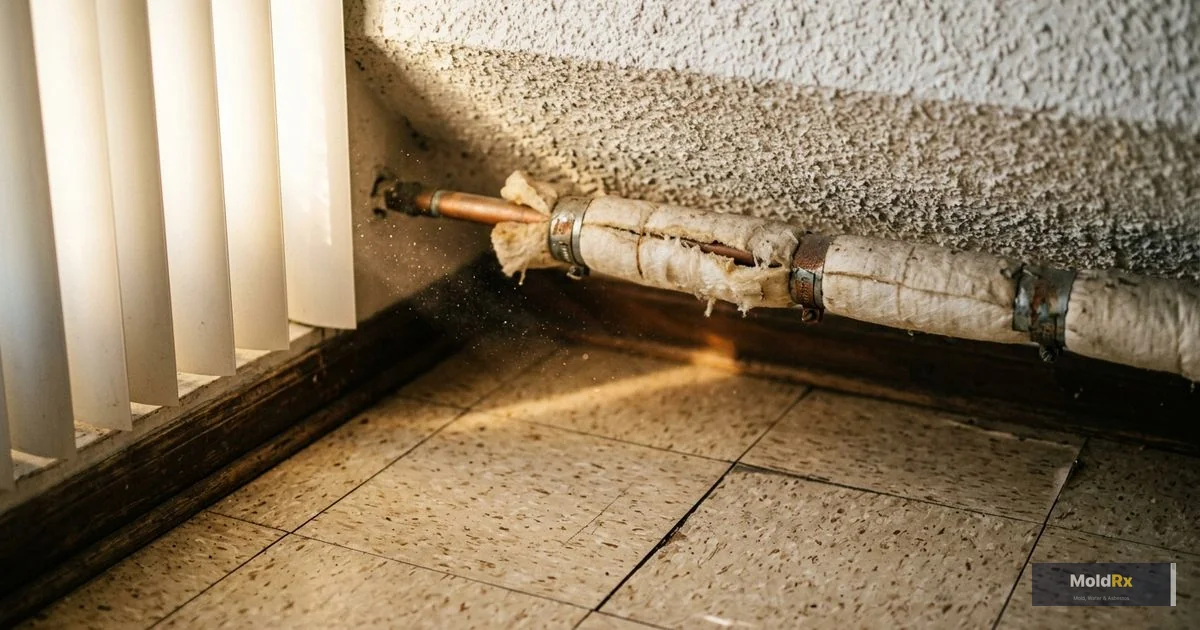
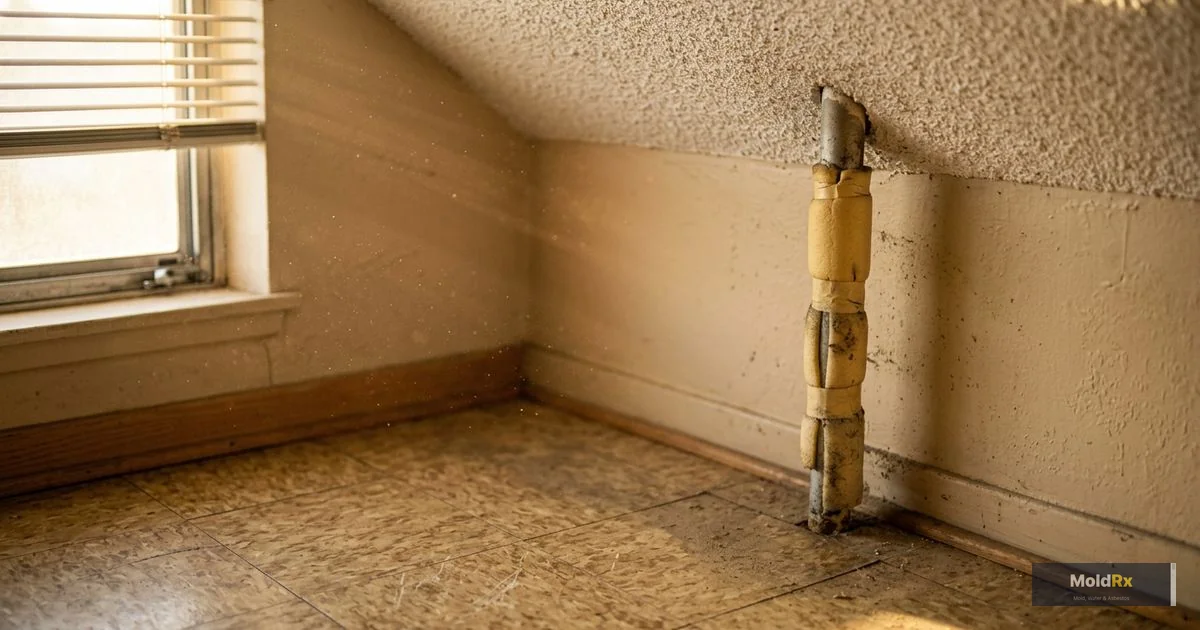
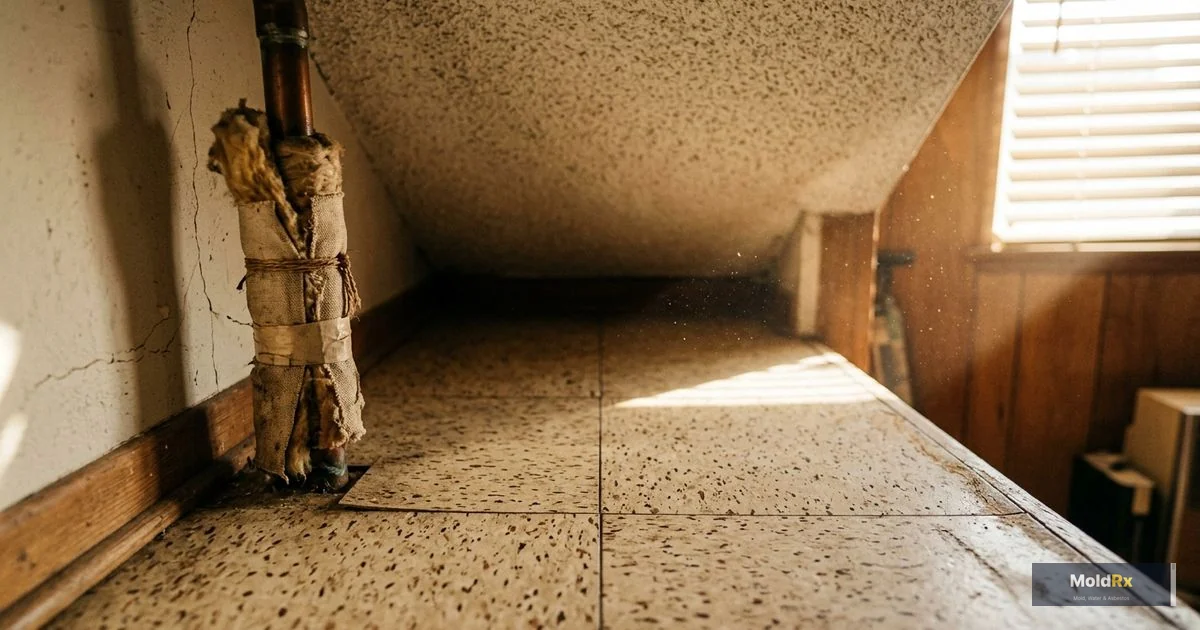
- Pipe insulation — Wrapping on hot water lines, water heater connections, and underfloor plumbing
- Electrical panel components — Arc-resistant boards behind breaker panels were frequently manufactured with asbestos
- Insulation batts and binders — Some fiberglass-like insulation used asbestos binders
Second, the geometry makes contamination faster. In a conventional 1,500-square-foot home, disturbing asbestos-containing material in one room may release fibers primarily into that space. In a mobile home — smaller volume, thinner interior walls, shared ductwork running the length of the unit — fiber release in one area can contaminate the entire living space rapidly.
Third, the threshold for recommending professional removal is lower. Because the consequences of fiber release are more severe in a compact, interconnected unit, materials that might be managed in place in a site-built home may warrant removal in a mobile home, particularly if any renovation or repair work will occur nearby.
Site-Built Homes: The Standard Mid-Century Profile
The remaining roughly 70 percent of Calimesa's housing consists primarily of detached single-family homes constructed between the early 1960s and late 1980s. These properties carry the same asbestos risk profile as comparable construction throughout the western Inland Empire. The materials most commonly found to contain asbestos in testing include:
- Popcorn and textured ceiling coatings — Spray-on acoustic ceiling texture was one of the most widespread residential asbestos applications, used in virtually every tract home built from the late 1950s through the late 1970s. The textured appearance that many Calimesa homeowners recognize overhead may contain 1 to 10 percent chrysotile asbestos
- Vinyl floor tiles and mastic adhesive — Both 9-inch and 12-inch vinyl tiles commonly contained asbestos, as did the black mastic adhesive used to secure them. Many Calimesa homes have had newer flooring installed directly over the original tiles, leaving the asbestos-containing layer undisturbed but present beneath the surface
- Joint compound and wall textures — Drywall taping mud and spray-on or troweled wall textures from this era frequently contained chrysotile asbestos
- Pipe insulation and boiler components — Corrugated wrapping on hot water lines and heating system connections
- Roofing materials — Cement-asbestos shingles, felt underlayment, flashing compounds, and tar-based roofing products
- Vermiculite attic insulation — Loose-fill vermiculite, particularly material sourced from the Libby, Montana mine (marketed as Zonolite), may contain tremolite asbestos. The lightweight, accordion-shaped granules are recognizable on sight in attic spaces
- Cement-asbestos siding — Gray or painted exterior cladding panels common on mid-century California homes
- Duct insulation and duct tape — Both the insulation wrapping forced-air ductwork and the tape at joints may contain asbestos
- Window glazing and caulking — Putty compounds around older windows and caulking at tubs, sinks, and exterior penetrations
Why Calimesa's Geography Accelerates Material Degradation
Calimesa's position at the mouth of the San Gorgonio Pass subjects its buildings to a demanding and unusual climate. Summer temperatures routinely reach the mid-90s and can exceed 105 degrees Fahrenheit. The pass funnels Santa Ana winds through the area with a Venturi effect that amplifies gusts to 45-55 mph on exposed sites, with mountain slopes nearby recording gusts near 60 mph. Winters bring cooler temperatures, occasional frost, and seasonal rains. UV exposure at 2,300 to 3,500 feet of elevation is materially higher than at sea level.
Over five and six decades, this cycle of extreme heat, freeze-thaw, sustained wind loading, and UV bombardment degrades building materials — particularly roofing, siding, insulation, and other exterior-facing components that may contain asbestos. Materials that were stable and intact when installed in 1968 may now be friable (crumbling or easily reduced to powder by hand pressure), which changes their regulatory classification and the urgency of the response.
The thermal cycling also works hard on HVAC systems. Forced-air heating and cooling units in Calimesa homes have likely been serviced, repaired, or replaced multiple times. Each service event on an older system potentially disturbed asbestos-containing duct insulation, furnace components, or pipe wrapping without the homeowner being aware of it.
The Sandalwood Fire: A Specific and Recent Risk Factor
On October 10, 2019, the Sandalwood Fire ignited when a garbage truck dumped a smoldering load near dry brush in Calimesa. The fire raced through the Villa Calimesa Mobile Home Park, destroying 74 structures and killing two residents. The conflagration charred more than 1.5 square miles of land before containment four days later.
That event is directly relevant to asbestos testing for two reasons. First, mobile homes destroyed or damaged in the fire that contained asbestos-bearing materials released those fibers into the surrounding soil and air during the burn. Properties near the fire's path may have residual contamination that was never identified or remediated. Second, homes that sustained heat exposure, smoke infiltration, or firefighting water intrusion without being destroyed may have experienced degradation of asbestos-containing materials that were previously stable. If your Calimesa property was in or near the Sandalwood Fire's footprint, testing is particularly important before any repair, renovation, or sale.
Understanding Asbestos Health Risks
Asbestos-containing materials that are intact, undisturbed, and in good condition generally pose minimal health risk. The fibers are locked within the material matrix — bound into the ceiling texture, the floor tile, the pipe insulation — and cannot become airborne without physical disturbance.
The danger arises when materials are cut, drilled, sanded, scraped, broken, sawed, or allowed to deteriorate to the point where the binding matrix fails. These actions release microscopic fibers into the air. Each asbestos fiber is many times thinner than a human hair. They have no odor, no taste, and are completely invisible without magnification. A person can inhale thousands of fibers without any immediate awareness.
Once inhaled, asbestos fibers lodge permanently in lung tissue and the mesothelial lining of the chest and abdominal cavities. The body cannot break them down or expel them. Over a latency period of 10 to 50 years, embedded fibers cause chronic inflammation, scarring, and cellular damage that can lead to:
- Mesothelioma — An aggressive, almost always fatal cancer of the mesothelial lining, caused almost exclusively by asbestos exposure
- Asbestosis — Progressive, irreversible scarring of lung tissue that reduces breathing capacity over time
- Lung cancer — Risk significantly increased by asbestos exposure, compounded by smoking history
- Pleural thickening and plaques — Permanent structural changes to the lung lining that restrict breathing
The long latency period makes asbestos exposure uniquely insidious. A homeowner who disturbs materials during a weekend renovation project may not develop symptoms for two or three decades. By the time disease presents, the damage is irreversible. Testing before disturbance eliminates this risk entirely.
California's Regulatory Framework for Asbestos
Calimesa property owners operate under overlapping federal, state, and regional regulations. Understanding these is essential for project planning.
Federal: OSHA 1926.1101 and AHERA
OSHA 1926.1101 is the federal asbestos standard for the construction industry. It regulates asbestos exposure during demolition, salvage, removal, encapsulation, renovation, and maintenance of structures containing asbestos. The standard sets a permissible exposure limit (PEL) of 0.1 fibers per cubic centimeter over an eight-hour time-weighted average and an excursion limit of 1.0 f/cc over 30 minutes. It requires building owners to identify the presence, location, and quantity of asbestos-containing materials (ACM) or presumed asbestos-containing materials (PACM) and to notify contractors and employees before work begins.
AHERA — the Asbestos Hazard Emergency Response Act — primarily governs schools and public buildings but established the laboratory accreditation framework (NVLAP) that underpins all credible asbestos analysis nationwide. Under AHERA, laboratories that analyze asbestos samples must hold accreditation through the National Voluntary Laboratory Accreditation Program administered by NIST. This standard applies to the labs that analyze Calimesa residential samples as well.
State: Cal/OSHA Title 8, Section 1529
Cal/OSHA Title 8 Section 1529 is the California asbestos standard for construction. It mirrors the federal OSHA standard but applies California-specific enforcement authority. The regulation requires that asbestos-containing materials be identified through laboratory analysis before any renovation or demolition activity that could disturb them in structures built before 1980. This applies to all property types — site-built homes, mobile homes, and commercial buildings. Cal/OSHA enforcement carries its own penalty structure, and violations can result in stop-work orders, monetary fines, and referral for criminal prosecution.
Regional: SCAQMD Rule 1403
SCAQMD Rule 1403 — Asbestos Emissions from Demolition/Renovation Activities — is the South Coast Air Quality Management District regulation that governs asbestos handling in the air basin that includes Calimesa. Rule 1403 requires:
- An asbestos survey by a certified consultant before any demolition or renovation, regardless of the structure's age
- Written notification to SCAQMD at least 10 working days before demolition of structures 100 square feet or larger
- Specific work practices for the removal and handling of all friable and certain non-friable asbestos-containing materials
- Use of SCAQMD Method 300-91 or EPA-approved analytical methods for sample analysis
Rule 1403 applies to residential single-unit dwellings with limited exceptions for renovations disturbing less than 100 square feet of intact material. For Calimesa's mobile home owners, where a single renovation may disturb materials throughout a compact unit, the 100-square-foot threshold is reached quickly.
Contractor Licensing: CSLB C-22
If asbestos is found and must be removed, California requires that removal be performed by a contractor holding a CSLB C-22 asbestos abatement specialty license. This is a distinct license category from general contracting. An unlicensed contractor performing asbestos removal faces penalties, and a property owner who hires an unlicensed contractor may share liability for any resulting exposure or environmental contamination.
Have questions about your project's regulatory requirements? Request your free estimate or call (888) 609-8907 — we will walk you through what applies to your specific situation.
How MoldRx Asbestos Testing Works in Calimesa
MoldRx only sends vetted asbestos testing specialists to your Calimesa property. Every inspector in our network holds current certifications, follows EPA and Cal/OSHA sampling protocols, and understands the specific material profiles found in both manufactured housing and mid-century site-built homes. Here is the process from first contact through final report.
Step 1: Consultation and Scope Development
Every engagement starts with understanding your situation. We need to know your property type (site-built home, mobile home, or commercial building), its approximate age or construction era, what work you are planning, and whether the property has been affected by events such as the 2019 Sandalwood Fire. For Calimesa's mobile homes, we identify the specific materials most likely to contain asbestos based on the unit's manufacturing date, manufacturer, and construction characteristics. For site-built homes, we focus on the materials typical of the construction era and the scope of your planned project.
This consultation ensures that the sampling plan answers the questions your project raises — no more, no less. A homeowner replacing flooring in a single room of a 1974 singlewide in Las Palomas Estates has different testing requirements than someone planning a full gut renovation of a 1965 ranch home on Singleton Road. We design the scope accordingly.
Step 2: Professional On-Site Sample Collection
Vetted specialists collect physical samples from each suspect material following EPA and Cal/OSHA protocols. Before extracting a sample, the material is wetted to suppress fiber release during collection. A small, representative piece — typically no larger than a quarter — is removed using specialized tools and sealed in a labeled container with full chain-of-custody documentation.
In mobile homes, particular care is taken because of the compact layout and shared air spaces. Sampling locations are selected to represent the full range of suspect materials present, and work areas are isolated as much as the unit's geometry allows.
The number of samples collected depends on the number of distinct homogeneous materials present and the scope of your project. Each homogeneous material — meaning each material that appears consistent in composition and installation throughout a given area — requires its own sample. A typical Calimesa home may require 5 to 15 samples depending on age and complexity. Mobile homes with multiple suspect materials (flooring, ceiling panels, siding, duct wrap, pipe insulation) may require samples from each.
Step 3: NVLAP-Accredited Laboratory Analysis
All samples are submitted to an NVLAP-accredited laboratory — the same accreditation standard established under AHERA and recognized by every California regulatory agency. The primary analytical method is polarized light microscopy (PLM), which definitively identifies asbestos presence, fiber type (chrysotile, amosite, crocidolite, tremolite, actinolite, or anthophyllite), and concentration percentage. PLM results are accepted by Cal/OSHA, SCAQMD, OSHA, and all real estate transaction parties.
When higher analytical sensitivity is required — for example, when materials test negative by PLM but suspicion remains, or when air clearance monitoring is needed after abatement — transmission electron microscopy (TEM) is available. TEM can detect fibers at concentrations below the PLM detection threshold and is the standard for air-quality verification.
Step 4: Detailed Report and Actionable Guidance
Your report is a practical, property-specific document. It identifies each tested material by description and physical location within your property, states whether asbestos was detected, and for positive results specifies the asbestos type and concentration percentage. The report then translates those laboratory findings into actionable guidance tied to your situation:
- Materials that tested negative — Can be disturbed, removed, or renovated without asbestos-specific precautions
- Materials that tested positive but will not be disturbed by your planned project — Can typically remain in place with periodic visual monitoring to ensure they remain in good condition
- Materials that tested positive and will be disturbed by your project — Require professional removal by a California-licensed CSLB C-22 asbestos abatement contractor before your renovation work can proceed
- Materials that are already damaged, friable, or deteriorating — May require prompt attention regardless of your renovation plans, as they could be actively releasing fibers into your living space
The report satisfies all documentation requirements for Cal/OSHA, SCAQMD Rule 1403, OSHA 1926.1101, real estate transactions, lender due diligence, and contractor coordination.
What to Expect During the Testing Process
-
Timeline: On-site sample collection is completed in a single visit, typically lasting one to three hours depending on property size and material complexity. Standard laboratory turnaround is 3 to 5 business days. Rush processing is available for urgent projects, time-sensitive real estate transactions, or active deterioration situations.
-
Minimal disruption: Sampling involves removing small pieces of material and does not require moving furniture, vacating the home, or extensive preparation. For both site-built homes and mobile homes, the process is quick and minimally invasive. You can remain in the home during sampling.
-
Full documentation: Every sample is tracked with chain-of-custody records from collection through NVLAP-accredited laboratory analysis. Reports meet the documentation standards required by California state agencies, SCAQMD, federal OSHA, and all standard real estate and lending parties.
-
Honest guidance: If testing is unnecessary for your situation — because of your home's construction date, the materials present, or the limited scope of your project — we will tell you directly. MoldRx does not recommend testing you do not need.
Common Asbestos Testing Scenarios in Calimesa
Pre-Renovation Testing
This is the most common reason Calimesa homeowners call. You are planning to remodel a kitchen, update a bathroom, replace flooring, remove popcorn ceilings, or open up a wall — and you need to know whether the materials you are about to disturb contain asbestos. In a mobile home, even projects that seem minor (swapping out a section of vinyl flooring, updating ceiling panels, modifying ductwork) can trigger regulatory requirements because the materials involved have a high probability of containing asbestos. Testing identifies exactly what is present and tells you whether your contractor needs special handling procedures, a CSLB C-22 licensed abatement contractor, and SCAQMD notification.
Pre-Purchase Property Inspections
Calimesa's affordable housing prices attract buyers, but a significant percentage of the available inventory predates 1980. Manufactured homes in established parks often sell at price points that make renovation attractive — but the renovation math changes dramatically if asbestos abatement is required. Testing before closing gives you the information needed to negotiate accurately, budget realistically, and avoid surprises after the deed is recorded.
Post-Disaster Assessment
Properties in or near the 2019 Sandalwood Fire footprint may carry residual asbestos contamination from materials released during the fire. Homes that sustained smoke, heat, or water damage during any fire event may have degraded asbestos-containing materials that were previously stable. Testing documents the current condition and determines whether remediation is needed.
Deterioration Concerns
You have noticed crumbling ceiling texture, cracking floor tiles, or deteriorating pipe insulation and want to know whether it contains asbestos before touching it. This is a sound instinct. Visually identifying asbestos is not possible — even experienced inspectors cannot determine asbestos content by appearance alone. Laboratory analysis is the only definitive method.
SCAQMD Compliance Documentation
You need formal documentation for a demolition permit, a renovation permit, or SCAQMD Rule 1403 notification. Our reports are formatted to meet these regulatory requirements and accepted by SCAQMD, Calimesa building officials, and Riverside County permitting agencies.
Calimesa Neighborhoods and Areas We Serve
MoldRx sends vetted asbestos testing specialists throughout the City of Calimesa (ZIP codes 92320 and 92373) and its surrounding unincorporated areas. We serve properties in every neighborhood and mobile home community:
- Calimesa Boulevard corridor — The city's commercial and residential spine, with homes dating to the 1960s and 1970s
- Singleton Road and Avenue L — Residential streets with mid-century ranch homes and scattered newer infill
- San Timoteo Canyon Road — Properties along the canyon that gives the surrounding area its geographic identity
- County Line Road — Homes near the Riverside-San Bernardino county boundary
- Californian Mobile Estates — 55+ community on California Street, approximately 130 sites
- Ponderosa Mobile Estates, Big Oak Gardens, The Colony — Established all-ages and senior parks
- Sharondale — A 55+ community with land-owned manufactured homes
- South Mesa, Las Palomas Estates, Villa Calimesa, Rancho Calimesa — Additional manufactured housing communities throughout the city
- Oak Valley and Summerwind developments — Newer construction (post-2000) that generally falls outside the asbestos risk window, though we test these properties when site conditions or specific materials warrant it
Our service area extends to neighboring communities including Yucaipa to the north, Beaumont and Cherry Valley to the south and east, and Redlands to the west.
Frequently Asked Questions
Should mobile homes in Calimesa be tested for asbestos?
Yes — if the unit was manufactured before 1980, testing is both legally required under Cal/OSHA Title 8 Section 1529 before renovation and strongly advisable for general awareness. Mobile homes from the 1960s and 1970s commonly contained asbestos in flooring, ceiling panels, siding, duct wrapping, pipe insulation, and electrical components. Because of the compact construction and shared air pathways in manufactured homes, fiber release in one area can contaminate the entire unit rapidly. Even projects that seem minor — replacing a section of vinyl flooring, adjusting ductwork, updating a ceiling panel — can disturb asbestos-containing materials.
When is asbestos testing legally required in Calimesa?
Cal/OSHA Title 8 Section 1529 requires testing before renovation or demolition that may disturb materials in structures built before 1980. SCAQMD Rule 1403 extends this requirement to all structures regardless of age before demolition projects and certain renovation activities. OSHA 1926.1101 requires building owners to identify ACM/PACM and notify contractors before work begins. Testing is also strongly recommended before purchasing older properties, when damaged or deteriorating materials are observed, or when homeowners need documented confirmation of their home's condition for insurance, lending, or peace-of-mind purposes.
What analytical methods are used for asbestos testing?
The primary method is polarized light microscopy (PLM), performed at an NVLAP-accredited laboratory. PLM identifies asbestos presence, fiber type, and concentration and is accepted by all California regulatory agencies. When higher sensitivity is needed — particularly for air-quality clearance monitoring after abatement work — transmission electron microscopy (TEM) is used. TEM detects asbestos fibers at concentrations below the PLM detection limit.
What makes mobile home asbestos testing different from site-built home testing?
Three factors distinguish the work. First, the materials are different — manufactured housing used lightweight ceiling panels, cement-asbestos siding, and specific flooring products that require familiarity with manufactured housing construction. Second, the compact geometry means fiber release spreads faster, so sampling and containment protocols must account for shared ductwork and thin interior walls. Third, the response threshold is often lower — materials that might be safely managed in place in a 2,000-square-foot house may warrant removal in a 900-square-foot mobile home where occupants are in constant proximity. Our vetted specialists have direct experience with both property types.
What happens if asbestos is found?
The response depends on the material's condition, location, and your project plans. Intact materials that will not be disturbed can typically be managed in place with periodic monitoring. Materials that must be disturbed by your planned renovation require removal by a CSLB C-22 licensed asbestos abatement contractor before other work begins. Materials that are already friable, damaged, or actively deteriorating should be evaluated promptly. Your report will include material-specific guidance for every positive result, including regulatory requirements for notification, handling, and disposal.
How does the 2019 Sandalwood Fire affect asbestos risk in Calimesa?
The Sandalwood Fire destroyed 74 structures — primarily mobile homes in the Villa Calimesa park — and exposed surrounding properties to intense heat, smoke, and firefighting water. Mobile homes that contained asbestos-bearing materials released those fibers during the fire. Properties near the fire's path may carry residual soil or structural contamination. Homes that sustained heat or smoke damage without being destroyed may have degraded asbestos-containing materials that were previously stable and intact. If your property is in or near the Sandalwood Fire footprint, testing before any work is especially important.
Can I collect asbestos samples myself?
California does not prohibit homeowners from collecting their own samples, but it is not recommended. Improper sampling can release fibers into your living space, contaminate areas that were previously safe, and produce non-representative samples that lead to inaccurate results. Professional sampling uses wet methods, specialized extraction tools, and containment procedures specifically designed to prevent fiber release. The difference in cost between DIY collection and professional sampling is modest compared to the risk of improper handling — and only professionally collected, laboratory-analyzed results satisfy SCAQMD Rule 1403 and Cal/OSHA documentation requirements.
Does asbestos testing damage my property?
No. Sampling involves removing very small pieces of material — typically the size of a quarter or smaller. Sampling sites are patched or sealed after collection. In most cases the sampling locations are not visible once the process is complete. There is no need to move furniture, remove personal belongings, or vacate the home during testing.
How long does the full process take?
On-site sample collection typically takes one to three hours depending on property size and the number of materials being sampled. Mobile home inspections generally fall on the shorter end of that range. Standard laboratory turnaround is 3 to 5 business days, with rush processing available for time-sensitive situations. From initial contact to final report delivery, most Calimesa projects are completed within one week.
Related Services in Calimesa
In addition to asbestos testing, MoldRx also sends vetted specialists for Mold Removal in Calimesa, Asbestos Removal in Calimesa, Water Damage Restoration in Calimesa, and Mold Testing in Calimesa.
Learn more about remediation services in Calimesa
Schedule Asbestos Testing for Your Calimesa Property
Calimesa's combination of mid-century site-built homes and one of the Inland Empire's highest concentrations of pre-1980 manufactured housing creates a community where asbestos risk is both widespread and varied. The 2019 Sandalwood Fire added a layer of complexity that other cities do not carry. Whether you own a 1960s ranch home along the Calimesa Boulevard corridor, a manufactured home in one of the city's established parks, or a commercial property near the I-10 interchange, laboratory-confirmed knowledge of what is in your building is the foundation for safe renovation, compliant demolition, informed property transactions, and responsible long-term property management.
MoldRx only sends vetted asbestos testing specialists who understand the specific materials and construction patterns found in Calimesa's diverse housing stock. They know what to look for in a 1970s singlewide and what to look for in a 1965 stucco ranch, and they will tell you clearly what the results mean and what your options are — including when the answer is that testing is not necessary for your situation.
Request your free estimate or call (888) 609-8907 to schedule asbestos testing for your Calimesa property.