Asbestos Testing in Buena Park, CA — MoldRx
Licensed Asbestos Testing Professionals Serving Buena Park and North Orange County
Planning a kitchen remodel in a Bellehurst ranch home, updating bathrooms in a 1960s property near Beach Boulevard, or replacing the roof on a Los Coyotes neighborhood residence? Before any of that work begins, you need laboratory confirmation of what is inside your walls, ceilings, and floors. Buena Park is one of North Orange County's quintessential postwar suburbs — incorporated in 1953 and built out almost entirely during the peak decades of asbestos use in American construction. The city's median home construction year is 1966, which means roughly half of Buena Park's nearly 25,000 housing units were built before that date, and a substantial majority predate the late-1970s regulatory restrictions on asbestos. The mineral is invisible to the naked eye, impossible to identify without lab analysis, and hazardous only when disturbed — which is precisely what renovation does. SCAQMD Rule 1403 requires testing before disturbing building materials in pre-1980 structures and extends the survey requirement to structures of any age before demolition. MoldRx only sends vetted asbestos testing professionals who understand the construction patterns across Buena Park and North Orange County.
Request your free consultation — we'll help you determine if testing is needed for your project.
Why Buena Park Properties Carry Asbestos Risk
Buena Park went from agricultural flatland to fully developed suburb in roughly two decades — and those two decades coincided almost perfectly with the era when asbestos was a standard ingredient in American building materials. That timing creates one of the highest concentrations of asbestos-era housing in Orange County.
A Postwar Suburb Built During the Asbestos Era
The area that became Buena Park began as farmland settled in the late 1800s, but the city's residential transformation started after World War II. When Buena Park incorporated on January 27, 1953, the landscape was still dotted with dairy farms. What changed everything was the Southern California postwar boom — returning veterans, FHA-backed mortgages, freeway expansion, and the magnetic pull of aerospace and entertainment industries.
Knott's Berry Farm, which had evolved from the Knott family's roadside berry stand in the 1920s into a full-scale attraction by the 1950s, anchored the city's identity. As Orange County's population exploded through the 1950s and 1960s, Buena Park filled in rapidly with tract housing, commercial corridors along Beach Boulevard and La Palma Avenue, and the infrastructure of a complete suburban community.
By 1970, the city was largely built out. Census data confirms that approximately 58 percent of Buena Park's housing stock dates to the 1940s through 1960s — the core decades of asbestos use. Another roughly 32 percent was constructed between 1970 and 1999, with the earlier portion still falling within the asbestos era. The vast majority of residential properties were built when chrysotile asbestos was mixed into floor tiles, ceiling texture, joint compound, pipe insulation, roofing felt, and cement siding as standard practice.
The EPA began regulating asbestos in spray-applied products in 1978, but existing inventory continued to be installed into the early 1980s. For a city where the median home was built in 1966, this is not an abstract historical footnote — it is a present-day reality that affects nearly every renovation project.
Climate, Material Preservation, and the Hidden Problem
Buena Park's semi-arid Mediterranean climate — warm, dry summers averaging around 85 degrees and mild winters with roughly 13 inches of annual rainfall — preserves asbestos-containing materials rather than accelerating their breakdown. Interior building materials in Buena Park homes can remain physically intact for decades. A popcorn ceiling sprayed in 1964 can look essentially the same in 2026.
That preservation is a double-edged sword. Well-preserved materials still contain asbestos at the same concentrations as the day they were installed. When a homeowner scrapes a decades-old textured ceiling that appears "perfectly fine," they release microscopic fibers into the air. Dry Southern California air keeps those fibers suspended longer than humid environments would. Inside an enclosed room during renovation, that combination is dangerous.
The issue is compounded by Buena Park's housing turnover. As the city's original generation of homeowners ages out and newer buyers acquire mid-century properties, renovations are constant. Kitchens and bathrooms from the 1960s are being gutted. Popcorn ceilings are being scraped. Original flooring is coming up. With median property values above $770,000 and median household income exceeding $108,000, homeowners are investing heavily in modernization — and every one of these projects has the potential to disturb asbestos-containing materials. The cost of testing is negligible compared to the value of the property — and negligible compared to the consequences of discovering asbestos mid-project, which stops all work until licensed abatement is complete.
When Asbestos Testing Is Necessary in Buena Park
Not every project requires asbestos testing, but more situations call for it than most homeowners expect.
Before Any Renovation or Demolition (California Law)
SCAQMD Rule 1403 requires an asbestos survey before renovation or demolition — residential and commercial, regardless of building age. A certified consultant must complete the survey before the City of Buena Park or Orange County will issue a permit. The only narrow exception is single-unit dwelling renovation disturbing less than 100 square feet of intact material. Kitchen tearouts, flooring replacement, popcorn ceiling removal, bathroom remodels, roof replacements — all require testing first. Non-compliance fines can exceed $20,000 per day, and the South Coast AQMD actively enforces in Orange County.
When Buying or Selling a Property
California disclosure laws require sellers to report known hazards. A pre-purchase asbestos test gives buyers a clear picture of what they are acquiring and what renovation costs will look like after closing. In Buena Park — where mid-century tract homes represent the majority of real estate inventory and where many buyers plan updates immediately after purchase — this information directly affects negotiations and budgeting. For properties changing hands at current Buena Park price points, the cost of testing is a small fraction of the transaction value.
When Materials Are Visibly Damaged or Deteriorating
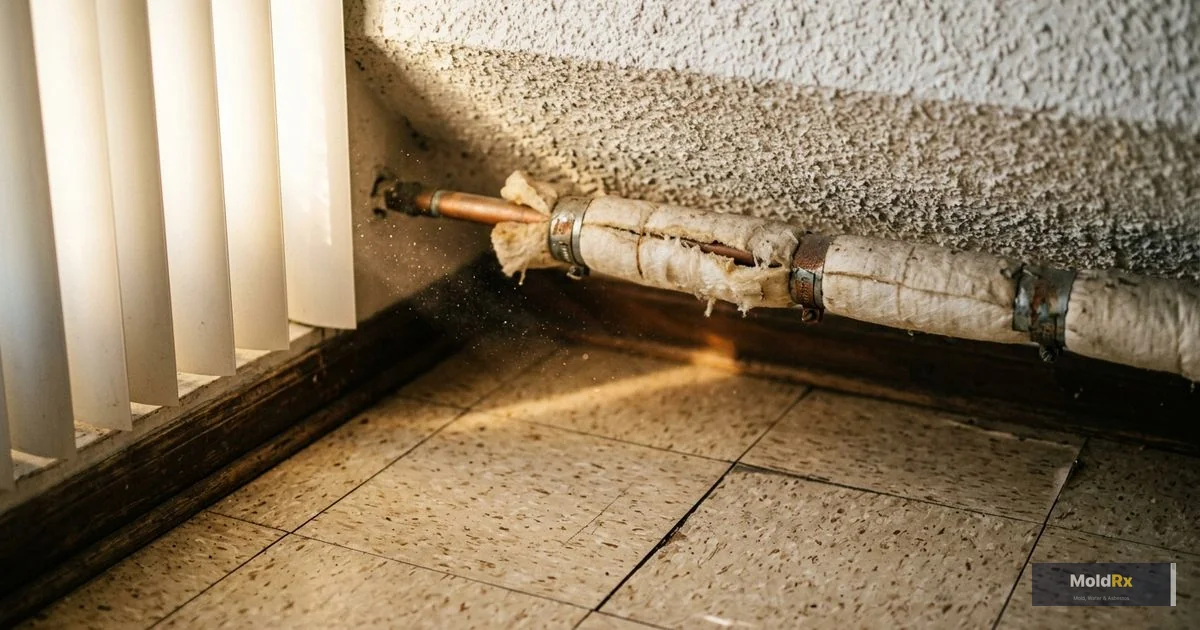
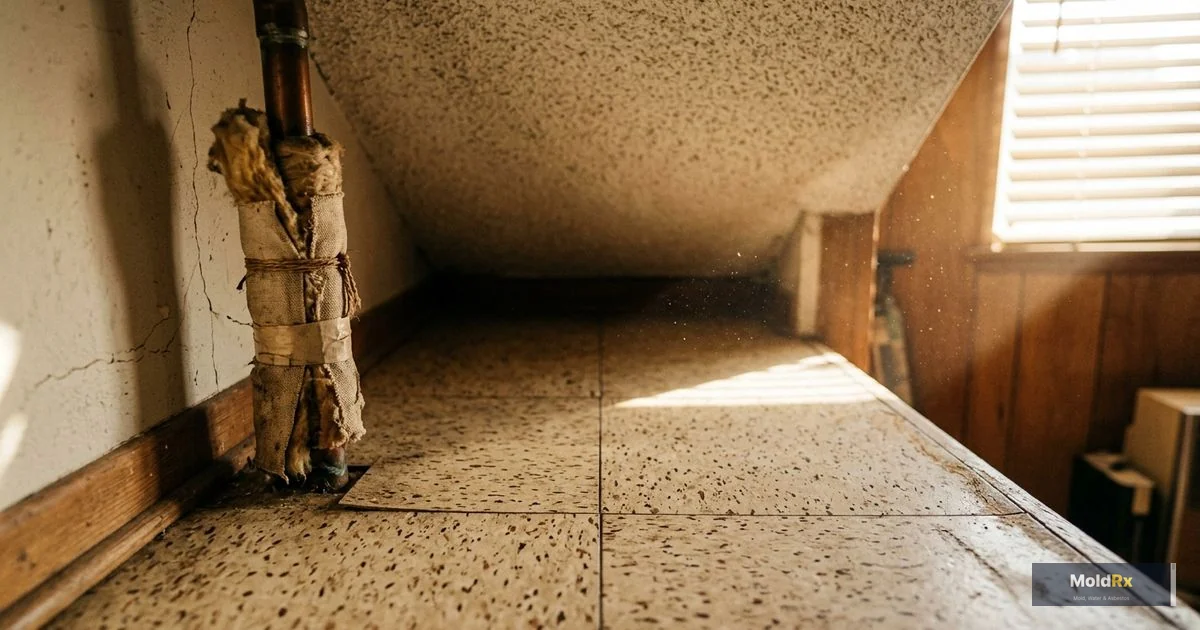
Crumbling pipe insulation in a garage, flaking ceiling texture, cracked floor tiles lifting at the edges — if materials in a pre-1980 Buena Park home show visible deterioration, the risk of fiber release increases substantially. Damaged ACM (asbestos-containing material) can release fibers during normal daily activity without anyone swinging a hammer. Testing identifies whether the damaged material contains asbestos so you can make informed decisions about repair, encapsulation, or removal.
When Converting or Adding Living Space
Garage conversions, ADU construction, and room additions frequently disturb original building materials — garage drywall, attic insulation, exterior siding, roofing — that may contain asbestos. Testing before construction planning prevents costly mid-project surprises.
Common Asbestos-Containing Materials in Buena Park Homes
Buena Park's housing spans a concentrated construction era, and the materials used during that period were remarkably consistent across the tract developments that define the city.
Floor Tiles and Mastic (9"x9" Vinyl)
Manufactured from the 1950s through the early 1980s, 9"x9" vinyl floor tiles contained 5% to 70% chrysotile asbestos. The black cutback adhesive (mastic) beneath them frequently contains asbestos as well. In Buena Park homes, these tiles are commonly hidden beneath newer flooring layers installed during previous renovations. Intact tiles are low-risk, but sanding, scraping, or breaking them during removal releases fibers.
Popcorn and Textured Ceilings
Spray-applied textured ceilings were standard from the mid-1960s through 1980 — the majority of Buena Park's construction window. These ceilings frequently contain chrysotile asbestos. The EPA banned asbestos in spray-applied surfacing in 1978, but existing stock continued to be applied into the early 1980s. Scraping textured ceilings without testing is one of the most common sources of residential asbestos exposure — and one of the most avoidable.
Pipe and Duct Insulation
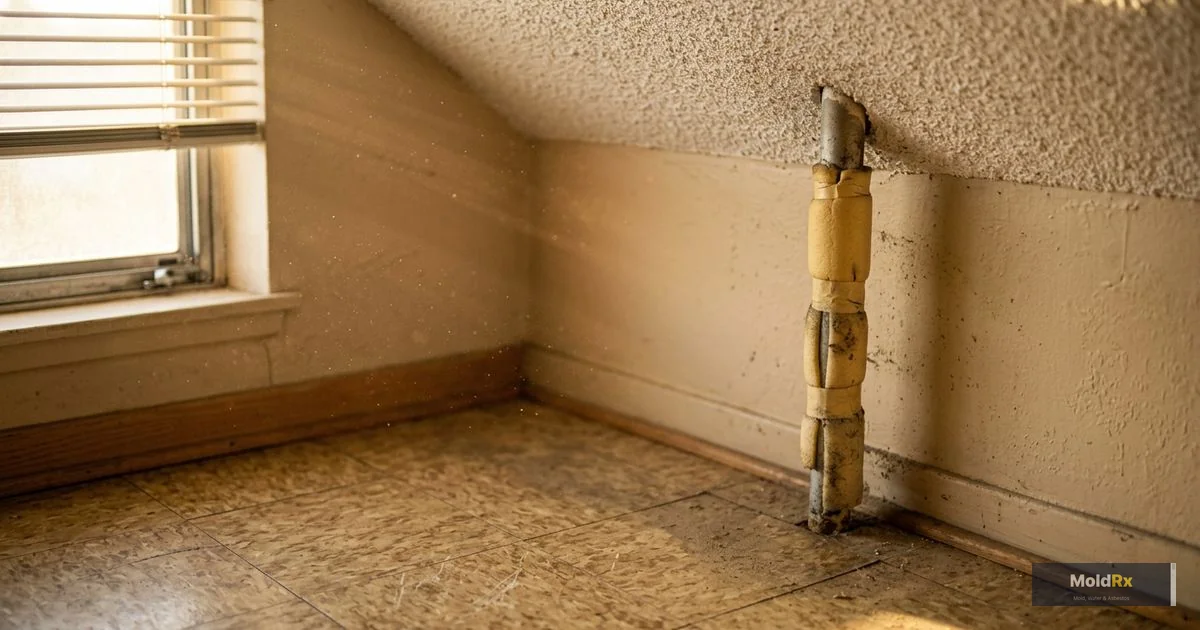
Corrugated paper wrap, calcium-silicate blocks, and air-cell insulation on heating and cooling system components in pre-1980 homes commonly contain asbestos. In Buena Park, where air conditioning runs for much of the year against summer temperatures in the mid-80s, ductwork insulation and pipe wrapping were standard installations. These materials are often in the worst condition because they sit in garages, mechanical closets, and attic spaces where temperatures fluctuate and maintenance attention is minimal.
Roofing Materials and Siding
Asbestos-cement roofing shingles, roofing felt, and siding panels were widely used in California construction through the 1970s. Dense and weather-resistant, they performed well in the Southern California climate and can remain on a home for decades — which means they are still present on many older Buena Park properties. These materials are low-risk while intact but become a testing and abatement concern at roof replacement time.
Joint Compound, Plaster, and Caulking
Drywall joint compound manufactured before 1980 frequently contained asbestos for workability and crack resistance. Plaster and caulking from this era also tested positive at high rates. Because joint compound is applied at every seam and screw hole, even a small remodel can disturb a surprising quantity of material.
Vermiculite Attic Insulation
A significant portion of vermiculite insulation sold in the United States came from the Libby, Montana mine, contaminated with tremolite asbestos. It appears as small, accordion-shaped granules in attic spaces. The EPA recommends treating all vermiculite insulation as potentially contaminated until tested. During the 1970s energy crisis, vermiculite was a popular attic retrofit, and Buena Park homes from this period may contain it.
How Asbestos Testing Works
Understanding the process helps you plan your project timeline and know what to expect at each stage.
1. Pre-Testing Consultation
Testing begins with a conversation about your property and your project — when the home was built, what materials you plan to disturb, and whether you have noticed any damage or deterioration. This information determines which areas need sampling and how many samples are required. For a straightforward renovation in a Buena Park home, the inspector can usually scope the work during a brief phone consultation.
2. Bulk Sample Collection
A certified inspector collects bulk samples following EPA procedures. Each suspected material is sampled separately — the inspector wets the material to suppress fiber release, removes a small section, and seals it in a labeled container. Homogeneous materials like floor tiles require a minimum of three samples per distinct area. The process is minimally invasive, and each collection point is sealed after sampling.
3. NVLAP-Accredited Laboratory Analysis
Samples go to an NVLAP-accredited laboratory. The primary method is PLM (Polarized Light Microscopy), which identifies asbestos fiber type and estimates concentration above approximately 1%. When PLM results are negative but low-level asbestos is suspected, TEM (Transmission Electron Microscopy) provides higher sensitivity. Standard turnaround is 3 to 5 business days; rush service (24 to 48 hours) is available.
4. Results Interpretation and Recommendations
You receive a written report identifying each material sampled, whether asbestos was detected, the fiber type (chrysotile, amosite, crocidolite, or others), and the estimated concentration. We walk you through what each result means for your specific project: which materials require licensed abatement before renovation can proceed, which can be safely managed in place, and which areas are clear for standard construction work.
What Happens If Asbestos Is Found?
A positive test result does not automatically mean your home is dangerous or that expensive removal is your only option. The appropriate response depends on the condition of the material, your project scope, and applicable regulations.
When Removal Is Required
Removal is required when your renovation will physically disturb ACM — tearing out positive-testing flooring, removing a wall with ACM joint compound, or scraping an asbestos-containing ceiling. SCAQMD Rule 1403 requires notification at least 10 working days before removal begins, and all abatement must be performed by a DOSH-registered contractor.
When Encapsulation May Be an Option
Encapsulation applies a sealant over intact ACM to prevent fiber release without physical removal. It is appropriate for materials in good condition that will remain in place — intact floor tiles being covered with new flooring rather than torn out, or siding on a wall outside the renovation area. For Buena Park homeowners undertaking partial renovations, encapsulation can be a practical solution for materials outside the renovation footprint.
When Leaving It Undisturbed Is Acceptable
If ACM is in good condition and will not be disturbed, leaving it in place is often the safest and most cost-effective option. Intact asbestos materials do not release fibers. Many Buena Park homeowners discover asbestos during testing for one project and manage materials in unaffected areas rather than removing everything at once — a practical strategy that is both safe and sensible.
Buena Park Asbestos Risk by Construction Era
Buena Park's development happened in a compressed timeline — most of the city was built within a 20-year window. But even within that span, different decades brought different material profiles. Knowing when your home was built helps set expectations before testing.
Pre-1953 (Agricultural Era): A small number of homes predate Buena Park's incorporation. These earliest structures may contain asbestos in nearly every material category, and six-plus decades of aging mean materials in unconditioned spaces have likely deteriorated. Testing is essential before any work.
1953-1965 (The Postwar Boom): Buena Park transformed from farmland to suburb. Thousands of tract homes went up in developments like Bellehurst. Construction used asbestos extensively — floor tiles, pipe insulation, textured ceilings, roofing felt, joint compound, and siding. These homes are now 60 to 73 years old, and materials in garages and attics may have deteriorated. Testing is essential before any renovation.
1965-1979 (Continued Build-Out and Peak Asbestos): Buena Park approached full build-out by the late 1960s. Popcorn ceilings, vinyl floor tiles, and pipe insulation from this era are among the most commonly tested materials. The late 1970s represent a regulatory transition — the EPA began restricting asbestos, but products already in the supply chain continued to be installed. Testing is essential for any renovation.
1980-1999 (Infill and Redevelopment): Roughly 32 percent of Buena Park's housing dates to this broader period. Early 1980s homes may still contain ACM from existing product inventory. Later construction carries lower risk but is not zero-risk. Testing is recommended before interior renovation.
2000-Present (Modern Construction): A small percentage of Buena Park's housing is newer infill and multi-family development. Minimal asbestos risk from building materials, but SCAQMD Rule 1403 still requires a survey before demolition regardless of building age.
What Sets MoldRx Apart
- Honest assessment. If testing is not necessary for your project, we will tell you. We have no financial incentive to recommend testing or abatement you do not need.
- NVLAP-accredited lab partners. Every sample is analyzed by a nationally accredited laboratory using PLM and, when warranted, TEM methods that meet EPA and Cal/OSHA standards.
- Clear, actionable results. No jargon-filled reports that leave you guessing. Plain language, specific recommendations, and a clear path forward for your Buena Park project.
- Family-owned accountability. We only send vetted asbestos testing professionals we stand behind. No subcontractor roulette — the people who show up are the people we trust with our own homes.
Get your free consultation — no obligations.
Buena Park Neighborhoods and Communities We Serve
Our asbestos testing services cover all residential and commercial properties in Buena Park, including:
- Bellehurst — One of Buena Park's most established neighborhoods, known for wide lots, tree-lined streets, and single-story ranch homes from the 1950s and 1960s. Homes here are squarely in the peak asbestos era and should be tested before any renovation.
- Los Coyotes — The area surrounding Los Coyotes Country Club, established in 1957, features larger homes and a mix of mid-century and later construction. Properties from the earliest decades carry the highest asbestos risk, though even partially updated homes may contain ACM in untouched areas.
- Buena Park Estates — Properties date primarily to the 1960s build-out period. Standard tract construction materials of the era — popcorn ceilings, vinyl tile, pipe insulation — warrant testing before renovation.
- North Buena Park — North of the 91 Freeway, a mix of residential and commercial properties. Homes and commercial spaces from the 1950s and 1960s should be tested before interior work.
- South Buena Park — South of the 91, neighborhoods near Knott's Berry Farm include some of the city's original postwar housing. Construction-era materials are likely present in homes that have not undergone previous abatement.
- Beach Boulevard Corridor — Commercial and mixed-use properties along Buena Park's primary artery span multiple decades. Older retail and office spaces warrant testing before tenant improvement or renovation work.
- Western Avenue Corridor — Residential properties near Western Avenue include 1960s and 1970s homes that are common candidates for modernization. Testing before renovation is strongly recommended.
We serve all Buena Park ZIP codes: 90620, 90621, and 90624.
Nearby Communities
We also serve neighboring North Orange County communities including Fullerton, Anaheim, Cypress, La Palma, Stanton, Cerritos, La Mirada, and Placentia.
Related Services in Buena Park
-> All services
Frequently Asked Questions
Is asbestos testing required before renovation in Buena Park?
Yes. SCAQMD Rule 1403 requires an asbestos survey before renovation or demolition in the South Coast Air Quality Management District, which includes all of Buena Park and Orange County. The survey must be performed by a certified consultant. The only exception is single-unit dwelling renovation involving less than 100 square feet of intact material. Most residential projects — kitchens, bathrooms, flooring, ceilings, roof replacements — exceed that threshold and require testing.
How many samples need to be collected?
EPA procedures require a minimum of three samples per homogeneous material in each distinct area. A typical Buena Park home remodel might need 8 to 15 samples across ceiling texture, floor tile, mastic, joint compound, and insulation. Larger whole-house renovations may require more. Your inspector determines the exact number based on your property and project scope.
How long do asbestos test results take?
Standard PLM analysis takes 3 to 5 business days. Rush service is available with turnaround as fast as 24 hours. TEM analysis, if needed, typically requires 5 to 7 business days. Your inspector can advise on which turnaround option fits your schedule.
Can I collect asbestos samples myself?
California does not prohibit homeowners from collecting samples in their own single-family home, but the practice is strongly discouraged. Improper technique can release fibers — the very hazard you are trying to assess. Samples collected by uncertified individuals may not be accepted for permits, SCAQMD notification, or real estate transactions. Use a certified inspector.
What does a positive asbestos test mean for my renovation?
A positive result means asbestos fibers were detected in the sampled material. Any material exceeding 1% asbestos is classified as ACM under federal and California regulations. A positive result does not mean immediate danger — intact, undisturbed ACM does not release fibers. But if your renovation will disturb that material, licensed abatement must be performed before construction work can proceed in that area.
Do all pre-1980 Buena Park homes contain asbestos?
No, but the probability is high enough that testing is the only responsible approach. Industry data suggests 80% or more of pre-1980 buildings contain at least one ACM. Some homes may have had asbestos removed during previous renovations; others were built with non-asbestos alternatives. Laboratory testing is the only way to know what your specific home contains.
My home was built after 1980 — do I still need testing?
SCAQMD Rule 1403 requires a survey before demolition regardless of building age. For renovation, asbestos risk is lower in post-1980 homes but not zero — roofing materials, gaskets, and imported floor tiles contained asbestos well after initial EPA bans. Early 1980s homes may still contain ACM from existing product inventory. Your inspector can assess whether testing is warranted.
Will my contractor handle asbestos testing?
Some contractors coordinate testing as part of pre-construction planning, but many do not. Cal/OSHA requires contractors to determine whether asbestos is present before work begins, but does not specify who performs the testing. Getting testing done independently is the most reliable approach — if asbestos is discovered mid-project, all work stops until abatement is complete.
I'm converting my garage to an ADU — does that require testing?
If the garage was built before 1980, yes. Garage conversions disturb drywall, insulation, roofing, and sometimes flooring that may contain asbestos. Joint compound, roofing felt, and pipe insulation wrap can all contain asbestos even in simple structures. Given that most Buena Park garages were built in the 1950s and 1960s, testing before conversion is the standard practice.
Get Asbestos Testing in Buena Park
Whether your home is a 1958 original near Knott's Berry Farm, a 1960s tract in Buena Park Estates, or a 1970s property near Los Coyotes, the process is straightforward and the results are definitive. In a city where the median home was built in 1966 — squarely in the peak asbestos construction era — testing is not an obstacle to your renovation. It is the first step in doing it right. A few days of testing and a few hundred dollars in lab fees protect your health, your property value, and your project timeline.
Call MoldRx to schedule your asbestos test — (888) 609-8907. Know before you start.