Mold Removal in Blythe, CA — MoldRx
IICRC-Certified Mold Removal Professionals Serving Blythe and the Palo Verde Valley
Blythe sits at 267 feet in the Palo Verde Valley, surrounded by irrigated farmland and the Colorado River, where summer temperatures routinely exceed 110 degrees and rainfall barely reaches five inches a year. On the surface, mold seems impossible here. Beneath the surface is a different story. The Palo Verde Irrigation District pushes Colorado River water through a canal network that saturates the soil under and around thousands of valley structures. Swamp coolers load indoor air with moisture from May through October. And a housing stock built largely in the 1960s through 1980s was never engineered for the moisture management these conditions demand. When Blythe homeowners finally notice mold, it has usually been growing behind walls for months. MoldRx only sends vetted, IICRC-certified mold removal professionals who follow IICRC S520/R520 remediation standards and EPA federal mold guidance — specialists who work Blythe and the Palo Verde Valley every week.
Request your free estimate — we'll assess your property and give you straight answers.
Why Mold Grows in Blythe Homes
Blythe is a city of approximately 17,800 residents in eastern Riverside County, California, positioned along the Colorado River at the junction of Interstate 10 and Highway 95. At just 267 feet above sea level, it occupies one of the lowest, hottest valleys in the state. Annual precipitation averages a mere 4.6 inches, yet professional remediators working in Blythe encounter active mold colonies with striking regularity. The reason lies in three moisture sources that are woven into daily life in the Palo Verde Valley.
Agricultural Irrigation and Subsurface Moisture
Blythe is the hub of the Palo Verde Valley — roughly 100,000 acres of irrigated farmland served by the Palo Verde Irrigation District, which holds the most senior Colorado River water rights in California. The canal and lateral system that delivers water to fields also raises the water table across the valley floor. Homes built near irrigation canals, on former agricultural parcels, or in low-lying areas of town often sit above soil that stays perpetually damp. That moisture migrates upward through concrete slab foundations by capillary action, wetting the bottom edges of drywall and the underside of flooring. The EPA recommends maintaining indoor humidity between 30 and 50 percent, but properties with subsurface moisture sources can exceed that range at floor level without visible signs. Once materials stay damp, mold colonizes within 24 to 48 hours — a timeline documented in both the IICRC S520 Standard and EPA publication 402-K-01-001 on mold remediation.
Swamp Coolers and Condensation Cycles
The majority of Blythe homes rely on evaporative coolers to manage summer heat that regularly exceeds 110 degrees. These systems cool by saturating air with water vapor, introducing several gallons of moisture into the indoor environment each day. At night, when exterior temperatures can drop 30 to 40 degrees from the daytime peak, warm moist indoor air contacts cooler wall and window surfaces and condenses. This daily condensation cycle — repeated for five to six months of the cooling season — steadily wets drywall, window framing, and wall cavities in a pattern that feeds mold growth without leaving obvious water stains. Older homes with single-pane windows and minimal insulation are especially vulnerable.
Aging Housing Stock
Homes in Blythe were built primarily in the 1960s and 1980s, with a median property value of approximately $204,000. Many of these structures still have original galvanized plumbing, which develops internal corrosion and pinhole leaks after decades of use. Ductwork installed during initial construction degrades in sustained triple-digit heat, creating gaps where condensation collects. Slab-on-grade foundations common in Blythe lack the moisture barriers that modern building codes require. Mobile homes and manufactured housing — a notable portion of the local housing stock — are particularly susceptible to undercarriage moisture buildup and subfloor mold when skirting traps humidity against the structure.
Monsoon Storms and Sudden Flooding
Between July and September, the North American Monsoon pushes moisture from the Gulf of California into the Palo Verde Valley. These storms produce intense, short-duration rainfall that overwhelms the valley's flat terrain and limited drainage infrastructure. Water pools against foundations, enters through aging window seals, and saturates crawl spaces. Because post-storm daytime temperatures immediately return to extreme heat, any water that enters a structure creates a high-temperature, high-humidity environment inside wall cavities — the exact conditions under which mold proliferates fastest.
Signs You Need Professional Mold Removal
Blythe's extreme heat makes mold feel unlikely, but the combination of irrigation moisture, swamp coolers, and aging housing creates conditions where mold grows hidden for months. These indicators tell you when professional assessment is warranted.
Visible Growth Beyond a Small Area
The EPA's publication 402-K-01-001 uses ten square feet as the threshold above which professional remediation is recommended. In Blythe homes, visible colonies most commonly appear along slab-to-drywall transitions where irrigation-saturated soil pushes moisture upward, inside swamp cooler housings and ductwork, behind bathroom tile on deteriorated shower pans, and on subfloor materials in manufactured homes where skirting has trapped humidity. If growth covers more than roughly a three-by-three-foot patch, or appears in multiple locations, professional containment and removal are appropriate.
Persistent Musty Odor Without Visible Mold
A persistent musty or earthy smell without an obvious source typically means mold is growing in a concealed location. In Blythe, the most common hidden sites are wall cavities at floor level where capillary moisture from the high water table wets drywall, the interior of swamp cooler supply plenums and ductwork, beneath manufactured home subfloors where skirting traps moisture against the undercarriage, and inside HVAC systems where daily condensation cycles from extreme temperature swings feed hidden growth. If the odor is strongest at floor level or intensifies when the swamp cooler runs, concealed mold is a strong possibility.
Recurring Mold After Previous Cleanup
If mold returns after you have already cleaned an area, the moisture source has not been corrected. In Blythe, this frequently means the elevated water table is still wicking moisture through the slab, a corroded galvanized supply line is still leaking behind a wall, or daily condensation cycles from the swamp cooler are still wetting the same surfaces. Recurring mold in the same location requires professional moisture mapping and source correction — not another round of surface treatment.
Water Damage History
The IICRC S520 standard and EPA guidance both document that mold colonizes damp materials within 24 to 48 hours of water exposure. Blythe properties that have experienced monsoon flooding, a plumbing failure in triple-digit heat, irrigation canal overflow, or any extended water intrusion should be evaluated even if surfaces appear dry. In Blythe's extreme heat, water that enters wall cavities or saturates subfloor materials creates an incubator for rapid mold colonization that may not be visible for weeks.
Health Symptoms That Worsen Indoors
The CDC notes that mold exposure can cause nasal stuffiness, throat irritation, coughing, wheezing, eye irritation, and skin irritation in sensitive individuals. If household members experience respiratory symptoms, allergy-like reactions, or headaches that improve when they leave the home and return when they come back, indoor mold is a reasonable possibility to investigate — particularly in Blythe homes where hidden slab moisture and swamp cooler condensation can sustain colonies that produce spores continuously without visible signs.
Health Risks of Mold Exposure
Mold produces allergens, irritants, and in some species mycotoxins that affect indoor air quality. The EPA, CDC, and WHO Guidelines for Indoor Air Quality: Dampness and Mould all document that prolonged exposure to elevated indoor mold levels is associated with respiratory symptoms, allergic reactions, and aggravation of existing conditions such as asthma. The health impact depends on the species present, the extent of colonization, the duration of exposure, and individual susceptibility.
This is not cause for alarm — mold exists in every outdoor environment, and brief exposure to normal background levels is unavoidable. The concern arises when indoor colonies reach concentrations significantly above normal outdoor baselines, which is what happens when mold establishes behind a wall, inside ductwork, or beneath flooring and releases spores into the living space continuously.
Populations at Higher Risk
Certain groups are more vulnerable to the effects of mold exposure:
- Children — Blythe has a younger-than-average population, with a significant proportion of families with school-age children. Developing respiratory systems are more susceptible to irritants, and the WHO specifically identifies children as a priority population in its dampness and mold guidelines.
- Adults with asthma or allergies — Mold is a documented asthma trigger. The CDC reports that mold exposure can cause asthma attacks in individuals with the condition and may contribute to asthma development in some children.
- Elderly residents — Age-related changes in immune function and respiratory capacity increase sensitivity to airborne mold spores, particularly relevant for Blythe's retirement-age residents.
- Immunocompromised individuals — People undergoing chemotherapy, organ transplant recipients, and those with chronic immune conditions face elevated risk from certain mold species, particularly Aspergillus.
The goal of professional remediation is to return indoor fungal ecology to normal background levels — what the IICRC S520 standard defines as Condition 1. That is a factual, measurable outcome, not a marketing claim.
When DIY Mold Removal Isn't Enough
The EPA's guidance on mold cleanup allows homeowners to address small areas of mold growth using basic precautions. However, several situations exceed what DIY methods can safely or effectively handle:
- The affected area exceeds ten square feet — EPA publication 402-K-01-001 identifies this as the threshold for professional remediation, based on the increased risk of spore dispersal during removal of larger colonies.
- Mold is inside HVAC ductwork or the air handler — The National Air Duct Cleaners Association (NADCA) recommends professional cleaning when mold is confirmed inside duct systems, because improper handling can distribute spores throughout the entire structure.
- Growth has penetrated structural materials — Mold that has colonized wall framing, subfloor sheathing, or roof decking requires selective demolition, containment, and professional drying that go beyond surface cleaning.
- The mold appears to be Stachybotrys (black mold) — Stachybotrys chartarum requires careful containment during removal per IICRC S520 protocols due to the mycotoxins it produces. Species identification requires laboratory analysis, not visual assessment alone.
- The water source is Category 2 or Category 3 — IICRC S500 classifies water from sewage backups, flooding, or contaminated sources as Category 2 (gray water) or Category 3 (black water). Mold resulting from these sources involves additional biohazard protocols.
- Documentation is needed for insurance or real estate — DIY cleanup does not produce the inspection reports, clearance testing, or remediation records that insurance carriers and buyers require.
If any of these conditions apply, professional assessment is the practical next step. Request a free estimate — we will tell you what you actually need.
How We Remove Mold in Blythe Properties
Every remediation project MoldRx coordinates in Blythe follows the IICRC S520/R520 standard for professional mold remediation and complies with Cal/OSHA Title 8 regulations for worker and occupant safety. The work is methodical, fully documented, and designed to eliminate mold at the source.
1. Inspection and Moisture Mapping
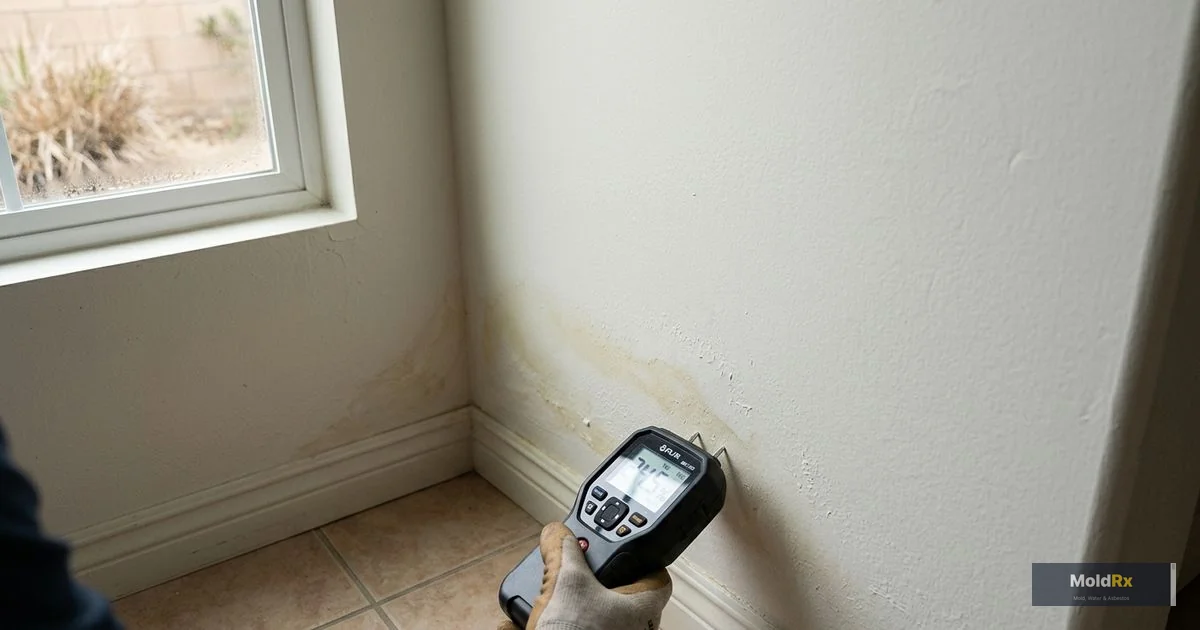
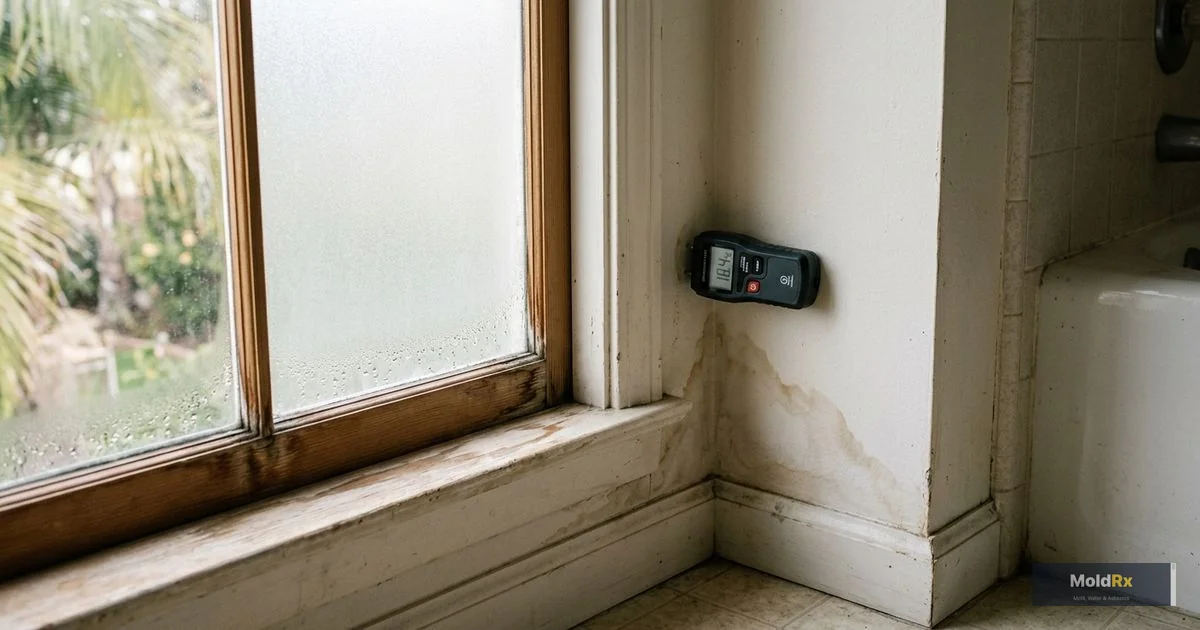
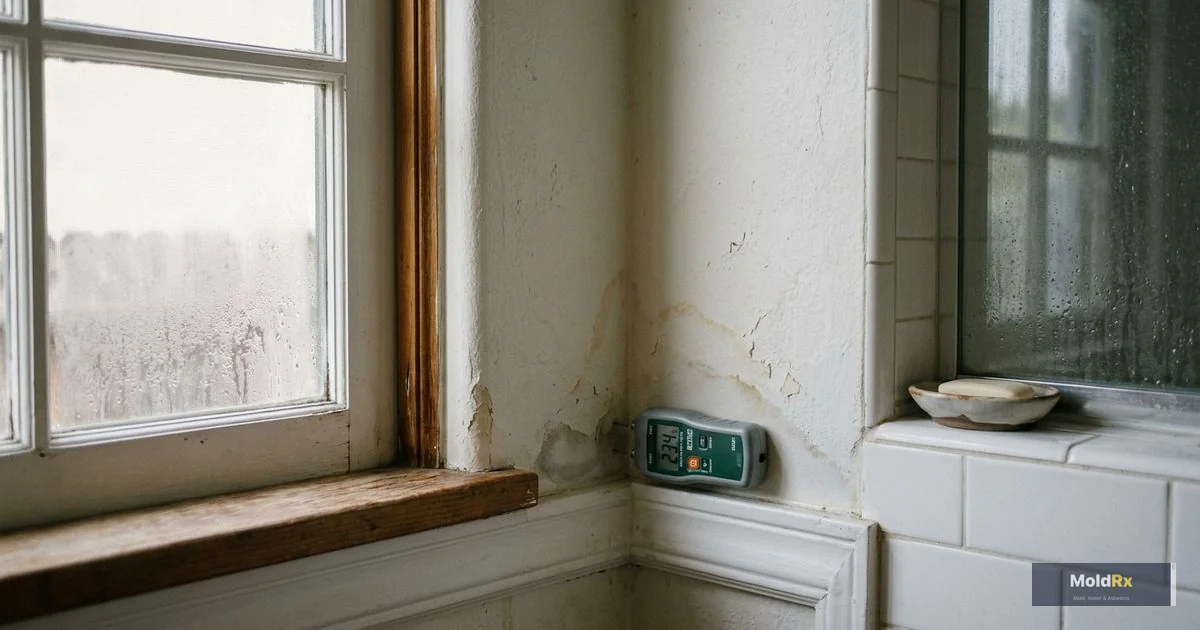
Before any removal begins, our professionals conduct a comprehensive inspection using infrared thermal imaging and calibrated moisture meters to locate all affected areas — visible and hidden. In Blythe, this means checking slab edges for capillary moisture from the elevated water table, inspecting swamp cooler supply plenums and drain lines, scanning irrigation-canal-adjacent exterior walls, and examining HVAC ductwork for internal condensation. The assessment follows protocols outlined in EPA 402-K-01-001, producing a detailed moisture map and scope of work before any material is disturbed.
2. Containment
Affected areas are isolated using polyethylene sheeting and negative air pressure machines equipped with HEPA filtration rated to capture particles as small as 0.3 microns. Containment prevents spore migration into unaffected rooms during the removal process. Protocols follow IICRC S520 classifications for Condition 2 and Condition 3 environments based on the contamination level found during inspection. The CDC and EPA both advise keeping vulnerable occupants — particularly children — away from active remediation areas, and the WHO Guidelines for Indoor Air Quality: Dampness and Mould document elevated respiratory risks for children exposed to mold-contaminated environments. Containment barriers remain in place until clearance verification confirms the space is safe to reoccupy.
3. Removal and Treatment
Mold-colonized porous materials — drywall, insulation, carpet padding, ceiling tiles — are carefully removed, double-bagged, and disposed of in compliance with IICRC S520 protocols and Cal/OSHA Title 8 section 5155 standards for airborne contaminant control. Structural framing and non-porous surfaces that can be salvaged are HEPA-vacuumed and treated with EPA-registered antimicrobial agents to eliminate residual growth and prevent recolonization. In Blythe properties, technicians frequently address mold along slab-to-drywall transitions where irrigation moisture has wicked upward, inside swamp cooler housings and ductwork, and behind exterior sheathing on canal-adjacent walls.
4. Moisture Correction
Mold removal without moisture correction is temporary. In Blythe, the correction strategy is tailored to whichever moisture pathway the inspection identified: installing or repairing vapor barriers on slab foundations to block capillary moisture from irrigation-saturated soil, servicing or replacing swamp cooler systems and upgrading drain routing, replacing corroded galvanized plumbing with modern materials, improving subfloor ventilation on manufactured homes, sealing foundation penetrations, and regrading exterior soil to direct monsoon runoff away from the structure. Each property receives a moisture correction plan specific to its conditions.
5. Post-Remediation Verification
Once remediation and moisture correction are complete, the project undergoes verification to confirm the property meets IICRC S520 Condition 1 — normal fungal ecology with no visible mold and no elevated spore counts. The homeowner receives a documentation package that includes before-and-after photographs, moisture readings at each project stage, the detailed scope of work performed, all materials and antimicrobials used, clearance test results, and a written summary of moisture corrections. This package supports insurance claims, real estate transactions, and long-term property records.
Mold Removal vs. Mold Remediation: What's the Difference?
The terms are often used interchangeably, but they describe different scopes of work. Mold removal refers to the physical elimination of mold-colonized materials — cutting out affected drywall, disposing of contaminated insulation, and cleaning surfaces. Mold remediation is the full process defined by the IICRC S520 Standard for Professional Mold Remediation: assessment and moisture mapping, containment of the affected area, removal of colonized materials, correction of the underlying moisture source, structural drying, and post-remediation verification to confirm the space meets Condition 1 — normal fungal ecology.
Removal without remediation is incomplete. If the moisture source that fed the colony is not identified and corrected, mold will return. In Blythe, where moisture sources like the elevated water table, irrigation canals, and daily swamp cooler condensation are persistent environmental conditions rather than one-time events, moisture correction is not optional — it is the difference between a permanent fix and a recurring problem.
MoldRx coordinates full remediation on every project — not just removal. Every Blythe job follows the complete IICRC S520 protocol from initial assessment through Condition 1 clearance, with documentation at each stage.
Preventing Mold After Remediation
Successful remediation eliminates the existing colony, but Blythe's unique combination of irrigation moisture, extreme heat, and aging housing means ongoing prevention requires attention to specific moisture pathways. These steps are tailored to conditions in the Palo Verde Valley.
Manage Your Swamp Cooler
Evaporative coolers are the dominant cooling system in Blythe and one of the most frequent moisture sources in local mold cases. Replace cellulose pads three to four times per cooling season — Blythe's mineral-heavy Colorado River water accelerates pad deterioration and creates an ideal mold substrate. Drain the reservoir and flush the distribution system monthly during active use. At the end of cooling season, winterize the unit completely: drain all water, disconnect the supply line, and cover the unit. A well-maintained swamp cooler manages humidity; a neglected one feeds mold colonies through five to six months of continuous operation.
Control Indoor Humidity
The EPA recommends maintaining indoor relative humidity between 30 and 50 percent. In Blythe, outdoor humidity is naturally very low — but indoor levels can spike well above 50 percent when swamp coolers run, during monsoon season, and in homes where slab moisture from the high water table adds continuous humidity at floor level. An inexpensive digital hygrometer placed in the main living area gives you a real-time reading. If humidity consistently exceeds 50 percent, reduce swamp cooler output, increase ventilation, or add supplemental dehumidification.
Address Condensation Zones
Blythe's extreme daily temperature range — 115-degree afternoons to 80-degree nights in summer — creates condensation wherever warm, swamp-cooler-moistened indoor air contacts cooler surfaces. Single-pane windows, uninsulated exterior walls, metal ductwork, and slab edges are the primary condensation sites. Upgrading to double-pane windows, adding wall insulation, and wrapping exposed ductwork in vapor-barrier insulation reduce the temperature differential that drives this daily condensation cycle. In manufactured homes, ensuring proper skirting ventilation prevents moisture from accumulating against the undercarriage.
Fix Water Intrusion Promptly
The IICRC S520 standard documents that mold colonization begins within 24 to 48 hours of a material becoming wet. In Blythe's extreme heat, that timeline can compress — interior wall cavities can reach 130 degrees or higher on summer afternoons, creating ideal incubation conditions for rapid mold growth. Whether the source is monsoon flooding, a plumbing failure, or irrigation canal seepage, dry affected materials immediately using fans, dehumidifiers, or professional extraction. Every hour of delay in Blythe's heat increases the scope of potential colonization.
Schedule Periodic Inspections
For Blythe homes near irrigation canals, properties with slab-on-grade foundations built before modern moisture barrier requirements, and manufactured homes with enclosed skirting, an annual professional moisture inspection is a practical preventive measure. A quick scan with thermal imaging and moisture meters can identify developing problems — rising slab moisture, condensation accumulation in wall cavities, early subfloor dampness — before mold colonization begins. Properties that have been vacant during summer months should be inspected before reoccupation.
What Sets MoldRx Apart
- Straight talk, not sales talk. We report what the inspection actually finds — including when the problem is smaller than you feared. No inflated scopes, no manufactured urgency.
- Licensed, insured, IICRC-certified. Every professional MoldRx sends to a Blythe property holds active credentials verified through the CSLB (Contractors State License Board) and carries full liability and workers' compensation insurance for Riverside County work.
- Full documentation on every job. Inspection reports, scope of work, moisture readings, clearance testing, photo documentation — every project produces a complete written record.
- Family-owned accountability. We only send vetted remediation professionals we stand behind. If something is not right, you call us directly and we make it right.
Get your free estimate — no obligations, no pressure.
Blythe Neighborhoods We Serve
MoldRx provides mold removal across every neighborhood in Blythe — ZIP codes 92225 and 92226 — including residential, commercial, manufactured housing, and agricultural properties.
- Downtown Blythe / Hobsonway Corridor — The city's commercial and residential core along East and West Hobsonway. Older homes and mixed-use buildings here date to the 1950s and 1960s, with original plumbing, minimal insulation, and slab foundations that lack modern moisture barriers — making hidden mold from subsurface irrigation moisture a persistent concern.
- East Blythe — Established residential area east of the downtown grid with a mix of single-family homes and larger parcels. Properties closer to the mesa bluffs sit on elevated terrain with better drainage, while lower-lying lots near canal laterals face higher risk from capillary slab moisture.
- Chanslor Way / Palo Verde College Area — Residential neighborhood near schools and the Palo Verde Valley Library. Housing in this area includes a mix of 1970s and 1980s construction, many with aging swamp cooler installations that contribute to indoor moisture problems during the long cooling season.
- Mesa Bluffs — Elevated residential area on the mesa above the valley floor, home to manufactured housing communities and single-family homes. Despite the higher terrain, manufactured homes with enclosed skirting frequently trap humidity against the undercarriage, creating subfloor mold conditions that go undetected until odor or floor damage appears.
- Intake Boulevard / Highway 95 Corridor — Properties along the north-south transportation corridor through Blythe. Homes and commercial buildings in this area experience heavy truck traffic vibration that can accelerate settling and crack slab foundations, creating entry points for subsurface moisture.
- Todd Park / Miller Park Area — Central residential neighborhoods close to city services. Compact lot sizes and older construction with galvanized plumbing create conditions where a single pinhole leak behind a shared wall can affect multiple rooms before detection.
- Colorado River Corridor — Residential and recreational properties along the river west of town, including areas near Mayflower Regional Park. Proximity to the river means consistently elevated soil moisture and higher ambient humidity than inland Blythe, increasing mold risk in any structure with foundation cracks or inadequate vapor barriers.
Nearby Communities We Also Serve
Related Services in Blythe
- Mold Removal in Blythe
- Asbestos Removal in Blythe
- Water Damage Restoration in Blythe
- Mold Testing in Blythe
- Asbestos Testing in Blythe
→ All remediation services in Blythe
Frequently Asked Questions
Can mold really grow in a desert city like Blythe?
Yes. Blythe's extreme heat creates a false sense of security, but the Palo Verde Irrigation District's canal system, widespread swamp cooler use, and aging housing stock introduce more than enough moisture for mold to colonize indoor materials. Professional remediators working in the valley encounter active mold colonies on a regular basis.
My home is near an irrigation canal — does that increase mold risk?
Properties adjacent to active canals and laterals in the Palo Verde Valley often have elevated subsurface moisture that migrates through slab foundations by capillary action. This can wet the bottom edges of drywall and subfloor materials without any visible water intrusion. If you notice musty odors at floor level or discoloration along baseboards, a professional inspection can determine whether mold is present.
How does swamp cooler use contribute to mold in Blythe?
Evaporative coolers add several gallons of water vapor to indoor air each day. In Blythe's extreme heat, the temperature differential between day and night causes that moisture to condense on cooler surfaces inside the home — behind walls, around window frames, and inside ductwork. Over a full cooling season, this repeated condensation cycle can produce significant hidden mold growth.
Should I get a mold inspection after monsoon flooding?
If your Blythe property has experienced any water intrusion during monsoon season — even minor pooling against the foundation — an inspection is worthwhile. Mold begins colonizing damp materials within 24 to 48 hours, and triple-digit post-storm temperatures accelerate that timeline. Early detection prevents a contained moisture problem from becoming a full remediation project.
Do I need to leave my home during mold removal?
For most projects with proper containment, occupants can stay in unaffected areas of the home. If contamination is extensive, involves the HVAC system serving the entire structure, or if household members include young children or individuals with respiratory conditions, our team may recommend temporary relocation during the most intensive removal phases.
How do I prevent mold from returning after remediation?
Ongoing moisture management is essential in Blythe. Key steps include maintaining swamp cooler pads and drain lines on a regular schedule, monitoring indoor humidity with a hygrometer and keeping levels between 30 and 50 percent, inspecting plumbing annually for leaks, ensuring bathroom and kitchen exhaust fans vent to the exterior, and maintaining positive drainage away from your foundation. For properties near irrigation canals, periodic moisture checks along slab edges can catch capillary moisture issues before mold establishes. Call for a free estimate to discuss prevention strategies specific to your property.
What is the difference between mold removal and mold remediation?
Mold removal is the physical elimination of mold-colonized materials. Mold remediation is the full IICRC S520 protocol: assessment, containment, removal, moisture source correction, structural drying, and post-remediation verification to achieve Condition 1 — normal fungal ecology. MoldRx coordinates full remediation on every project, because removal without moisture correction and verification leads to recurrence — especially in Blythe, where persistent moisture sources like the high water table and swamp cooler condensation make source correction essential.
Is black mold more dangerous than other types?
Stachybotrys chartarum — commonly called black mold — produces mycotoxins that can affect health, and the IICRC S520 standard requires specific containment protocols during its removal. However, the CDC notes that mold color alone is not a reliable indicator of species or toxicity. Many common molds appear dark or black, and many harmful species do not. Any mold colony exceeding the EPA's ten-square-foot threshold warrants professional remediation regardless of color. Laboratory analysis is the only reliable way to identify the species present.
How should I prepare my home for mold remediation?
Our professionals will provide specific preparation instructions based on your scope of work. Generally, you should move personal belongings, furniture, and stored items away from the affected area. Clear a path from the entry to the work zone. If the HVAC system or swamp cooler will be shut down during containment, plan for alternative cooling — particularly important in Blythe's summer heat. Secure pets in an unaffected area or arrange temporary boarding. For manufactured homes, ensure technicians have clear access to skirting panels if subfloor work is required. Our team handles containment setup, equipment staging, and all remediation work.
Does MoldRx provide emergency mold removal in Blythe?
Yes. Mold colonization begins within 24 to 48 hours of water exposure, and Blythe's extreme heat accelerates that timeline significantly. Time-sensitive situations — monsoon flooding, burst plumbing in triple-digit temperatures, irrigation overflow, swamp cooler failures — require rapid response. Call (888) 609-8907 to reach our team. We coordinate prompt assessment and containment to limit the scope of colonization before it spreads into additional building materials.
Get Mold Removal in Blythe
Call MoldRx for your free estimate — (888) 609-8907. Clear answers. Honest guidance. Work done right.