Asbestos Testing in Big Bear Lake, CA
MoldRx Only Sends Vetted Asbestos Testing Specialists to Big Bear Lake and the San Bernardino Mountains
Big Bear Lake sits at 6,752 feet in the San Bernardino Mountains, roughly ninety miles northeast of Los Angeles. The lake is a man-made reservoir created in 1884 -- at the time the largest artificial lake in the world -- and expanded to its modern size when the current dam was completed in 1912.
The permanent population hovers around 5,000 to 5,500, but that number barely hints at the reality of the housing stock. Big Bear Lake has one of the highest vacancy rates of any incorporated city in California -- roughly 65 percent citywide and over 80 percent in Moonridge -- because the majority of homes are vacation cabins, short-term rentals, and seasonal residences occupied only part of the year.
Most of the construction that shaped this community happened between the 1940s and the late 1970s, squarely within the peak era of asbestos use in American building products. The mountain environment then spent five to eight decades subjecting those materials to stresses that lowland homes never experience. Professional asbestos testing is the only way to determine what is present, and California law requires it before renovation or demolition of pre-1980 structures.
If you own a cabin, chalet, vacation rental, or year-round home in Big Bear Lake and you are planning any project that will disturb building materials, this page explains what you need to know.
Schedule a free consultation with MoldRx for your Big Bear Lake property.
How Asbestos Entered Big Bear Lake's Building Stock
Asbestos is a naturally occurring fibrous mineral incorporated into more than 3,000 commercial building products during the twentieth century. Residential use peaked between approximately 1940 and 1978 -- years that align almost perfectly with the major construction waves that built Big Bear Lake into the community it is today.
The Construction Timeline
The early resort era (1920s-1940s). By the 1920s, more than 200 resorts operated in the valley. Builder Gus Maltby and others constructed cabins and lodges through the 1940s using standard materials of their time -- plaster, pipe insulation, roofing, and heating components that routinely contained asbestos. At 80-plus years of age, these materials have had ample time to deteriorate under mountain weather.
The ski boom (1950s-1960s). Snow Summit opened in 1952 with a mile-long double chairlift, and by the mid-1950s Southern California had gone from one chairlift in 1946 to more than 14 ski areas within a three-hour drive of Los Angeles. Big Bear Lake was the epicenter. A-frame cabins, mid-century chalets, and commercial resort buildings went up rapidly. Floor tiles, ceiling textures, insulation, roofing felts, and fireplace components from this era routinely contained chrysotile, amosite, or crocidolite asbestos.
Year-round residential expansion (1970s). As improved roads made Big Bear viable for permanent living, the community shifted from a seasonal destination toward a year-round population center. Barn-style roofs became popular during the 1960s and 1970s, driven by well-known local builders, and the interior materials -- joint compounds, vinyl floor tiles, duct insulation, popcorn ceilings -- commonly contained asbestos.
Transition period (1980s-1990s). Federal and state restrictions began reducing asbestos use after 1978, but the phase-out was gradual. Some products manufactured through the mid-1980s still contained asbestos. Bear Mountain ski area opened in 1969 and was rebranded in 1988, bringing renewed development. Homes from this window warrant evaluation when original materials will be disturbed.
Modern construction (2000s and newer). Recent construction carries low asbestos risk in original materials, but renovations of older cabins that incorporated salvaged materials, or additions built onto existing older structures, may still contain asbestos in the older components.
Why Mountain Conditions Accelerate Material Deterioration
This is what separates Big Bear Lake from every valley and coastal community in Southern California. At 6,752 feet of elevation, properties face environmental stresses that break down building materials faster than identical materials at sea level -- and that includes materials containing asbestos.
Freeze-thaw cycling. Winter temperatures regularly drop below freezing. Water penetrating building materials freezes, expands, and creates micro-fractures. In asbestos-containing materials, repeated freeze-thaw cycles destroy the binding matrix holding fibers in place, converting stable, non-friable material into friable material that releases fibers more readily.
Heavy snow loads. Roofing materials -- including asbestos-containing shingles, felts, and cement-asbestos panels -- bear significant weight for months each winter. This sustained stress over decades causes cracking and displacement that would not occur on a lowland roof.
Moisture intrusion. Snowmelt, ice dams, and ambient moisture at elevation allow water to penetrate walls, ceilings, and subfloor assemblies. Asbestos-containing materials that absorb moisture lose structural integrity faster than identical materials in dry climates.
Temperature extremes and UV exposure. Summer highs reach the 80s while winter lows drop into the teens, producing continuous expansion and contraction. Higher elevation also means more intense ultraviolet radiation, which degrades exterior caulking, glazing putty, cement-asbestos siding, and roofing faster than identical materials at lower elevations.
The cumulative effect: asbestos-containing materials in a Big Bear Lake cabin built in 1955 may be in substantially worse condition than identical materials in a home of the same age in the Inland Empire. Testing is not just about identifying what is present -- it is about characterizing the condition of materials that have been under mountain stress for decades.
Common Asbestos-Containing Materials in Big Bear Lake Properties
The following materials are found throughout Big Bear Lake's housing stock. None can be identified as asbestos-containing by visual inspection alone. PLM (polarized light microscopy) laboratory analysis is the only definitive method.
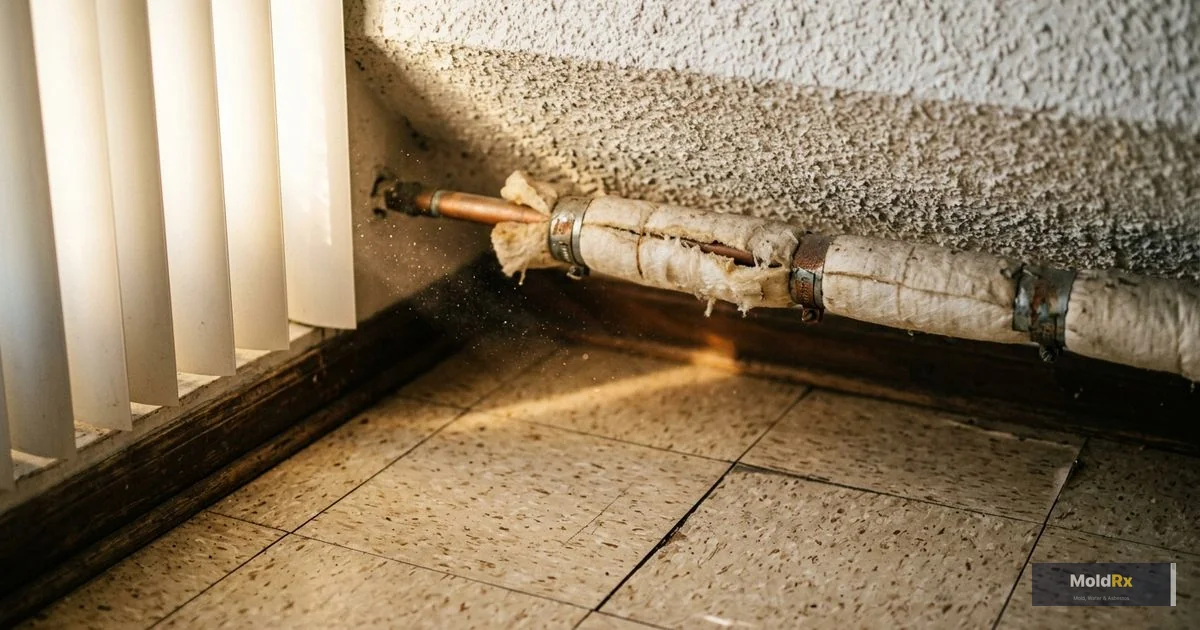
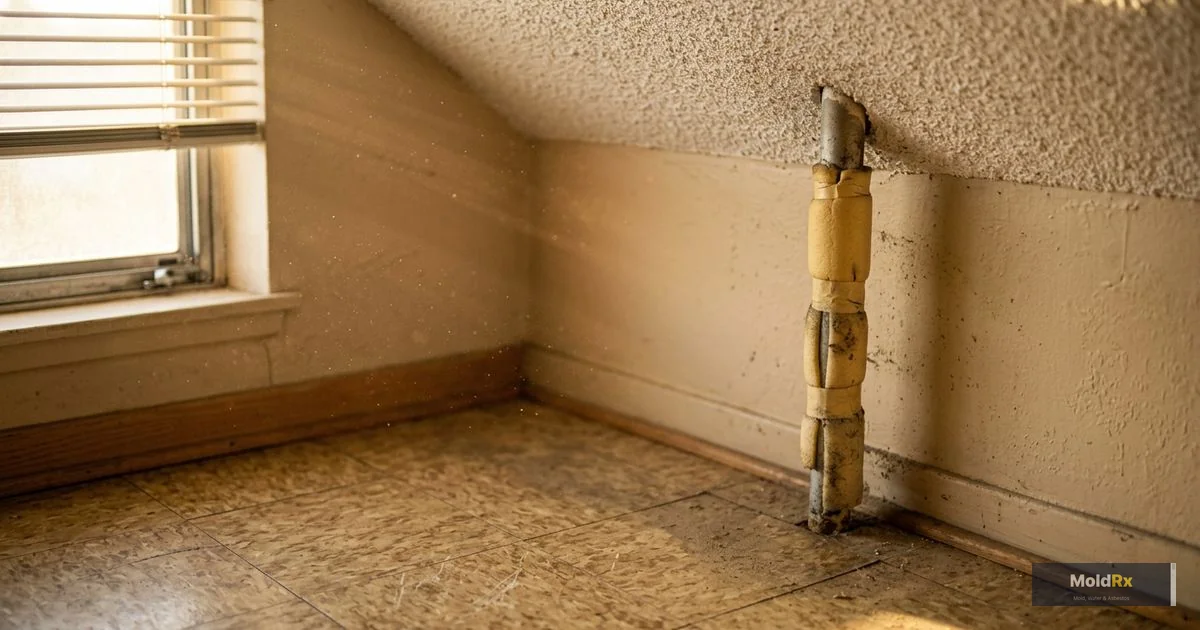
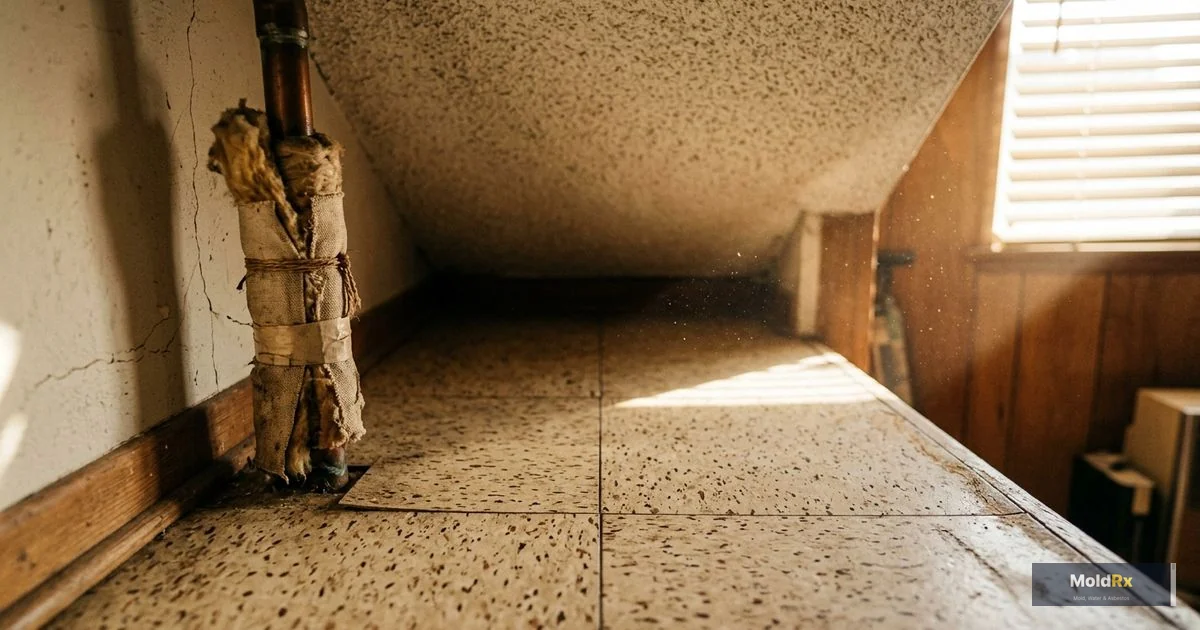
- Pipe insulation and boiler wrapping -- White or gray wrapping on heating pipes, water heater connections, and boiler components. Critical in mountain homes where heating systems run heavily for six or more months per year.
- Vermiculite attic insulation -- Loose-fill insulation, much of it from the Libby, Montana mine contaminated with tremolite asbestos. In mountain properties, often disturbed by snowmelt leaks and animal intrusion.
- Roofing shingles and felt -- Cement-asbestos shingles and reinforced roofing felt, often degraded by decades of snow loads, freeze-thaw cycling, and UV exposure at altitude.
- Popcorn and textured ceiling coatings -- Spray-applied acoustic textures containing chrysotile asbestos, found in structures from the 1950s through the late 1970s.
- Vinyl floor tiles and mastic -- Both the 9x9-inch tiles and the black cutback adhesive beneath them, frequently concealed under carpet in remodeled cabins.
- Duct insulation -- Insulation inside or around forced-air heating ductwork in systems worked hard through mountain winters.
- Wood stove and fireplace components -- Heat shields, fireproof millboard, flue pipe gaskets, and cement board around fireboxes.
- Cement-asbestos (transite) siding -- Rigid exterior cladding frequently cracked and deteriorated from decades of mountain weather and freeze-thaw stress.
- Joint compound and drywall mud -- Taping compounds concealed under paint and wallpaper on interior walls and ceilings.
- Window glazing putty and caulking -- Often brittle and crumbling from decades of temperature cycling at altitude.
The Vacation Rental and Seasonal Property Factor
With roughly 60 to 80 percent of housing units classified as seasonal or vacant depending on the neighborhood, most Big Bear Lake properties sit unoccupied for significant portions of the year. The city requires vacation rental registration and conducts inspections for permitted short-term rentals, but those inspections focus on fire safety and occupancy -- not the condition of concealed building materials.
Properties endure unattended freeze-thaw cycles, moisture events, and temperature extremes when no one is present to notice progressive deterioration. Guests, renters, maintenance workers, and contractors may all be exposed if deteriorating asbestos-containing materials are releasing fibers. For vacation rental owners, testing establishes a factual baseline, identifies materials requiring monitoring or removal, and documents due diligence regarding the safety of a property that hosts paying guests.
Why Asbestos Testing Matters: Health and Regulatory Context
The Health Risk
Asbestos fibers are microscopic, invisible, and odorless. When materials remain intact, they generally do not release fibers. The danger emerges when materials are disturbed through renovation, demolition, weathering, or when freeze-thaw damage converts stable materials into a friable state.
Once inhaled, asbestos fibers embed permanently in lung tissue. The body cannot break them down. Over 10 to 50 years, embedded fibers cause inflammation, scarring, and cellular damage leading to mesothelioma (a cancer caused almost exclusively by asbestos exposure), asbestosis (irreversible lung scarring), and elevated lung cancer risk.
No regulatory body has established a safe threshold of exposure. A single high-intensity event -- tearing out a textured ceiling or ripping up old floor tiles during a cabin renovation without testing -- can produce disease decades later. Identification before disturbance is the standard of care.
The Regulatory Framework
Multiple federal, state, and regional regulations govern asbestos identification, handling, and removal. Big Bear Lake property owners should understand the key authorities that apply to their projects.
EPA AHERA (Asbestos Hazard Emergency Response Act). AHERA established accreditation standards for asbestos inspectors and mandates that laboratories hold NVLAP accreditation through NIST.
OSHA 1926.1101. The federal asbestos standard for construction requires building owners to identify asbestos-containing materials before any renovation or demolition. It sets the permissible exposure limit at 0.1 fibers per cubic centimeter over an 8-hour time-weighted average.
Cal/OSHA Title 8 §1529. California's parallel standard mirrors and in certain areas exceeds federal requirements, mandating identification of asbestos-containing materials before any work that may disturb them.
SCAQMD Rule 1403. Big Bear Lake falls within SCAQMD jurisdiction, not the Mojave Desert AQMD. SCAQMD Rule 1403 requires an asbestos survey by a Certified Asbestos Consultant (CAC) or Certified Site Surveillance Technician (CSST) before any demolition and before renovation that could disturb 100 or more square feet of suspect material. Written notification must reach SCAQMD at least 10 working days before demolition begins -- even if the survey found no asbestos. Only NVLAP-accredited laboratory results satisfy the rule.
NVLAP laboratory accreditation. NIST accredits laboratories for bulk analysis using PLM (polarized light microscopy) and airborne analysis using TEM (transmission electron microscopy). NVLAP-accredited labs must meet ISO/IEC 17025 standards and participate in ongoing proficiency testing. Results carry full regulatory weight for SCAQMD Rule 1403, OSHA 1926.1101, and Cal/OSHA Title 8 §1529 compliance.
CSLB C-22 licensing. If removal is necessary, California law requires abatement by a contractor holding the CSLB C-22 Asbestos Abatement classification, with four years of journey-level experience and active DOSH registration.
These are enforceable requirements with real penalties, and they apply to Big Bear Lake properties exactly as they apply anywhere in Southern California.
Request Your Free Estimate for Asbestos Testing in Big Bear Lake
Every Big Bear Lake property has its own story: a 1948 cabin near Boulder Bay, a 1955 A-frame in Moonridge, a 1960s chalet, a 1970s home in Fox Farm, a commercial building in the Village. Each has different materials, different exposure history, and different testing needs. MoldRx only sends vetted specialists who understand mountain properties and the regulatory requirements that apply.
Get a free estimate for asbestos testing in Big Bear Lake.
How Asbestos Testing Works in Big Bear Lake
Step 1: Consultation and Property Assessment
The process begins with understanding your property: when it was built, what type of structure it is, how it is used (year-round residence, seasonal cabin, vacation rental, commercial space), and what work you are planning. For Big Bear Lake properties, the assessment also evaluates the structure's condition relative to mountain stresses -- moisture intrusion, freeze-thaw damage, roof stress, and material deterioration.
A 1952 A-frame that has endured 70 winters requires a different approach than a 1978 home that has been continuously maintained. A vacation rental sitting unoccupied most of the year faces different challenges than a home with permanent residents. These factors inform which materials need sampling and how many samples are appropriate.
Step 2: Professional Sample Collection
A vetted specialist visits your property and collects physical samples from each suspect material following EPA NESHAP and Cal/OSHA protocols. Each material is wetted before sampling to suppress fiber release, extracted with specialized tools, sealed in labeled containers, and documented with chain-of-custody records.
In mountain properties, the specialist pays particular attention to materials showing weather-related deterioration: cracking, moisture staining, surface erosion, or loss of structural integrity. Pipe insulation in crawl spaces, vermiculite in attic spaces, roofing components, and fireplace surrounds receive focused evaluation as the materials most aggressively affected by Big Bear Lake's elevation and climate.
Step 3: NVLAP-Accredited Laboratory Analysis
Samples are submitted to a laboratory holding NVLAP accreditation for bulk asbestos analysis. The primary analytical method is PLM (polarized light microscopy), which identifies:
- Whether asbestos is present in the sample
- The specific type of asbestos (chrysotile, amosite, crocidolite, tremolite, actinolite, or anthophyllite)
- The concentration percentage within the material
TEM (transmission electron microscopy) is available when higher analytical sensitivity is required, such as for air quality clearance testing after abatement work or when PLM results are inconclusive at low concentrations. Standard PLM results are typically delivered within 3 to 5 business days. Rush processing is available for urgent projects or time-sensitive renovation schedules.
Step 4: Report, Interpretation, and Mountain-Specific Guidance
Your report identifies every material sampled, its location, observed condition, and whether asbestos was detected. For positive results, asbestos type and concentration are documented. The report provides:
- Materials requiring abatement by a CSLB C-22-licensed contractor before renovation can proceed
- Intact materials manageable through periodic monitoring, with mountain-specific seasonal notes
- Regulatory documentation meeting SCAQMD Rule 1403, Cal/OSHA Title 8 §1529, and OSHA 1926.1101 requirements
- Practical guidance tailored to your property type: year-round home, seasonal cabin, vacation rental, or commercial building
The goal is an actionable document that tells you what you have, what condition it is in, and what steps are required before your project can move forward in full regulatory compliance.
What to Expect During the Testing Process
- Minimal disruption. Sample collection does not require vacating the property. Samples are small, and wetting procedures prevent fiber release. For vacation rentals, testing can be scheduled between guest bookings.
- Turnaround. On-site work is completed in a single visit. Standard lab results arrive within 3 to 5 business days. Rush processing is available.
- Year-round access. Winter scheduling may require coordination around weather and road conditions on Highway 18 and Highway 38, but interior sampling is not weather-dependent.
- Complete documentation. Reports meet Cal/OSHA Title 8 §1529, SCAQMD Rule 1403, OSHA 1926.1101, and AHERA standards -- suitable for contractor coordination, real estate transactions, insurance, vacation rental compliance, and regulatory submissions.
- Honest guidance. If your property's age and materials suggest low risk, we will tell you. MoldRx does not manufacture urgency where none exists.
Big Bear Lake Neighborhoods and Areas We Serve
MoldRx only sends vetted asbestos testing specialists throughout Big Bear Lake and the surrounding mountain communities. We serve properties in the 92315 and 92314 ZIP codes and surrounding areas, including:
- The Village commercial district and surrounding residential streets
- Boulder Bay lakefront properties
- Moonridge residential neighborhood and Bear Mountain ski area vicinity
- Fox Farm and adjacent mountain residential areas
- Fawnskin on the north shore of Big Bear Lake
- Sugarloaf and surrounding mountain communities
- Properties along the Big Bear Lake shoreline
- Big Bear City and Erwin Lake areas
- Properties accessible via Highway 18 and Highway 38
- Moonridge Meadows area and Snow Summit vicinity
Whether your property is a 1940s lakeside cabin, a 1955 Snow Summit-era A-frame, a 1960s Moonridge chalet, a 1970s year-round home, or a Village commercial building, the specialists MoldRx sends understand mountain conditions and their effects on asbestos-containing materials.
Related Services in Big Bear Lake
In addition to asbestos testing, we also offer Mold Removal in Big Bear Lake, Asbestos Removal in Big Bear Lake, Water Damage Restoration in Big Bear Lake, and Mold Testing in Big Bear Lake services to Big Bear Lake property owners.
Learn more about remediation services in Big Bear Lake
Frequently Asked Questions About Asbestos Testing in Big Bear Lake
My cabin was built in the 1950s during the Snow Summit ski boom. Is asbestos almost certain?
Cabins built during the 1940s through the 1960s have a very high probability of containing asbestos in multiple materials. The post-war wave and the ski boom following Snow Summit's 1952 opening used standard products of the era: pipe insulation, flooring, roofing, ceiling textures, and heating components that routinely contained asbestos. Factor in 70-plus years of freeze-thaw cycling, snow loads, and moisture intrusion at 6,752 feet and the condition of these materials becomes an additional concern. Testing is strongly recommended before any renovation and worth considering even without a planned project.
Does the mountain environment make asbestos more dangerous?
The mountain environment does not change asbestos fibers themselves, but it accelerates the deterioration of the materials containing them. Freeze-thaw cycling, snow loads, moisture intrusion, temperature swings, and UV exposure at altitude break down binding matrices that hold fibers in place. Over decades, stable materials become friable and release fibers more readily. A roofing felt intact for 50 years at sea level may be cracked after 30 years at Big Bear Lake's elevation -- making proactive testing more important here than for comparable lowland homes.
I own a vacation rental in Big Bear Lake. Do I need asbestos testing?
If your rental was built before 1980, testing is strongly advisable. Vacation rentals host a rotating cast of guests, maintenance workers, and cleaners who may be exposed to deteriorating materials without knowing it. Seasonal properties endure unattended freeze-thaw cycles and moisture events that degrade materials when no one is present to notice. Big Bear Lake's vacation rental program requires registration and inspections, but those focus on fire safety and occupancy -- not concealed building materials. Testing establishes a documented baseline that informs maintenance decisions, demonstrates responsible ownership, and protects against future liability.
Should I test a Big Bear property I only use seasonally?
Yes, particularly if it was built before 1980. A season of unmonitored snowmelt, ice dams, and roof stress can change the condition of ceiling materials, pipe insulation, and roofing components significantly. Testing establishes a documented baseline of what materials contain asbestos and what condition they are in, giving you early warning about materials that may need attention before they become a hazard.
Is Big Bear Lake under SCAQMD or MDAQMD jurisdiction?
Big Bear Lake falls within the South Coast Air Quality Management District (SCAQMD), not the Mojave Desert AQMD. SCAQMD Rule 1403 applies to all demolition and renovation activities involving asbestos-containing materials here. An asbestos survey is required before demolition and before renovation that could disturb 100 or more square feet of suspect material. Notification must reach SCAQMD at least 10 working days before demolition, even if the survey found no asbestos.
What happens if asbestos is found in my Big Bear Lake property?
It depends on the material's condition and your plans. Intact materials that will not be disturbed can be managed through periodic monitoring -- especially important in Big Bear Lake where condition changes from season to season. Deteriorated or soon-to-be-disturbed materials must be professionally removed by a CSLB C-22-licensed abatement contractor before other work begins. For vacation rentals, special consideration applies to deteriorated materials that could expose guests or maintenance workers.
Can testing be done during winter?
Yes. MoldRx serves Big Bear Lake year-round. Winter scheduling may require coordination around weather events and road access via Highway 18 or Highway 38, but interior sample collection can be performed regardless of outdoor conditions. Snow on the ground does not prevent testing. Contact us to discuss timing and we will work with you to find a practical scheduling window that accounts for mountain weather conditions.
How long does the process take from start to finish?
On-site sample collection is completed in a single visit, typically within a few hours depending on property size and the number of suspect materials. Standard NVLAP-accredited laboratory analysis takes 3 to 5 business days. Rush processing is available when project timelines are tight. From initial contact to final report, most Big Bear Lake residential projects are completed within one to two weeks, with the upper range reflecting potential weather-related scheduling adjustments rather than the testing process itself.
Schedule Asbestos Testing for Your Big Bear Lake Property
Big Bear Lake properties face a combination of construction-era materials and sustained environmental stress that makes asbestos testing essential for responsible property ownership. Whether you are planning a cabin renovation, purchasing a mountain home, preparing a property for the vacation rental market, or ensuring the safety of a structure that has endured decades of mountain winters, professional testing provides the definitive answers that visual inspection cannot.
MoldRx only sends vetted asbestos testing specialists who understand mountain properties and the full regulatory framework -- SCAQMD Rule 1403, Cal/OSHA Title 8 §1529, OSHA 1926.1101, AHERA, NVLAP accreditation -- that governs asbestos work in Big Bear Lake. You get PLM and TEM laboratory results, proper documentation, and honest guidance about what the findings mean.
No guesswork. No runaround. Call (888) 609-8907 or request your free estimate online to schedule asbestos testing for your Big Bear Lake property.