Asbestos Testing in Beaumont, CA
MoldRx Only Sends Vetted Asbestos Testing Specialists to Beaumont and the San Gorgonio Pass
Beaumont sits at the summit of the San Gorgonio Pass, roughly 2,600 feet above sea level, where the western Inland Empire gives way to the desert corridor running toward Palm Springs. The city incorporated in 1912, making it one of the older municipalities in Riverside County, but its trajectory has been anything but steady. For most of the twentieth century Beaumont was a quiet railroad and agricultural town. The population hovered around 11,000 as late as 2000. Then the housing boom arrived. Master-planned developments — Sundance, Tournament Hills, Fairway Canyon, Solera at Oak Valley, Noble Creek — converted thousands of acres of former ranchland and orchards into suburban neighborhoods. By the mid-2020s the population had surged past 55,000, and roughly three-quarters of the city's housing stock had been built after the year 2000.
That three-quarters figure is the easy part. It is the other quarter — the older homes concentrated in downtown Beaumont, along Beaumont Avenue, near Sixth Street and Pennsylvania Avenue, and in the original residential pockets south of the railroad corridor — that requires careful attention before any renovation, demolition, or property transaction moves forward. These properties were built during the decades when asbestos was a standard ingredient in American construction materials. Professional testing is the only way to determine what is present, and California law requires it before work that may disturb materials in pre-1980 structures.
If you are planning a project on an older Beaumont property, the information below will help you understand what needs to happen before the first wall is opened.
Ready to get started? Request your free estimate or call (888) 609-8907 to speak with someone today.
How Asbestos Entered Beaumont's Older Housing Stock
Asbestos is a naturally occurring fibrous mineral that appeared in more than 3,000 commercial building products during the twentieth century. Its heat resistance, tensile strength, and low cost made it standard in everything from floor tiles to roof shingles. In residential construction, asbestos use peaked between approximately 1940 and 1978, then tapered as federal and state restrictions took hold.
The Railroad Town Era: 1880s Through Mid-Century
Beaumont's origins trace to the Southern Pacific Railroad. In 1875 the railroad established Summit Station at the top of the San Gorgonio Pass. A land company purchased the townsite in 1887 and renamed it Beaumont — French for "beautiful mountain." By 1912 the town had incorporated, and through the early twentieth century it grew modestly around agriculture (once dubbed "the land of the big red apple" for its orchards), a bank, churches, and the railroad depot.
The homes and commercial buildings erected during this era — the 1910s through the 1950s — used construction materials common to the period. Plaster walls, pipe insulation, roofing felts, and fireproofing compounds from these decades routinely contained asbestos. Buildings from this window that survive in downtown Beaumont today represent the highest probability of asbestos-containing materials in the city.
Mid-Century Residential Growth: 1950s Through 1970s
After World War II, Beaumont experienced steady if unspectacular growth as working families settled along the I-10 corridor. Neighborhoods filled in along Beaumont Avenue, Pennsylvania Avenue, Sixth Street, and the streets radiating from the downtown core. The contractors who built these homes were not deliberately choosing asbestos. They were purchasing the materials that distributors stocked: vinyl floor tiles, textured ceiling coatings, pipe insulation, roofing shingles, joint compounds, and duct tape that contained asbestos as a routine manufacturing ingredient.
Census-derived housing data illustrates the distribution. Approximately 1.5 percent of Beaumont's current housing stock was built before 1940. Another 2.2 percent dates to the 1940s, 4.7 percent to the 1950s, 4.4 percent to the 1960s, and 5.4 percent to the 1970s. Combined, roughly 18 percent of the city's homes predate 1980. In raw numbers that represents several thousand dwellings, and they are concentrated in a relatively compact geographic area: the original town footprint.
The Boom Era: 2000s to Present
Beginning around 2001, Beaumont became one of the fastest-growing cities in California. Sundance, built by Pardee Homes, sold its first 100 homes in 100 days. Tournament Hills followed with its gated entry and private lake. Fairway Canyon, Solera at Oak Valley, Noble Creek, Four Seasons, Olivewood, and Oak Valley Greens added thousands more rooftops.
Homes built after 2000 carry low asbestos risk in their original construction materials. The practical phase-out was complete well before these developments began. However, low risk does not mean zero risk. Properties built on parcels where older structures previously stood may incorporate remnant materials. Additions connecting new construction to an older home introduce materials of uncertain age. And a small number of imported building products have been found to contain asbestos even in recent manufacturing runs.
The Transition Window: 1980s Through 1990s
About 13 percent of Beaumont's housing was built between 1980 and 1999. Federal restrictions reduced asbestos use after 1978, but manufacturers were permitted to exhaust existing inventory. Some asbestos-containing products remained on shelves into the mid-1980s. Homes from this window warrant evaluation when original materials will be disturbed.
Common Asbestos-Containing Materials in Beaumont's Pre-1980 Homes
If your Beaumont property was built before 1980, any of the following materials may contain asbestos. None of them can be identified as asbestos-containing through visual inspection. A floor tile with 5 percent chrysotile looks identical to one with zero percent. Laboratory analysis using polarized light microscopy (PLM) is the only definitive identification method.
- Popcorn and acoustic ceiling textures — Spray-applied textured coatings containing chrysotile asbestos were among the most common residential applications, standard from the 1950s through the late 1970s
- Vinyl floor tiles and mastic — Both 9-inch and 12-inch tiles and the black cutback adhesive beneath them frequently contained asbestos fibers
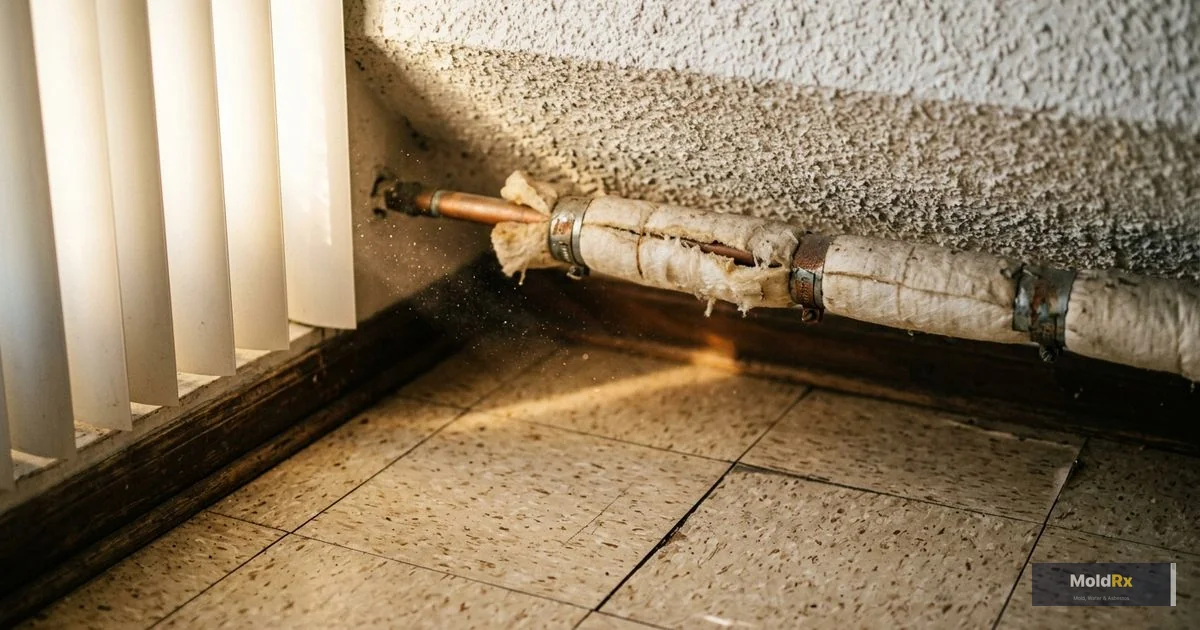
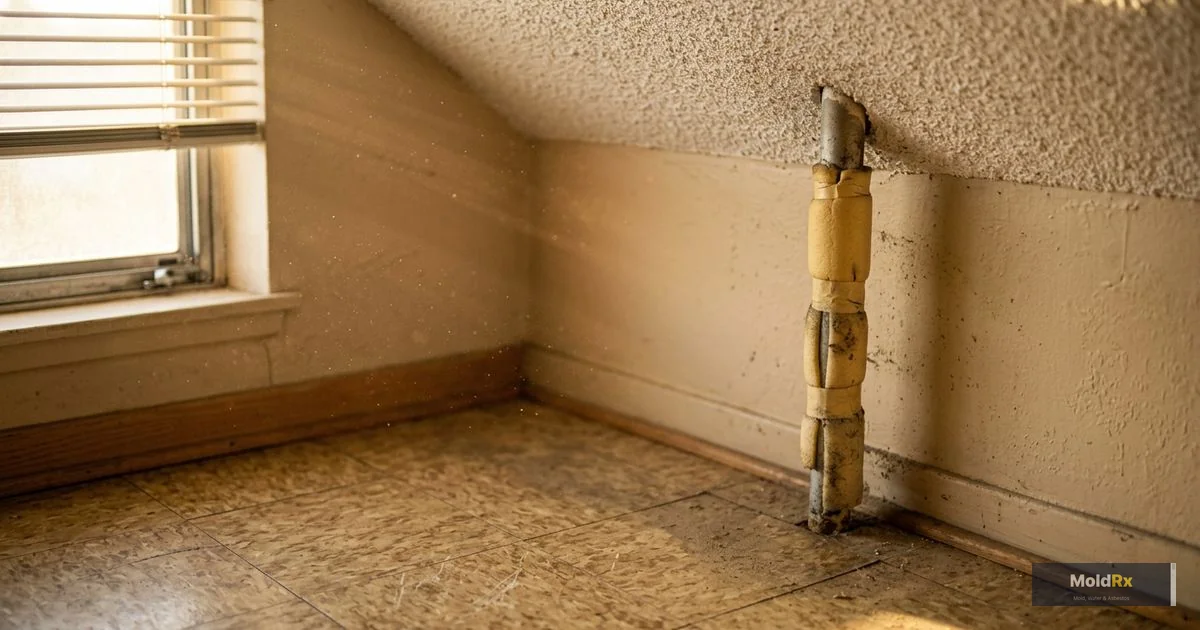
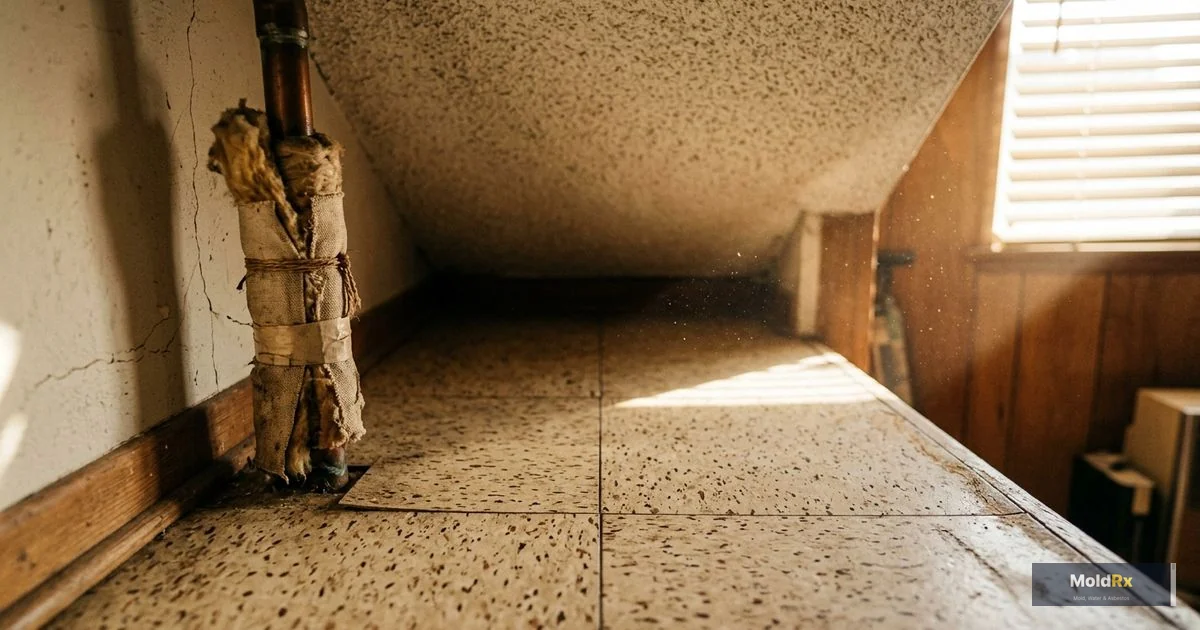
- Pipe insulation — White or gray wrapping on hot water pipes, water heater connections, heating system piping, and under-slab plumbing
- Duct insulation and duct tape — Insulation inside or around forced-air HVAC ductwork and the fabric-backed tape used at duct joints
- Roofing shingles, felt, and flashing — Cement-asbestos shingles, asbestos-reinforced underlayment, and flashing compounds on homes with original roofing
- Cement-asbestos (transite) siding — Rigid exterior cladding panels reinforced with asbestos fibers, common on mid-century homes throughout the pass
- Joint compound and drywall mud — Taping compounds used to finish seams between drywall panels, often concealed under multiple coats of paint
- Vermiculite attic insulation — Loose-fill insulation poured into attic spaces; much of the vermiculite sold in the U.S. came from a mine contaminated with tremolite asbestos
- Fireplace and wood stove components — Millboard, heat shields, gaskets, and cement board surrounding fireboxes
- Window glazing putty and caulking — Putty securing glass panes and caulking around tubs, sinks, and exterior joints
- Electrical panel components — Arc chutes, backing boards, and insulation within older panels
Climate and Maintenance History
Beaumont's semi-arid climate pushes summer temperatures into the mid-90s and low 100s, while its 2,600-foot elevation brings colder winter nights and the San Gorgonio Pass funnels powerful Santa Ana winds through the corridor. This combination of thermal cycling, UV exposure, and wind stress subjects older building materials to decades of wear. HVAC systems have been repaired, roofing patched, pipes re-wrapped, and insulation shifted.
Each of these maintenance activities may have disturbed asbestos-containing materials without the homeowner's knowledge, potentially spreading fibers within wall cavities, attic spaces, or living areas. Comprehensive testing reveals not only where asbestos currently exists but whether previous work has already created conditions that need attention.
Why Asbestos Testing Matters: Health and Legal Context
The Health Risk
Asbestos fibers are microscopic, invisible, and odorless. When asbestos-containing materials remain intact and undisturbed they generally pose limited risk. The danger arises when materials are disturbed — through renovation, demolition, weathering, water damage, or routine maintenance such as scraping a textured ceiling, pulling up old floor tiles, or drilling into a wall finished with asbestos-laden joint compound.
Once airborne, fibers can be inhaled deep into lung tissue and the mesothelium (the lining surrounding the chest and abdominal cavities). The body cannot break them down or expel them. Over latency periods of 10 to 50 years, lodged fibers produce chronic inflammation, scarring, and cellular damage that can lead to:
- Mesothelioma — a cancer of the lung lining or abdominal lining, almost exclusively caused by asbestos exposure
- Asbestosis — progressive, irreversible scarring of lung tissue that restricts breathing capacity over time
- Lung cancer — risk substantially elevated by asbestos exposure, particularly when combined with tobacco use
No safe exposure threshold has been established. A single high-intensity exposure event can produce disease decades later. Identification before disturbance is the only reliable prevention strategy.
The Regulatory Framework That Applies to Beaumont Property Owners
Multiple overlapping federal, state, and regional regulations govern asbestos identification and management. For Beaumont property owners in Riverside County, the key authorities are:
EPA AHERA (Asbestos Hazard Emergency Response Act). Enacted in 1986, AHERA established the accreditation standards for asbestos inspectors and laboratory protocols used across all testing. AHERA mandates that laboratories analyzing asbestos samples hold accreditation through the NIST National Voluntary Laboratory Accreditation Program (NVLAP).
OSHA 29 CFR 1926.1101. The federal asbestos standard for the construction industry (OSHA 1926.1101) requires building owners to identify asbestos-containing materials before construction, renovation, or demolition. It sets the permissible exposure limit at 0.1 fibers per cubic centimeter over an 8-hour time-weighted average and requires a designated competent person on all asbestos worksites.
Cal/OSHA Title 8, Section 1529. California's state standard (Cal/OSHA Title 8 §1529) mirrors and in certain respects exceeds federal requirements. It mandates identification of asbestos-containing materials before any work that may disturb them and specifies training, medical surveillance, and work practices specific to California.
SCAQMD Rule 1403. Beaumont falls within the South Coast Air Quality Management District. SCAQMD Rule 1403 requires an asbestos survey by a certified consultant before demolition and before renovation that may disturb 100 or more square feet of suspect material. Written notification to SCAQMD is required at least 10 working days before regulated work begins. Visual identification alone does not satisfy the rule — laboratory-confirmed results from an accredited facility are mandatory.
NVLAP Laboratory Accreditation. Administered by NIST, the NVLAP program accredits laboratories for bulk asbestos analysis via PLM and airborne analysis via TEM. NVLAP-accredited labs must meet ISO/IEC 17025 standards and participate in ongoing proficiency testing. Every sample MoldRx facilitates goes to an NVLAP-accredited laboratory.
CSLB C-22 Licensing. When removal becomes necessary, California requires the work be performed by a contractor holding the CSLB C-22 Asbestos Abatement classification from the Contractors State License Board. C-22 licensees must have at least four years of journey-level abatement experience and maintain active DOSH registration.
How Asbestos Testing Works in Beaumont
Here is the process from first contact through final report.
Step 1: Consultation and Property Evaluation
The process starts with understanding your property: when it was built, its construction type, renovation history, and what work you are planning. A 1950s home in the downtown core has fundamentally different testing priorities than a 1975 house near Cherry Valley or a 2005 home in Sundance where an older detached garage also sits on the parcel. For mixed-era properties, sampling focuses on the original structure while evaluating whether newer portions warrant testing.
Step 2: Professional Sample Collection
A vetted specialist visits your property and collects physical samples from each suspect material following EPA NESHAP and Cal/OSHA Title 8 §1529 protocols:
- Each material is wetted before sampling to suppress fiber release
- Representative samples are extracted using specialized cutting and coring tools
- Each sample is sealed in a labeled container with a unique identifier
- A chain-of-custody form documents the collector, collection time, and sample location
Sample collection for a typical Beaumont property is completed in a single visit, generally within a few hours. You do not need to vacate your home.
Step 3: NVLAP-Accredited Laboratory Analysis
Samples are submitted to a laboratory holding NVLAP accreditation for bulk asbestos analysis. The primary analytical method is polarized light microscopy (PLM), which identifies:
- Whether asbestos is present in the sample
- The specific type of asbestos (chrysotile, amosite, crocidolite, tremolite, actinolite, or anthophyllite)
- The concentration percentage within the material
When greater sensitivity is required — for clearance testing after abatement or when PLM results are inconclusive at low concentrations — transmission electron microscopy (TEM) provides finer-scale resolution. Standard PLM results arrive within 3 to 5 business days. Rush processing is available.
Step 4: Report, Interpretation, and Practical Guidance
Your report identifies every material sampled, its location, and whether asbestos was detected. For positive results, asbestos type and concentration are documented. The report provides:
- Identification of which materials require professional abatement before renovation can proceed
- Assessment of which materials are intact and can be managed in place through periodic monitoring
- Regulatory documentation meeting SCAQMD Rule 1403, Cal/OSHA Title 8 §1529, and OSHA 1926.1101 requirements
- Practical recommendations tailored to your project scope and property condition
If your home's age and materials suggest low risk in certain areas, you will be told directly. If specific materials do not need testing given your project scope, that comes to you without hedging.
Have questions about your property? Request your free estimate or call (888) 609-8907 — no obligation, no pressure.
Beaumont's Two Eras: Understanding Your Property's Risk Profile
One of the most useful things you can do before starting a renovation project in Beaumont is determine which era your property belongs to.
High-Risk Properties: The Original Town (Pre-1980)
Homes and commercial buildings in Beaumont's original footprint — the downtown core, Beaumont Avenue corridor, neighborhoods near Sixth Street and Pennsylvania Avenue, residential streets south of the railroad corridor, and scattered older parcels near Cherry Valley — have a high probability of containing asbestos in multiple building systems. Testing is essential before renovation, demolition, or major maintenance, and it is a legal prerequisite under Cal/OSHA Title 8 §1529 and SCAQMD Rule 1403.
Commercial properties deserve particular attention. Downtown Beaumont contains structures dating to the 1920s and 1930s that have been repurposed and re-tenanted multiple times. Previous renovation work may or may not have included proper asbestos assessment.
Low-Risk Properties: Master-Planned Communities (Post-2000)
Homes in Sundance, Tournament Hills, Fairway Canyon, Solera at Oak Valley, Noble Creek, and other post-2000 communities generally do not require testing for their original materials. Exceptions include properties built on sites where older structures previously stood and homes with additions incorporating salvaged or uncertain-origin materials.
Transition Properties: 1980s and 1990s
About 13 percent of Beaumont's housing falls into the 1980-1999 window. When original materials in homes from this era will be physically disturbed, evaluation is warranted.
What to Expect During the Process
- Minimal disruption. Sample collection does not require you to vacate your home or make special preparations. Samples are small, and wetting and containment procedures prevent fiber release during collection.
- Single-visit turnaround. On-site work is completed in one visit. Standard lab results arrive within 3 to 5 business days. Rush processing is available when project deadlines require it.
- Complete documentation. Your report satisfies documentation requirements under Cal/OSHA Title 8 §1529, SCAQMD Rule 1403, and federal OSHA 1926.1101 standards. It is suitable for contractor coordination, real estate transactions, insurance records, building department submissions, and permanent property files.
- Honest guidance. The specialists MoldRx sends have no financial incentive to find asbestos or recommend unnecessary work. You receive factual lab results and straightforward recommendations based on what those results mean for your specific project.
Beaumont Neighborhoods and Areas We Serve
MoldRx sends vetted asbestos testing specialists to properties throughout Beaumont. We serve the 92223 ZIP code and surrounding areas, including:
- Historic downtown Beaumont and the original commercial district
- Beaumont Avenue corridor and the older residential neighborhoods
- Sixth Street and Pennsylvania Avenue neighborhoods
- Sundance, Fairway Canyon, Tournament Hills, and Solera at Oak Valley master-planned communities
- Noble Creek, Four Seasons, Olivewood, and Oak Valley Greens
- Properties along the I-10 corridor through the San Gorgonio Pass
- Cherry Valley to the north and rural parcels in the surrounding pass area
Our coverage extends to neighboring communities including Banning to the east, Calimesa to the west, and the broader San Gorgonio Pass region.
Related Services in Beaumont
In addition to asbestos testing, MoldRx also sends vetted specialists for Mold Removal in Beaumont, Asbestos Removal in Beaumont, Water Damage Restoration in Beaumont, and Mold Testing in Beaumont.
Learn more about remediation services in Beaumont
Frequently Asked Questions About Asbestos Testing in Beaumont
My Beaumont home was built in 2005. Do I need asbestos testing?
Homes built after 2000 in Beaumont's master-planned communities are generally low risk for asbestos in their original materials, and testing is typically not necessary. However, if your lot includes an older structure (a detached garage, workshop, or original farmhouse predating the development) or if additions incorporated materials of uncertain origin, a consultation can determine whether testing is warranted.
What about the older buildings in downtown Beaumont?
Downtown properties dating to the 1920s and 1930s are among the highest-risk structures in the city. Plaster, pipe insulation, roofing, flooring, and fireproofing from this era routinely contained asbestos. Testing is essential before any renovation, tenant improvement, or demolition. Many structures have been repurposed multiple times, and previous work may not have included proper assessment under AHERA, SCAQMD Rule 1403, or Cal/OSHA Title 8 §1529 standards.
When is asbestos testing legally required in Beaumont?
Cal/OSHA Title 8 §1529 requires identification of asbestos-containing materials before any renovation or demolition that may disturb materials in pre-1980 structures. SCAQMD Rule 1403 adds the requirement of an asbestos survey by a certified consultant before demolition and before renovation projects involving 100 or more square feet of suspect material, along with written notification to SCAQMD at least 10 working days before regulated work begins. Testing is also strongly recommended before purchasing older properties or when damaged or deteriorating materials are observed in any structure.
How are asbestos samples collected without creating a hazard?
Trained specialists follow EPA NESHAP and Cal/OSHA Title 8 §1529 collection protocols. Each suspect material is wetted to suppress fiber release before a small sample is extracted with specialized tools, then immediately sealed in a labeled container with chain-of-custody documentation. The amount of material removed is small and the wetted area is left in a safe condition.
What happens if asbestos is found in my Beaumont home?
The response depends on the material's condition and your project plans. Intact materials that will not be disturbed can be managed in place through periodic visual inspection. Materials that are damaged, deteriorating, or will be disturbed by renovation or demolition must be professionally removed by a CSLB C-22 licensed abatement contractor before other work begins. Your testing report specifies findings for each material and recommends the appropriate action.
What is the difference between PLM and TEM analysis?
PLM (polarized light microscopy) is the standard method for analyzing bulk material samples — pieces of floor tile, ceiling texture, insulation, and similar materials collected from your property. It identifies asbestos type and concentration percentage. TEM (transmission electron microscopy) operates at much higher magnification and is used primarily for air monitoring samples and clearance testing after abatement, or when PLM results are inconclusive at very low fiber concentrations. Both methods require NVLAP-accredited laboratory facilities.
Is Beaumont in the SCAQMD jurisdiction?
Yes. SCAQMD Rule 1403 applies to all demolition and renovation activities involving asbestos-containing materials in Beaumont. An asbestos survey is required before demolition and before renovation that could disturb 100 or more square feet of suspect material. Written notification to SCAQMD is required in addition to testing and abatement requirements.
How long does the entire testing process take?
On-site sample collection is completed in a single visit, typically within a few hours. Standard NVLAP-accredited PLM analysis takes 3 to 5 business days. Rush processing is available. From initial contact to final report delivery, most Beaumont residential projects are completed within one week.
Schedule Asbestos Testing for Your Beaumont Property
Beaumont's split identity — historic railroad town and modern master-planned suburb — means asbestos risk varies dramatically from one property to the next. A home in the original downtown built in the 1950s occupies a completely different risk category than a home in Tournament Hills built in 2010. Testing is the only way to know what your specific property contains, and for pre-1980 structures it is a legal prerequisite for renovation and demolition work under OSHA 1926.1101, Cal/OSHA Title 8 §1529, and SCAQMD Rule 1403.
MoldRx only sends vetted asbestos testing specialists who understand Beaumont's construction history, the sharp distinction between its older core and newer developments, and the full regulatory framework that applies to your project. You get NVLAP-accredited laboratory results, proper documentation for every applicable regulation, and honest guidance about what the findings mean and what to do next.
No guesswork. No runaround. Request your free estimate or call (888) 609-8907 to schedule asbestos testing for your Beaumont property.