Emergency Water Damage Restoration in Barstow, CA — MoldRx
MoldRx Only Sends Vetted, IICRC-Certified Water Damage Restoration Professionals to Barstow Properties
Water is inside your Barstow home right now, and every minute it sits there it is destroying something. Subfloor warping. Drywall wicking moisture up into the wall cavity. Mold colonization beginning in as little as 24 hours — even here in the Mojave Desert, where most people assume "the dry air will handle it." It will not. The surface dries. The structure behind it stays wet, hidden, and rotting.
MoldRx exists for exactly this moment. We do not send the first company that answers the phone. We only connect Barstow property owners with restoration professionals who hold active IICRC S500 (water damage restoration) and IICRC S520 (mold remediation) certifications, carry proper CSLB licensing for California, and follow EPA guidelines for contaminated water handling. That vetting process is non-negotiable — because what happens in the next few hours determines whether you are looking at a targeted dry-out or a full structural rebuild.
If you have standing water, active leaking, or sewage backup in your Barstow property right now, do not wait. Call (888) 609-8907 or request your free emergency estimate immediately.
Why Water Damage in Barstow Is More Dangerous Than You Think
Barstow sits in the heart of the Mojave Desert in San Bernardino County, with a population of approximately 25,000 residents and a climate defined by extremes — summer highs routinely exceeding 110°F, winter lows dropping into the 20s, and annual rainfall averaging just 4 to 5 inches. Those numbers make water damage sound impossible. They make it worse.
Here is why.
The Desert Drying Illusion
When water enters a Barstow home — from a burst pipe, a failed water heater, monsoon flooding — the surface-level moisture evaporates fast in the arid air. Within hours, floors may feel dry to the touch. Walls look fine. The homeowner assumes the problem resolved itself.
It did not. Water that penetrated drywall, migrated under engineered flooring, or pooled beneath the slab is now trapped in materials that hold moisture like a sponge. Barstow's extreme diurnal temperature swings — often 30 to 40 degrees between day and night — create condensation cycles inside wall cavities that feed hidden moisture pockets for weeks. By the time you smell something or see discoloration, you have active mold growth and potentially compromised structural framing. What could have been a Category 1 clean-water dry-out is now a Category 2 or Category 3 contamination event requiring demolition.
This is why IICRC S500 standards mandate professional moisture mapping with thermal imaging and penetrating moisture meters — not the touch test, not the eyeball test. Every vetted professional MoldRx sends to Barstow follows this protocol without exception.
Barstow's Aging Housing Stock
The median year of construction for homes in Barstow is 1969. That is not a typo. The majority of the city's housing was built between the 1940s and early 1970s, when Barstow thrived as a critical railroad junction — the Atchison, Topeka and Santa Fe Railway (now BNSF) established Barstow Yard, which still stretches nearly five miles along the Mojave River and employs roughly 1,000 people. The railroad workers who built this town also built its homes, and those homes are now 50 to 80+ years old.
What that means for water damage:
- Galvanized steel and copper plumbing well past its 40-to-50-year service life. Pinhole leaks, joint failures, and catastrophic pipe bursts are not a matter of if — they are a matter of when.
- Polybutylene piping installed in homes from the late 1970s through the early 1990s — a material that becomes brittle with age and fails without warning.
- Slab-on-grade foundations common throughout established neighborhoods like Barstow Heights, Lenwood, areas along Main Street, and properties south of East Mountain View Street. Slab leaks in these homes often go undetected for weeks, silently saturating concrete and migrating into walls.
- Evaporative coolers (swamp coolers) — the dominant cooling system in High Desert homes. Supply line failures, overflow pan cracks, float valve malfunctions, and hard-water mineral buildup create slow, persistent water intrusion that homeowners frequently miss until significant damage has occurred.
- Aging water heaters in garages and utility closets. A 50-gallon tank failure in a 1960s Barstow home releases water into areas that are often the last to be checked.
These are not hypothetical risks. They are the reality of owning property in a city where the housing stock predates modern plumbing standards by decades.
Flash Flooding and the Mojave River
Barstow straddles the Mojave River, and the USGS maintains an active stream gauge (Station 10262500) that monitors flow levels through the city. During monsoon season — July through September — sudden, violent thunderstorms can dump one to two inches of rain in under an hour across the desert floor. The hardpan desert soil cannot absorb that volume. Runoff channelizes instantly, overwhelming drainage infrastructure and filling dry washes that cut through residential neighborhoods.
This is not theoretical. On August 26, 2025, a monsoon thunderstorm dropped heavy rain across the Barstow area, triggering flash flooding that closed State Route 247 in both directions near Slash X south of town. Flooded roadways were reported near Lenwood Road and Barstow High School. Caltrans kept SR-247 between the Barstow Veterans Home and Northside Road closed for multiple days while engineering crews assessed storm damage. Rainfall totals reached one to two inches in under an hour — a volume the desert landscape simply cannot absorb.
Properties near the Mojave River channel, along Lenwood Road, and near Barstow Community Hospital face the highest exposure. When floodwater enters a home, it is almost never Category 1 clean water — it carries desert sediment, road contaminants, and potentially septic overflow, making it a Category 3 (black water) event requiring immediate professional extraction and antimicrobial treatment under IICRC S500 and EPA protocols.
Water Damage Categories and Classes: What Barstow Homeowners Need to Know
This is not academic — classification directly determines scope of work, safety protocols, and response urgency. The IICRC S500 Standard for Professional Water Damage Restoration defines both contamination level (Category) and saturation extent (Class) for every water loss event.
Water Damage Categories (Contamination Level)
Category 1 — Clean Water: Sanitary source, no substantial health risk — broken supply lines, sink overflows, toilet tank failures. Easiest to remediate if caught within hours. Left untreated in Barstow's climate, Category 1 degrades to Category 2 within 24 to 48 hours as bacteria colonize warm, stagnant moisture.
Category 2 — Gray Water: Significant contamination that can cause illness. Dishwasher or washing machine discharge, toilet overflows with urine, sump pump failures, or degraded Category 1 water. Requires enhanced PPE, antimicrobial treatment, and removal of porous materials like carpet padding and lower drywall.
Category 3 — Black Water: Grossly contaminated with pathogenic, toxigenic, or harmful agents. Sewage backups, river or storm drain flooding, and any standing water older than 72 hours. Category 3 events in Barstow are more common than homeowners realize — monsoon flash flooding entering through doors, garage seals, or foundation cracks almost always qualifies. Requires full PPE, containment, removal of all affected porous materials, HEPA air filtration, and antimicrobial application per IICRC S500, EPA, and Cal/OSHA standards.
Water Damage Classes (Extent of Saturation)
Class 1 — Minimal Absorption: Affects only part of a room. Minimal moisture absorption, shortest drying time. A contained supply line drip caught within hours.
Class 2 — Significant Absorption: Affects an entire room or more. Water has wicked up walls less than 24 inches. Moisture present in structural materials — plywood, particle board, drywall, concrete. Common in Barstow slab leak scenarios where water migrates laterally under flooring before detection.
Class 3 — Extensive Saturation: Walls, ceilings, insulation, carpet, and subfloor saturated from overhead sources or significant flooding. Maximum drying effort required. Typical of water heater failures and monsoon intrusion.
Class 4 — Specialty Drying: Materials with very low permeance — hardwood flooring, plaster walls, concrete, stone — that trap moisture and require extended drying with specialty equipment. Many older Barstow homes with original plaster walls and concrete slab foundations fall into this class.
The classification of your water damage determines every decision that follows. This is why MoldRx only sends IICRC S500-certified professionals who perform the assessment correctly the first time.
MoldRx Emergency Restoration Process for Barstow Properties
When you contact MoldRx for water damage in Barstow, here is exactly what happens — and why each step matters.
Step 1: Emergency Triage and Dispatch
Your call to (888) 609-8907 connects you with our coordination team, not a call center reading a script. We assess the situation — water source, estimated volume, time since onset, property type, whether occupants are still in the home — and dispatch the nearest vetted, IICRC S500-certified restoration team to your Barstow property. For active emergencies, response is 24/7/365, including weekends and holidays. Flash floods and pipe bursts do not wait for business hours.
Step 2: On-Site Assessment and Moisture Mapping
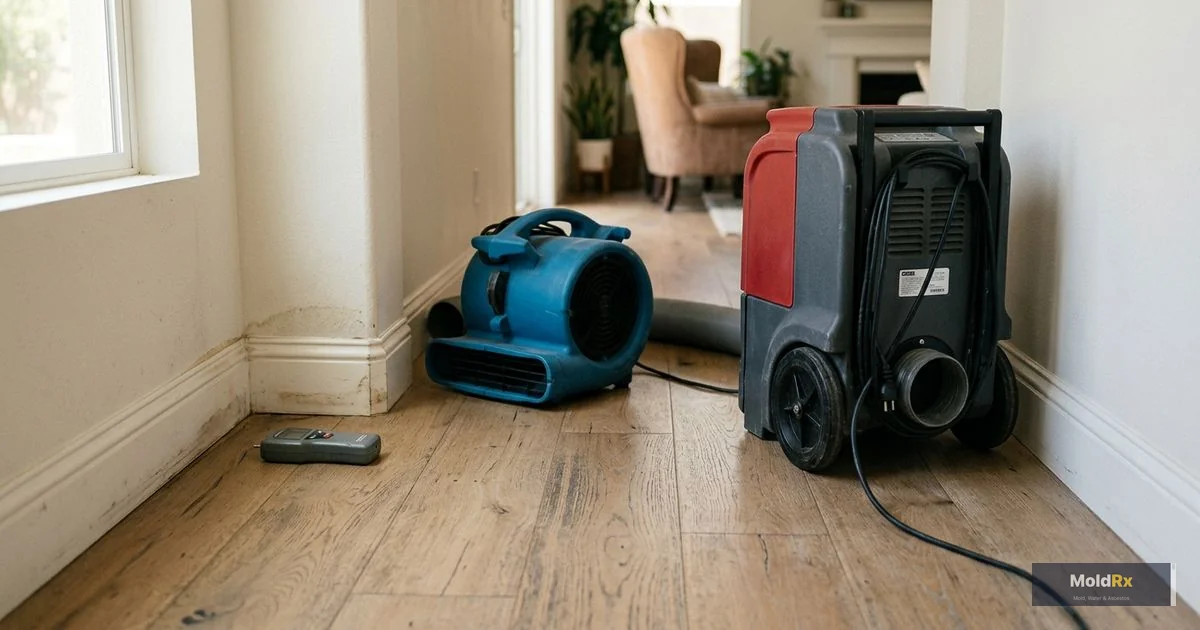
The team arrives with thermal imaging cameras, penetrating and pin-type moisture meters, and hygrometers. They identify the water source, determine the Category (1, 2, or 3) and Class (1 through 4), and map the full extent of moisture intrusion — including areas behind walls and under flooring that show no visible damage.
In Barstow's older homes, this assessment routinely reveals damage far beyond what is visible. Water from a slab leak may have traveled 15 to 20 feet before surfacing as a damp baseboard. Without thermal imaging, that entire damage path goes untreated.
All findings are documented with photos, moisture readings, and detailed notes — the foundation for both the restoration plan and your insurance claim.
Step 3: Rapid Water Extraction
Standing water is removed immediately using truck-mounted and portable extraction units. Every hour water remains in contact with building materials increases damage exponentially. In Barstow homes with slab foundations, extraction includes sub-surface removal using weighted tools that pull water from carpet, pad, and concrete beneath.
For Category 3 events — sewage backups, monsoon flood intrusion — extraction is performed under full containment with HEPA-filtered negative air pressure. All affected porous materials are removed and bagged for disposal per EPA and Cal/OSHA requirements.
Step 4: Structural Drying and Dehumidification
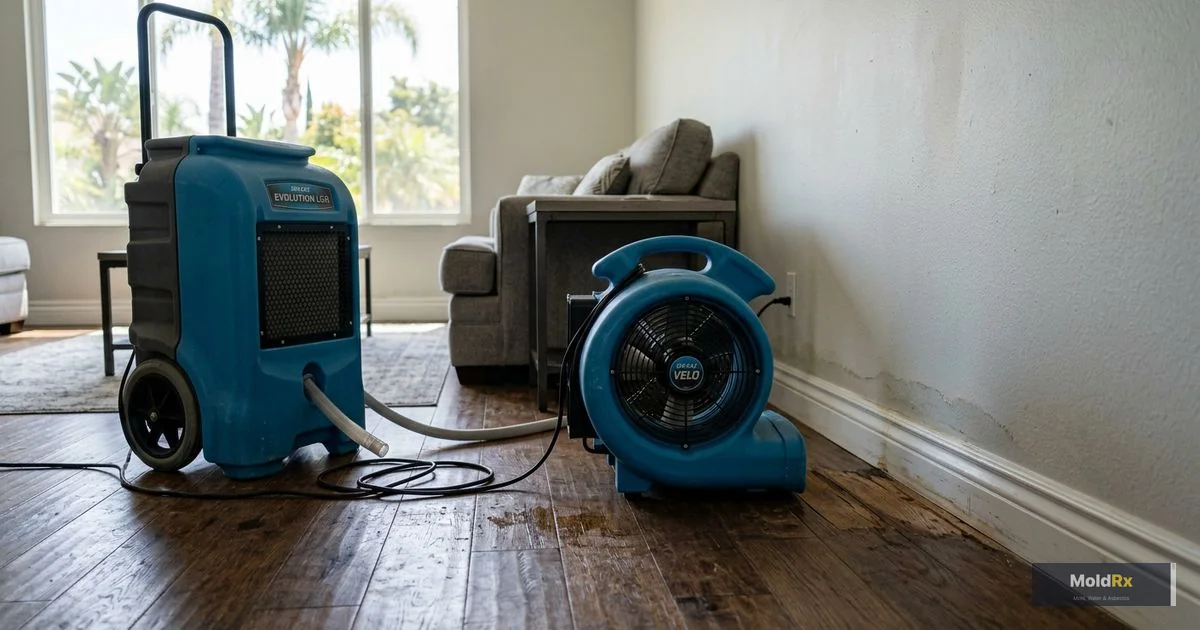
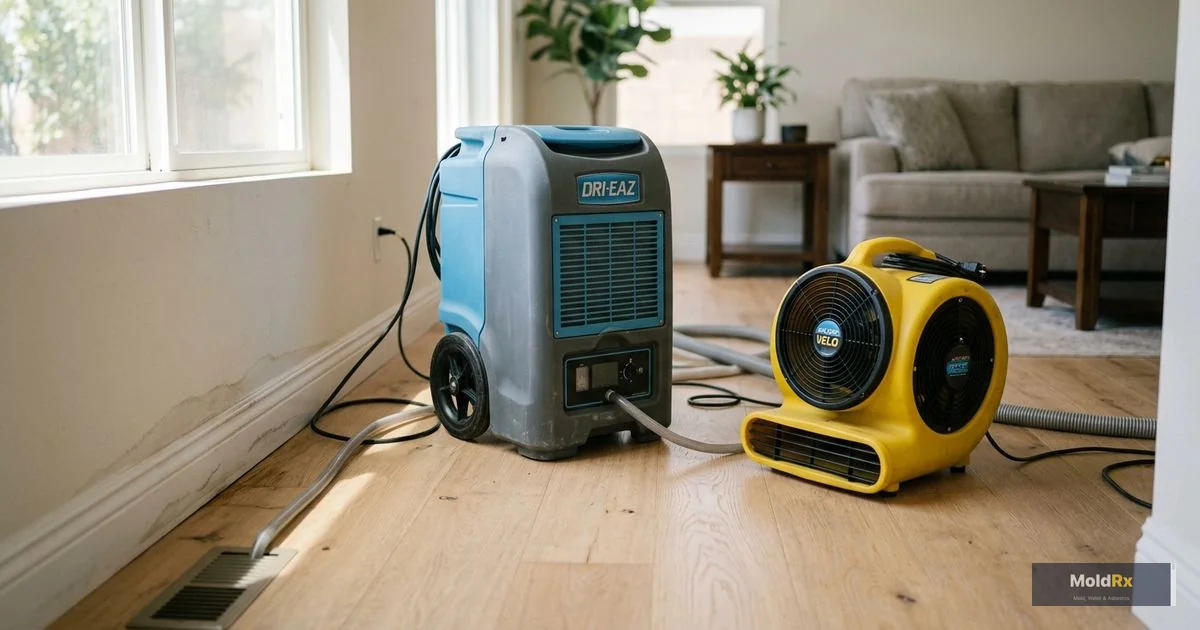
This is where Barstow restorations diverge from coastal or humid climates. Industrial air movers and commercial-grade low-grain refrigerant (LGR) dehumidifiers create targeted airflow patterns that pull trapped moisture from wall cavities, subfloor systems, concrete slabs, and wood framing.
Barstow's low ambient humidity helps exterior drying but does nothing for moisture locked inside building materials. Relying on "just opening the windows" is the most common mistake Barstow homeowners make — and the reason so many water events escalate into mold remediation projects weeks later.
Drying equipment runs continuously. Moisture levels are monitored daily. The process is complete only when meter readings confirm all materials have returned to dry standard per IICRC S500 specifications — not when things feel dry.
For Class 4 situations involving original plaster walls or concrete slab penetration, specialty protocols — including desiccant dehumidification and heat-injection drying — extract moisture from low-permeance materials without secondary damage.
Step 5: Antimicrobial Treatment and Mold Prevention
All affected areas receive antimicrobial treatment to eliminate bacteria and prevent mold colonization. For Category 2 and Category 3 events, this is mandatory. Treatment is applied to exposed framing, subfloor, concrete, and any materials that will be enclosed by reconstruction.
In Barstow's climate, mold prevention is about ensuring no residual moisture remains trapped before materials are sealed behind new drywall or flooring. IICRC S520 protocols guide this phase, and every professional MoldRx dispatches holds this certification.
Step 6: Documentation, Coordination, and Restoration
Complete documentation is compiled — initial moisture readings, daily drying logs, final verification readings, photos from every phase, itemized scope of work. This package is structured to support insurance claims and provides a clear, defensible record of everything performed and why.
If reconstruction is needed, the restoration team coordinates drywall replacement, flooring reinstallation, and trim work — ensuring new materials are installed into a verified-dry structure, not on top of residual moisture.
Barstow Neighborhoods and Areas We Serve
MoldRx coordinates emergency water damage restoration across all of Barstow and the surrounding High Desert communities. Our coverage includes:
- Barstow Heights — Established neighborhood dating to the 1950s with mid-century housing stock and aging plumbing systems
- Lenwood — Rural community along historic Route 66, many residences built between 1940 and 1969, high flash-flood exposure near Lenwood Road
- Lower Heights and neighborhoods north of Main Street
- Historic Downtown Barstow — Properties along Main Street and the original Route 66 corridor
- Areas near Barstow Community Hospital
- Properties along the I-15 and I-40 corridors
- Yermo, Daggett, and Newberry Springs — Unincorporated communities east of Barstow
We serve all properties within ZIP codes 92311 and 92312, including single-family homes, multi-family properties, manufactured homes, and commercial buildings. Whether you own a 1950s ranch in Barstow Heights or a commercial property along the interstate corridor, our vetted professionals have handled the specific challenges your property type presents.
What You Should Do Right Now If You Have Water Damage
If water is actively entering your Barstow property, take these steps immediately:
-
Shut off the water supply if the source is plumbing. The main shut-off is typically near the street meter or where the supply line enters the house.
-
Turn off electrical power to affected areas if water is near outlets or panels. Do not walk through standing water to reach a breaker — call your utility for an emergency disconnect.
-
Do not extract water yourself with a shop vac or household fans. Improper extraction drives water deeper into materials and spreads contamination.
-
Do not demolish wet drywall or flooring before a professional assessment. Premature demo can release mold spores and destroy evidence your insurer needs.
-
Call MoldRx at (888) 609-8907 or request your free emergency estimate. We dispatch vetted, IICRC S500-certified restoration teams to Barstow properties 24/7.
Common Water Damage Scenarios in Barstow
Slab Leaks
Barstow's slab-on-grade construction and aging copper supply lines make slab leaks one of the most common water damage events in the city. Water pressurized at 40 to 80 PSI leaks continuously beneath concrete, saturating the slab and wicking into walls. By the time homeowners notice warm floor spots, high water bills, or running-water sounds with all fixtures off, structural damage may be extensive. Slab leak restoration here almost always involves Class 2 or Class 4 drying protocols.
Water Heater Failures
A standard 40-to-50-gallon water heater lasts 8 to 12 years. In Barstow homes built in the 1950s through 1970s, many replacement units are themselves past service life. When a tank ruptures, it releases its entire volume in minutes — and in homes with interior water heater closets, the damage path extends through multiple rooms. These are typically Category 1, Class 2 or Class 3 events — clean water, but extensive saturation.
Monsoon Flash Flood Intrusion
When monsoon storms hit Barstow, water enters through garage doors, sliding door thresholds, foundation cracks, and any deteriorated point in the building envelope. This water carries soil, road oil, animal waste, and potentially septic overflow — classified as Category 3 (black water) requiring full material removal, antimicrobial treatment, and HEPA air scrubbing per IICRC S500 and Cal/OSHA standards.
Evaporative Cooler and Appliance Failures
Swamp cooler supply lines, float valves, and overflow pans fail gradually. A slow drip from a roof-mounted unit can saturate ceiling insulation and attic framing for weeks before water stains appear — typically a Class 3 event with active mold growth by the time it is discovered. Similarly, rubber supply hoses on washing machines, dishwasher connections, and refrigerator water lines all fail without warning. A burst hose in an interior laundry closet — common in Barstow's older floor plans — can release hundreds of gallons before anyone notices, escalating quickly in homes with particleboard subflooring that absorbs water aggressively.
Related Services in Barstow
If your Barstow property has experienced water intrusion, mold testing and remediation may also be necessary. MoldRx coordinates the following vetted services throughout Barstow and San Bernardino County:
- Mold Removal in Barstow
- Mold Testing in Barstow
- Asbestos Removal in Barstow — Critical for pre-1980 homes where water damage may disturb asbestos-containing materials
- Asbestos Testing in Barstow
- Water Damage Restoration in Barstow
For Barstow homes built before 1980, any restoration involving demolition should include asbestos testing first. Disturbing asbestos-containing materials without containment creates an airborne hazard far more dangerous than the water damage itself. Our vetted professionals check for this as part of the assessment protocol.
→ Learn more about remediation services in Barstow
Frequently Asked Questions
How quickly do I need to act on water damage in Barstow?
Immediately. The IICRC S500 standard identifies 24 to 48 hours as the critical window before mold colonization begins. In Barstow's warm climate, that window can be even shorter. Category 1 water degrades to Category 2 within 48 hours and can reach Category 3 within 72 hours if untreated. Do not wait to see if it dries on its own — it will not dry correctly without professional equipment and monitoring.
What is the difference between Category 1, 2, and 3 water damage?
Category 1 is clean water from a sanitary source (supply line break, sink overflow). Category 2 is gray water that can cause illness (washing machine discharge, degraded Category 1). Category 3 is black water — grossly contaminated with sewage, chemicals, or biological hazards (sewer backup, monsoon floodwater, standing water older than 72 hours). The Category determines safety protocols, PPE requirements, and material removal scope. Our IICRC S500-certified professionals classify the water correctly during the initial assessment.
How do I know if my Barstow home has a slab leak?
Common indicators include unexplained spikes in your water bill, the sound of running water when all fixtures are off, warm or damp spots on the floor, cracked or heaving flooring, musty odors with no visible source, and moisture or mildew along baseboards. In Barstow homes with original or aging copper plumbing, slab leaks are extremely common. If you suspect one, request a professional assessment — thermal imaging can pinpoint the leak location without destructive investigation.
Will my homeowner's insurance cover water damage restoration in Barstow?
Most policies cover sudden and accidental water damage — burst pipes, water heater failures, appliance malfunctions. Gradual damage from deferred maintenance is typically excluded. Flood damage from monsoons requires separate flood insurance. Regardless of coverage, thorough documentation is essential — our vetted professionals provide moisture readings, photos, drying logs, and scope-of-work reports structured to support claims. Request a free estimate to understand your situation before filing.
How long does water damage restoration take in Barstow?
A contained Class 1/Category 1 event may require 3 to 5 days. A Class 3/Category 3 event involving demolition, antimicrobial treatment, and reconstruction can take 2 to 4 weeks. Barstow's low humidity aids drying for exposed materials, but Class 4 situations involving concrete and plaster require extended timelines regardless. You will receive a realistic timeline after the on-site assessment.
Can water-damaged materials in my Barstow home be saved?
It depends on the material, the Category of water, and how quickly drying begins. Hardwood flooring, drywall, and carpet can often be saved if Category 1 water is extracted within 24 to 48 hours. Porous materials exposed to Category 2 or Category 3 water are almost always replaced — they cannot be adequately decontaminated. Original plaster walls in older Barstow homes can sometimes be preserved using Class 4 specialty protocols, but if mold growth has begun behind the plaster, removal is the only safe option.
What certifications should a water damage restoration company have?
At minimum: active IICRC S500 (water damage restoration) and IICRC S520 (mold remediation) certifications, proper CSLB licensing for California, and adequate liability and workers' compensation insurance. For Category 3 events, technicians must follow Cal/OSHA biohazard safety regulations. MoldRx verifies all credentials before adding any professional to our network — confirmed certifications and verified field performance, not a paid directory listing.
Stop the Damage. Call MoldRx Now.
Water damage does not plateau. It does not stabilize. It gets worse every hour — and in Barstow's aging housing stock, where plumbing is decades past its service life and flash flooding is a documented annual threat, the margin for error is zero.
MoldRx does one thing: we connect Barstow property owners with vetted, IICRC S500- and IICRC S520-certified restoration professionals who follow EPA and Cal/OSHA standards, document everything for your insurance claim, and do not stop until moisture readings verify the job is complete. No upselling. No guesswork. No technicians who showed up because they were the cheapest option on a directory.
Call (888) 609-8907 now for emergency water damage restoration in Barstow. Or request your free estimate online — we respond to emergencies 24/7/365.