Asbestos Testing in Banning, CA
MoldRx Only Sends Vetted Asbestos Testing Specialists to Banning and the San Gorgonio Pass
Banning occupies the western mouth of the San Gorgonio Pass, the wind corridor separating the San Bernardino Mountains from the San Jacinto Range in Riverside County. Named for General Phineas Banning and incorporated in 1913, the city grew from a stagecoach and railroad stop into a community of approximately 32,000 across ZIP codes 92220 and 92223. Most of that growth happened between the 1940s and late 1970s -- the exact decades when asbestos-containing materials dominated the construction supply chain.
Later development brought the Sun Lakes 55-plus community (built 1987--2003) and the 831-acre Rancho San Gorgonio master plan. But thousands of older homes in the original townsite, along the Banning Bench, and through the downtown core remain the center of the city's asbestos question. You cannot identify asbestos by looking at a material. Laboratory analysis is the only definitive method, and California law requires testing before renovation or demolition work on pre-1980 structures.
This page covers how asbestos entered Banning's housing, what the health risks are, how testing works, which regulations apply, and what your results mean in practical terms.
How Asbestos Ended Up in Banning Homes
Asbestos is a naturally occurring fibrous mineral valued for heat resistance, tensile strength, and low cost. Manufacturers incorporated it into more than 3,000 building products between the 1920s and early 1980s. Residential use peaked between roughly 1940 and 1978.
Banning grew from a small railroad settlement to about 20,000 people by 1990, tracking directly with the decades of heaviest asbestos use. Contractors building homes along Ramsey Street, on the Banning Bench, and near downtown were purchasing standard products from regional distributors: floor tiles, ceiling textures, pipe insulation, roofing felts, and joint compounds that contained chrysotile, amosite, or other asbestos fiber types.
Understanding which construction era your property belongs to is the first step in evaluating risk.
Pre-1950s Residences
Banning's original townsite and surrounding parcels contain some of the oldest homes in the pass. Structures from this period may contain asbestos in plaster, pipe insulation, knob-and-tube wiring insulation, and early roofing products. These materials have had seventy-plus years of exposure to the pass environment, making condition assessment especially important.
1950s Through 1970s -- The Primary Risk Window
This is the era that produced the highest concentration of asbestos-containing materials in Banning homes. The city's postwar residential growth filled neighborhoods on the Banning Bench, along Lincoln Street, around Highland Springs Avenue, and in the blocks surrounding downtown with tract housing built from the standard material palette of the time.
Materials from this window that routinely contained asbestos include:
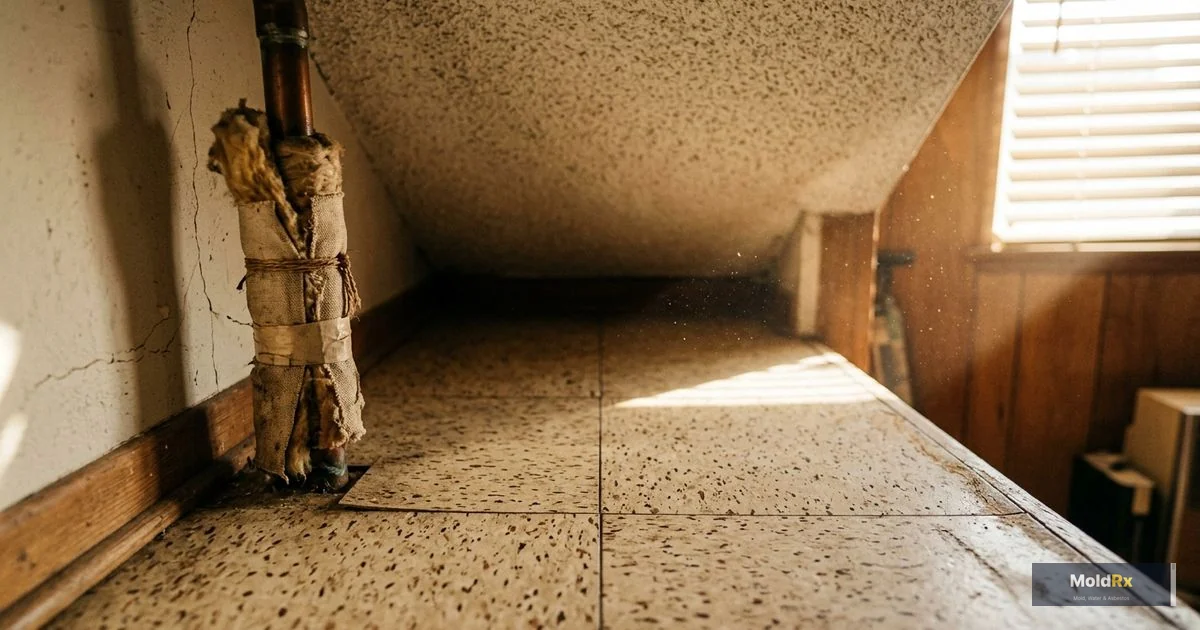
- 9-inch and 12-inch vinyl floor tiles with black cutback mastic adhesive
- Spray-applied acoustic ceiling textures (popcorn ceilings), one of the most common chrysotile applications
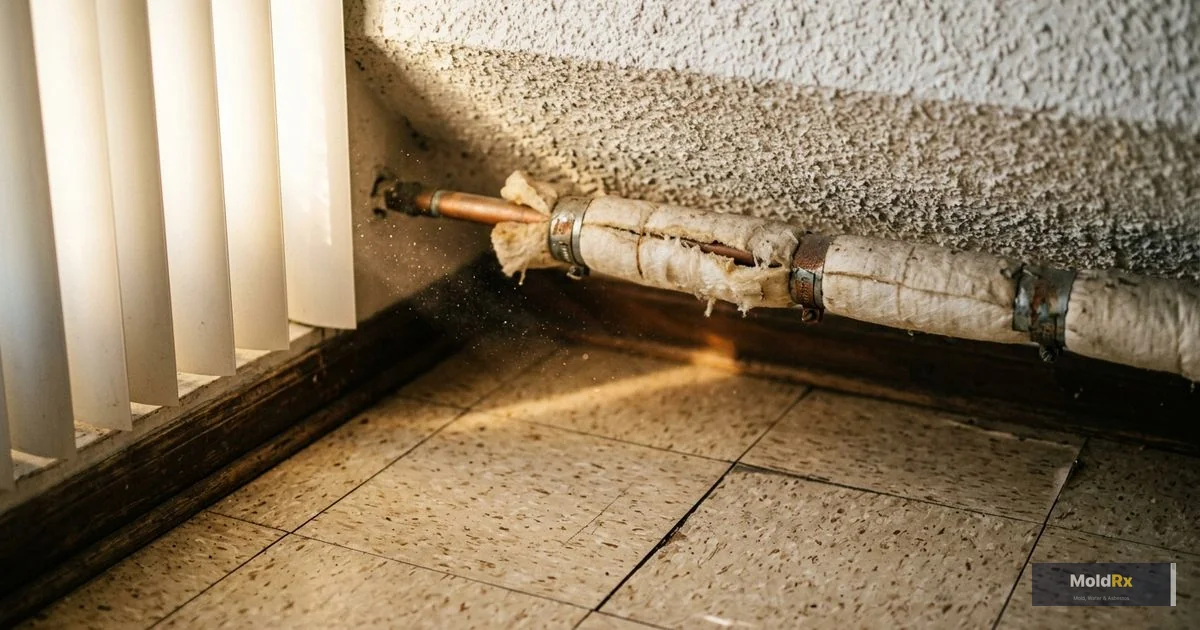
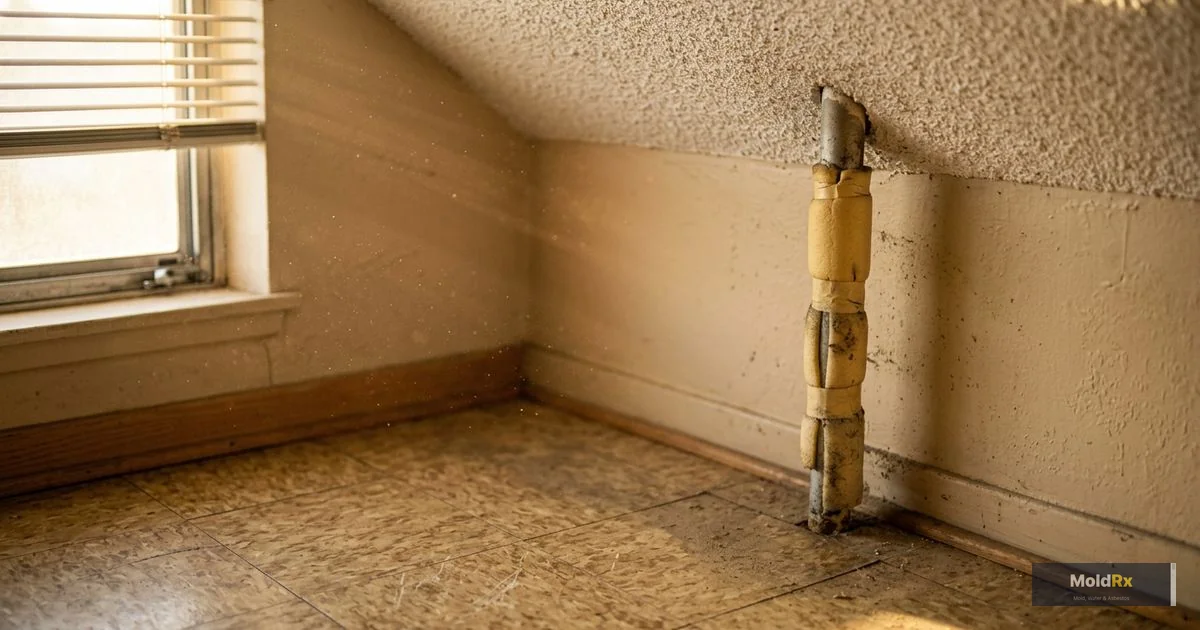
- Pipe and duct insulation on hot water lines, heating system connections, and HVAC ductwork
- Roofing shingles, felt underlayment, and flashing compounds
- Cement-asbestos (transite) siding -- rigid exterior panels reinforced with asbestos fiber
- Joint compound and drywall mud used to finish seams between drywall panels
- Vermiculite attic insulation, a significant percentage of which originated from the Libby, Montana mine contaminated with tremolite asbestos
A home built in 1962 on the Banning Bench could contain asbestos in its ceiling texture, floor tiles, pipe wrap, roof shingles, and wall joint compound simultaneously. None of these materials announce their asbestos content visually. A floor tile containing five percent chrysotile looks identical to one containing zero.
1980s Through 1990s -- The Transition Period
Federal and California state restrictions reduced asbestos use after 1978, but the transition was not instantaneous. Manufacturers continued shipping existing asbestos-containing inventory into the mid-1980s. Homes from this window, particularly those built between 1978 and 1986, deserve evaluation when original materials will be disturbed during renovation or repair.
2000s and Newer Construction
The Sun Lakes community (approximately 3,300 homes built between 1987 and 2003) and the Rancho San Gorgonio development brought thousands of newer residences to the city. Sun Lakes offers fifty different floor plans across its 1,000 rolling acres of golf-course neighborhoods on the city's southern side. These newer homes carry low asbestos risk in their original construction materials.
However, if an addition was built onto an older structure, or if salvaged materials were incorporated, those older components still require evaluation before disturbance.
The San Gorgonio Pass Factor: Why Banning Is Different
Banning's geography introduces an environmental variable that most Riverside County cities do not share. The San Gorgonio Pass funnels air between two mountain ranges through a Venturi effect, producing sustained winds of 30 to 40 mph and gusts regularly exceeding 50 mph. The National Weather Service has recorded gusts above 75 mph in the pass corridor -- the same wind resource that powers over 600 turbines in the San Gorgonio Pass wind farm stretching from Cabazon toward North Palm Springs.
For homeowners, this relentless wind accelerates deterioration of exterior building materials. Roofing shingles, stucco, cement-asbestos siding, and exterior trim weather faster under decades of sustained wind than identical materials in calmer locations. When those materials contain asbestos and begin to crack, flake, or erode, fiber release becomes a concern even without intentional disturbance.
The pass also subjects structures to significant thermal cycling -- summer highs in the mid-90s to low 100s, winter nights in the low 30s. Repeated expansion and contraction degrades roofing felt, duct insulation, pipe wrapping, and sealant compounds. Asbestos-containing materials on Banning homes may be in measurably worse condition than identical materials in sheltered locations twenty miles west.
If you own a pre-1980 home in Banning and notice cracking, chalking, flaking, or erosion on exterior surfaces, testing is particularly advisable.
Understanding the Health Risk
Asbestos fibers are microscopic, invisible to the naked eye, and odorless. You cannot detect them without laboratory analysis. When asbestos-containing materials remain intact and undisturbed, they generally do not pose an immediate inhalation hazard. The danger begins when materials are disturbed -- through renovation, demolition, weathering, water damage, or even routine maintenance tasks like drilling into a textured ceiling or pulling up old floor tiles.
Once airborne, asbestos fibers can be inhaled and become permanently lodged in lung tissue and the lining of the chest cavity. The body cannot break down or expel these fibers. Over latency periods of 10 to 50 years, embedded fibers cause chronic inflammation and cellular damage that can produce three primary diseases:
- Mesothelioma -- a cancer of the lung or abdominal lining, almost exclusively caused by asbestos exposure
- Asbestosis -- progressive, irreversible scarring of lung tissue that restricts breathing
- Lung cancer -- the risk increases substantially with asbestos exposure, particularly combined with smoking
No safe threshold of asbestos exposure has been established. Even a single day of unprotected demolition work on asbestos-containing materials can produce disease decades later. Identification before disturbance is the medical and legal standard of care.
The Regulatory Framework Protecting Banning Property Owners
Multiple overlapping federal, state, and regional regulations govern asbestos identification, handling, and removal. These rules exist because asbestos disease is preventable, and testing is the first link in the prevention chain. Understanding the regulatory landscape helps explain why professional testing and proper documentation are required rather than optional.
Federal Regulations
AHERA (Asbestos Hazard Emergency Response Act). Originally enacted in 1986 to address asbestos in schools, AHERA established the accreditation standards for asbestos inspectors and the laboratory protocols that apply across all asbestos testing work today. AHERA requires that laboratories analyzing bulk asbestos samples hold accreditation through the NIST National Voluntary Laboratory Accreditation Program (NVLAP).
OSHA 29 CFR 1926.1101. The federal asbestos standard for construction, commonly cited as OSHA 1926.1101, requires building owners to identify asbestos-containing materials before any construction, renovation, or demolition activity. It sets a permissible exposure limit of 0.1 fibers per cubic centimeter over an 8-hour time-weighted average and mandates that a competent person oversee all asbestos-related work on site.
California State Regulations
Cal/OSHA Title 8, Section 1529. California's parallel asbestos standard, Cal/OSHA Title 8 SS1529, mirrors and in several areas exceeds the federal requirements. It requires identification of asbestos-containing materials before any work that may disturb them and mandates specific training, medical surveillance, and work practices for anyone performing asbestos-related activities in the state. Cal/OSHA enforcement applies to all Banning properties.
CSLB C-22 Licensing. If asbestos is found and removal becomes necessary, the California Contractors State License Board requires that abatement be performed by a contractor holding the CSLB C-22 Asbestos Abatement classification. C-22 licensees must demonstrate at least four years of journey-level abatement experience and maintain active registration with the Division of Occupational Safety and Health (DOSH). This licensing requirement protects Banning property owners from unlicensed operators performing dangerous work.
Regional Air Quality Regulations
SCAQMD Rule 1403. Banning falls within the South Coast Air Quality Management District. SCAQMD Rule 1403 governs asbestos emissions from demolition and renovation activities across Riverside, San Bernardino, Los Angeles, and Orange counties. The rule requires:
- An asbestos survey by a certified consultant before demolition or renovation
- Written notification to SCAQMD at least 10 working days before work begins on projects involving 100+ square feet of asbestos-containing material, or any demolition
- Specific handling, removal, and disposal procedures for identified materials
- A copy of the notification form provided to Banning's permitting department before a permit is issued
Compliance requires laboratory-confirmed testing results. Visual identification alone does not satisfy Rule 1403.
Laboratory Accreditation Standards
NVLAP (National Voluntary Laboratory Accreditation Program). Administered by NIST, NVLAP accredits laboratories for bulk asbestos analysis using PLM and for airborne analysis using TEM. NVLAP accreditation ensures the lab meets ISO/IEC 17025 standards, participates in proficiency testing, and maintains documented quality systems. Results from an NVLAP-accredited lab carry full regulatory and legal weight for SCAQMD Rule 1403 compliance, real estate transactions, and abatement documentation.
Get your free estimate for asbestos testing in Banning -- call (888) 609-8907 or schedule online.
How the Asbestos Testing Process Works in Banning
Step 1: Consultation and Scope Definition
Every Banning property is different. A 1955 ranch near downtown has different priorities than a 1972 tract home on the Bench or a commercial building along West Ramsey Street. We begin by understanding your property: construction era, planned work scope, previous survey history, and whether the project is driven by a remodel, a real estate transaction, or concern about damaged materials.
For Banning properties, we also consider environmental exposure. A home on the Banning Bench facing decades of pass winds has different exterior conditions than a sheltered property closer to the foothills. These factors inform which materials need sampling and how many samples are needed for thorough coverage.
Step 2: Professional On-Site Sample Collection
A vetted specialist visits your property and collects physical samples from each suspect material. The collection process follows EPA NESHAP and Cal/OSHA protocols:
- Each material is wetted before sampling to suppress fiber release during extraction
- Small representative samples are removed using specialized cutting and coring tools
- Each sample is sealed in a labeled container with a unique identifier
- A chain-of-custody form documents who collected each sample, the time of collection, and the precise location within the property
Multiple samples from different locations ensure that results represent the full property, not just one spot. A single material type can vary in asbestos content from one area to another when materials were applied in phases or sourced from different batches. On-site work for a standard Banning residence is completed in a single visit.
Step 3: NVLAP-Accredited Laboratory Analysis
Samples are submitted to a laboratory holding NVLAP accreditation for bulk asbestos analysis. The primary analytical method is polarized light microscopy (PLM), which identifies:
- Whether asbestos is present in the sample
- Which type of asbestos fiber is present (chrysotile, amosite, crocidolite, tremolite, actinolite, or anthophyllite)
- The concentration percentage of asbestos in the material
PLM is the standard method for bulk material samples. For situations requiring greater analytical sensitivity, such as air monitoring during or after abatement, transmission electron microscopy (TEM) provides detection at much lower fiber concentrations.
Standard PLM results are typically available within 3 to 5 business days. Rush processing can deliver results within 24 hours for time-sensitive projects.
Step 4: Report, Interpretation, and Practical Next Steps
Your report identifies every material sampled, its exact location in the property, and whether asbestos was detected. For positive results, the asbestos type and percentage are documented. The report provides:
- Clear identification of which materials require professional abatement by a CSLB C-22 licensed contractor before renovation work can proceed
- Condition assessment of which materials are currently intact and can be managed in place through periodic monitoring (known as an operations-and-maintenance approach)
- Regulatory documentation that satisfies SCAQMD Rule 1403, Cal/OSHA Title 8 SS1529, and OSHA 1926.1101 requirements for your project file, permit applications, and property records
- Practical guidance on next steps specific to your project timeline, your budget, and your property's actual condition
MoldRx only sends vetted specialists who do not have a financial incentive to find asbestos or to recommend unnecessary work. You get factual results and straightforward interpretation.
What to Expect During the Process
- Minimal disruption. Sample collection does not require you to vacate your home or perform special preparation. Samples are small, and the wetting and containment procedures prevent fiber release during collection.
- Turnaround. On-site work is completed in a single visit. Standard laboratory results arrive within 3 to 5 business days. Rush options are available when your project timeline demands faster answers.
- Complete documentation. Your report meets the documentation requirements of Cal/OSHA Title 8 SS1529, SCAQMD Rule 1403, OSHA 1926.1101, and AHERA laboratory standards. It serves as the foundation for any subsequent abatement work and provides a permanent record for your property files and disclosures.
- Honest assessment. If materials are unlikely to contain asbestos based on their type and installation date, or if testing certain materials is unnecessary for your project scope, we say so directly. No upselling.
Common Materials That Require Testing in Pre-1980 Banning Homes
The following materials were standard in Banning homes built before 1980 and frequently test positive for asbestos:
- Popcorn and acoustic ceiling textures -- Spray-applied textured coatings containing chrysotile asbestos, widely applied from the 1950s through the late 1970s
- Vinyl floor tiles and mastic -- Both the 9-inch and 12-inch tiles and the black cutback adhesive beneath them
- Pipe insulation -- White or gray wrapping on hot water pipes, water heater connections, and heating system piping
- Duct insulation and duct tape -- Insulation inside or around HVAC ductwork and fabric-backed tape at duct joints
- Roofing shingles, felt, and flashing -- Cement-asbestos shingles, reinforced felt underlayment, and flashing compounds. Pass winds accelerate deterioration of these exterior materials.
- Cement-asbestos (transite) siding -- Rigid exterior cladding panels, common on mid-century pass homes and susceptible to wind erosion
- Vermiculite attic insulation -- Loose-fill insulation, much of which originated from the Libby, Montana mine contaminated with tremolite asbestos
- Joint compound and drywall mud -- Taping compounds hidden beneath paint, often overlooked during assessments
- Window glazing putty and caulking -- Putty in older windows and caulking around tubs, sinks, and exterior joints
- Fireplace and wood stove components -- Millboard, heat shields, gaskets, and cement board around fireboxes
- Electrical panel components -- Arc chutes, backing boards, and insulation within older panels
The challenge is consistent: none of these materials can be identified as asbestos-containing by visual inspection alone. Only NVLAP-accredited laboratory analysis using PLM (or TEM for airborne samples) provides a definitive answer.
Banning Neighborhoods and Areas We Serve
MoldRx only sends vetted asbestos testing professionals to properties throughout Banning and the broader San Gorgonio Pass. We serve properties in the 92220 and 92223 ZIP codes, including:
- Historic downtown Banning and the original townsite neighborhoods along the railroad corridor
- Banning Bench and the residential areas along the higher elevations north of the city center
- Sun Lakes -- the 55-plus active adult community with approximately 3,300 homes built between 1987 and 2003
- Rancho San Gorgonio -- the 831-acre master-planned residential community on the city's southern side
- Neighborhoods along Ramsey Street, Lincoln Street, Highland Springs Avenue, and Sunset Avenue
- Smith Creek and surrounding rural residential properties in the unincorporated pass area
Our coverage extends to neighboring pass communities including Beaumont to the west, Cabazon to the east, Cherry Valley to the north, and the unincorporated Riverside County areas between them.
Related Services in Banning
In addition to asbestos testing, we also offer Mold Removal in Banning, Asbestos Removal in Banning, Water Damage Restoration in Banning, and Mold Testing in Banning services to Banning property owners.
Learn more about remediation services in Banning
Frequently Asked Questions About Asbestos Testing in Banning
When is asbestos testing legally required in Banning?
Cal/OSHA Title 8 SS1529 requires identification of asbestos-containing materials before renovation or demolition work on structures built before 1980. SCAQMD Rule 1403 requires an asbestos survey before any demolition and before renovation that could disturb 100+ square feet of suspect material, with notification to Banning's permitting department before a permit is issued. Testing is also recommended before purchasing older properties, when deteriorating materials are observed, or for insurance and disclosure documentation.
Does the wind in the San Gorgonio Pass affect asbestos materials?
Yes. Sustained winds and gusts above 75 mph accelerate weathering on exterior materials. Roofing, cement-asbestos siding, stucco, and trim containing asbestos deteriorate faster in Banning than in calmer Riverside County locations. If you notice cracking, flaking, or erosion on pre-1980 exterior materials, testing is particularly advisable. Thermal cycling between hot summers and cold winter nights compounds this effect.
What materials are most commonly found to contain asbestos in Banning homes?
The most frequently identified materials are popcorn ceiling textures, vinyl floor tiles with black mastic, pipe and duct insulation, roofing shingles and felt, joint compound, and cement-asbestos siding. Less obvious materials like window glazing putty, electrical panel components, and vermiculite insulation also test positive. The only certainty comes from NVLAP-accredited PLM or TEM analysis.
What happens if asbestos is found in my Banning home?
It depends on condition and your plans. Intact materials that will not be disturbed can often be managed in place through periodic monitoring (operations-and-maintenance approach). Materials that will be disturbed must be removed by a CSLB C-22 licensed abatement contractor before other trades begin. Your report identifies each positive material, its condition, and the recommended action.
Can I collect my own asbestos samples in California?
California allows homeowners to collect samples from their own residential property. However, improper sampling technique can release fibers into your living space and produce unreliable laboratory results. Professional sample collection follows EPA NESHAP and Cal/OSHA protocols specifically designed to prevent fiber release during the process. Regardless of who collects the sample, analysis must be performed by an NVLAP-accredited facility using approved PLM or TEM methods.
My home is in Sun Lakes. Do I need asbestos testing?
Sun Lakes homes were built between 1987 and 2003, after the peak era of asbestos use in residential construction. Original construction materials in Sun Lakes homes generally carry low asbestos risk. However, if you are renovating and your specific home has components of uncertain origin, additions from earlier construction, or materials sourced from older structures, testing before disturbance is the safe and legally sound approach. A brief consultation with MoldRx can help determine whether testing is warranted for your situation.
How long does the entire process take from start to finish?
On-site sample collection is completed in a single visit, typically within a few hours depending on the size and complexity of the property. Standard NVLAP-accredited laboratory analysis takes 3 to 5 business days. Rush processing can deliver PLM results within 24 hours for time-sensitive projects. From initial contact to final report delivery, most Banning residential projects are completed within one week.
What is the difference between PLM and TEM analysis?
PLM (polarized light microscopy) is the standard method for analyzing bulk material samples -- physical pieces of tile, insulation, ceiling texture, and similar materials. It identifies asbestos type and concentration. TEM (transmission electron microscopy) is used for airborne fiber analysis, including air monitoring during abatement and clearance testing afterward. Both methods require NVLAP-accredited laboratory facilities. Your specialist will recommend the appropriate method based on your project.
Schedule Asbestos Testing for Your Banning Property
Banning's combination of mid-century housing stock, aggressive San Gorgonio Pass winds, and extreme thermal cycling makes asbestos testing especially relevant for property owners planning renovation, demolition, maintenance, or sale of pre-1980 structures. Testing gives you definitive, NVLAP-accredited, laboratory-confirmed answers about what is in your home's materials, and it provides the documentation required by Cal/OSHA Title 8 SS1529, SCAQMD Rule 1403, OSHA 1926.1101, and AHERA standards for any subsequent work.
MoldRx only sends vetted asbestos testing specialists who understand the construction patterns in the San Gorgonio Pass, the environmental factors that affect material condition in this wind corridor, and the regulatory requirements that apply to your Riverside County project. You get factual results and honest guidance -- nothing more, nothing less.
No guesswork. No runaround. Contact MoldRx to schedule asbestos testing for your Banning property -- call (888) 609-8907 or request your free estimate online.