Emergency Water Damage Restoration in Apple Valley, CA — MoldRx
MoldRx Only Sends Vetted, Water Damage Restoration Specialists to Apple Valley Homes — Available 24/7
Water is inside your Apple Valley home right now, and every hour matters. A slab leak slowly saturating your foundation. A swamp cooler line that cracked overnight. A supply line that blew while you were at work. Whatever brought you here, the damage is already spreading — through drywall, into subfloor cavities, beneath your slab. In the High Desert, the destruction water causes is invisible long before it becomes catastrophic.
You do not have time to gamble on the wrong company. MoldRx coordinates vetted, IICRC S500-certified water damage restoration professionals who understand what Apple Valley properties face and who respond to emergencies around the clock. We do not send just anyone. Every specialist in our network carries the credentials, the equipment, and the field experience to handle water Categories 1 through 3 and damage Classes 1 through 4 — because the difference between a three-day dry-out and a five-figure structural rebuild is measured in hours, not days.
Your home is taking on damage right now. Request your free estimate or call (888) 609-8907 immediately.
Why Water Damage in Apple Valley Is a Different Animal
Apple Valley sits at roughly 2,900 feet elevation in San Bernardino County's High Desert, home to approximately 76,000 residents across a sprawling expanse of subdivisions, ranchettes, and newer master-planned communities. Incorporated in 1988, this town has grown in waves — and each wave of construction brought its own vulnerabilities.
The Housing Stock Is Aging — Fast
The median construction year for Apple Valley homes is 1987. That means a significant share of the housing stock — particularly in neighborhoods like Apple Valley Ranchos, Sitting Bull, and the areas south of Bear Valley Road — was built in the 1970s through 1990s. These properties carry plumbing systems that are now 30 to 50 years old: galvanized steel supply lines corroding from the inside out, early copper joints developing pinhole leaks, and polybutylene piping (common in 1980s desert construction) that has been failing across the region for decades.
The result is predictable and relentless: slab leaks. Apple Valley homes sit overwhelmingly on slab-on-grade foundations. When a supply line or waste line fails beneath that slab, water migrates laterally through the concrete and into surrounding materials — silently, invisibly — until you notice a warm spot on your tile floor, a spike in your water bill, or the faint smell of something wrong. By then, the damage has been spreading for days or weeks.
Swamp Coolers: The High Desert's Hidden Flood Risk
Roughly 290 days of sunshine a year and summer temperatures that routinely exceed 100 degrees Fahrenheit mean that evaporative (swamp) coolers remain a primary cooling method in Apple Valley. These rooftop units rely on a constant water supply, float valves, reservoirs, and distribution lines — all of which are exposed to extreme UV degradation, mineral buildup from Apple Valley's notoriously hard water, and temperature cycling that cracks fittings over time.
When a swamp cooler fails, water does not puddle politely on your roof. It follows gravity through roof penetrations, into attic insulation, down interior wall cavities, and across ceiling drywall. A single malfunctioning float valve can release gallons of water into your home's structure before anyone notices. These losses are deceptive: the visible damage is a fraction of what is happening behind walls and above ceilings.
Desert Climate Creates a Dangerous False Sense of Security
Annual rainfall in Apple Valley averages only 5 to 6 inches. Relative humidity hovers between 15 and 30 percent for much of the year. Homeowners naturally assume that water damage will "dry itself out" in this climate. This assumption has destroyed more Apple Valley homes than the water itself.
Here is the reality: when water enters a wall cavity, migrates under flooring, or saturates subfloor materials, the dry desert air outside has almost no effect on the trapped moisture inside. These enclosed spaces maintain their own microclimate — elevated humidity, reduced airflow, stagnant warmth. According to EPA mold prevention guidelines, mold colonization can begin within 24 to 48 hours of water intrusion, regardless of the outdoor climate. In Apple Valley's summer heat, the interior of a wet wall cavity becomes an incubator.
Without professional extraction, psychrometric monitoring, and controlled structural drying, that hidden moisture becomes a mold problem — and a mold problem in a desert home is one that insurance adjusters and buyers find deeply alarming.
Monsoon Season and Flash Flooding
Apple Valley's dry reputation obscures a dangerous reality: when rain arrives in the High Desert, it arrives violently. Summer monsoon storms and winter atmospheric rivers can dump intense rainfall in short windows. The hard, calcium-rich desert soil has minimal absorption capacity, sending sheets of runoff toward foundations, into garages, and through any crack or gap in your home's envelope.
In 2025, San Bernardino County experienced multiple severe weather events that prompted state emergency declarations. Rock Springs Road between Hesperia and Apple Valley was shut down due to flooding — a reminder that the High Desert is not immune to catastrophic water events. Flash floods do not need to reach your front door to cause damage. Surface water pooling against your foundation, seeping through weep screeds, or backing up through landscape drains can introduce thousands of gallons into your slab and lower wall assemblies.
The IICRC S500-Compliant Restoration Process — How Vetted Specialists Save Your Home
When you call MoldRx about water damage in your Apple Valley property, we dispatch professionals who follow the ANSI/IICRC S500 Standard for Professional Water Damage Restoration — the nationally recognized protocol that defines how water damage should be assessed, classified, mitigated, and documented. This is not a suggestion. It is the standard that insurance carriers, public adjusters, and courts rely on to determine whether restoration work was performed correctly.
Here is what that process looks like in your home:
1. Emergency Response and Loss Assessment
A vetted specialist arrives and performs a comprehensive assessment of the loss. Using calibrated moisture meters, thermal imaging cameras, and hygrometers, they map the full extent of water migration — not just where you can see damage, but where water has traveled behind walls, under cabinets, and into structural cavities. This moisture mapping establishes the baseline that every subsequent decision is built on.
The specialist classifies the loss along two axes defined by IICRC S500:
Water Category (Contamination Level):
- Category 1 — Clean water from a sanitary source: broken supply lines, sink overflows, appliance malfunctions. Low health risk, but still demands immediate extraction.
- Category 2 — Grey water with significant contamination: dishwasher or washing machine discharge, toilet overflows with urine, sump pump failures. Requires enhanced antimicrobial protocols.
- Category 3 — Black water carrying pathogenic or toxigenic agents: sewage backups, flooding from rivers or storm runoff, toilet overflows with fecal matter. Demands hazmat-level safety protocols compliant with Cal/OSHA regulations.
Damage Class (Evaporation Rate):
- Class 1 — Least amount of water absorption. Only part of a room is affected, with low-porosity materials.
- Class 2 — Significant water absorption. An entire room of carpet and cushion, or water wicking up walls 12 to 24 inches.
- Class 3 — Greatest amount of water absorption. Ceilings, walls, insulation, carpet, cushion, and subfloor are saturated — common in swamp cooler failures and attic-origin losses.
- Class 4 — Specialty drying situations. Water has penetrated deep into low-permeance materials like hardwood, plaster, concrete, or stone. These materials require extended drying times and specialized equipment. Slab leak losses in Apple Valley frequently fall into this category.
This dual classification is not academic. It determines equipment placement, drying goals, antimicrobial treatment requirements, safety protocols, and the scope of materials that may need removal. Getting it wrong means either over-remediating (costing you money) or under-remediating (leaving hidden damage that surfaces months later).
2. Water Extraction — Removing the Source of Ongoing Damage
Standing water is removed immediately using truck-mounted and portable extraction units. For Apple Valley's slab-on-grade homes, weighted extraction tools pull water from carpet, pad, and hard surfaces while sub-surface extractors address water trapped in concrete pores.
Every hour that standing water remains in contact with building materials, the damage class escalates. A Class 2 loss at 8 AM becomes a Class 3 loss by evening if water is not extracted promptly. This is why MoldRx coordinates 24/7 emergency response — because water does not wait for business hours, and neither should your restoration team.
3. Structural Drying — The Science That Separates Professionals from Amateurs
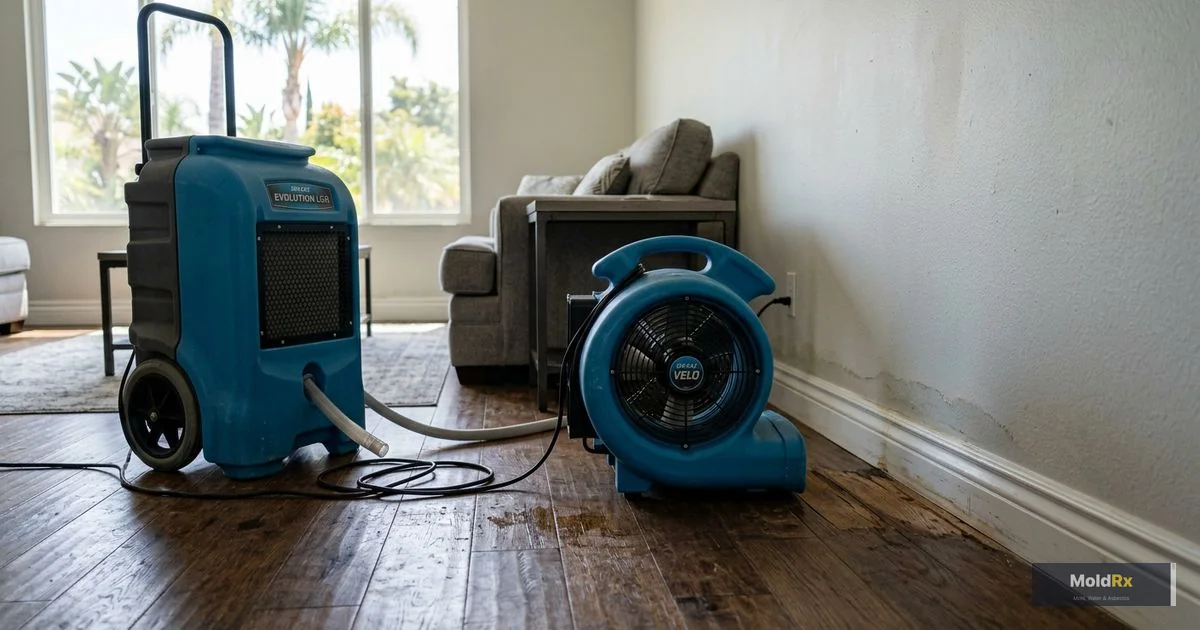
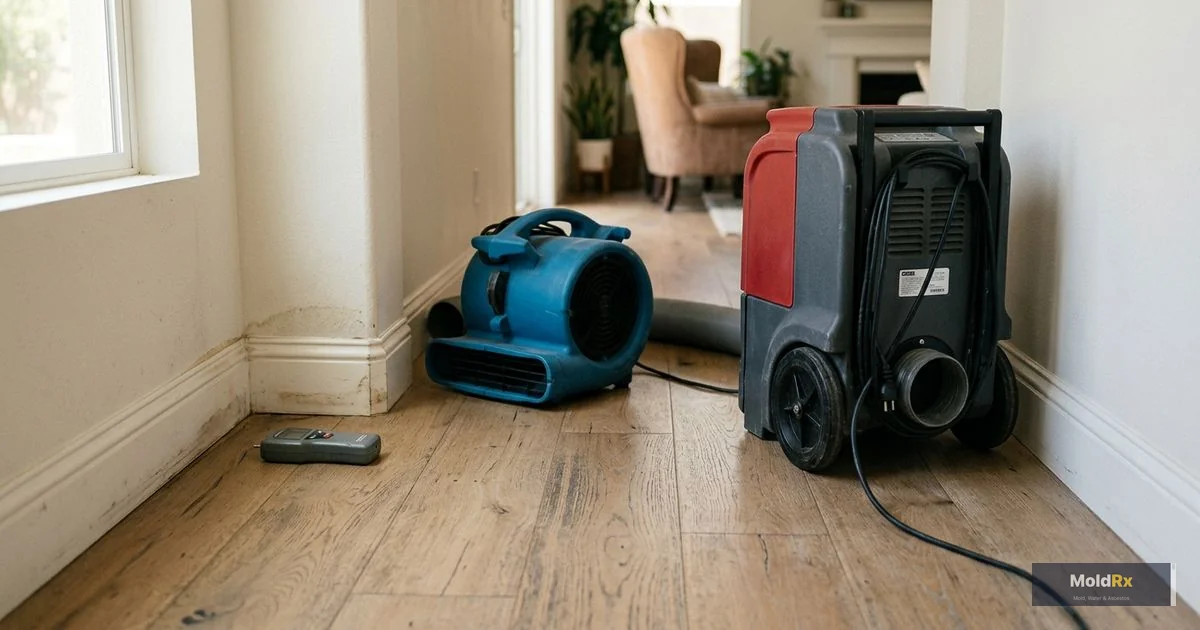
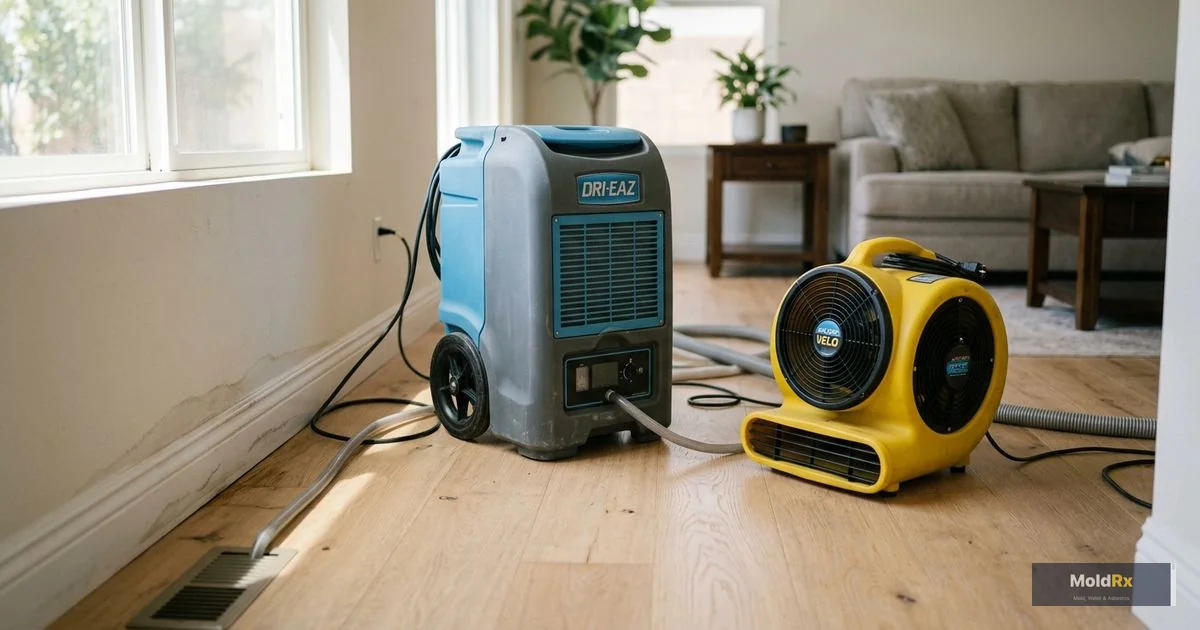
This is where credential depth matters most. Vetted specialists establish psychrometric drying goals based on ambient temperature, relative humidity, and the specific materials affected. Industrial-grade dehumidifiers (desiccant and LGR units), high-velocity air movers, and specialty equipment like injectidry systems (for wall cavities) and floor mat systems (for hardwood and concrete) are positioned according to IICRC S500 protocols.
Moisture readings are taken at least daily using penetrating and non-penetrating meters. Temperature and relative humidity are logged at dehumidifier inlets and outlets, inside affected areas, outside the structure, and within wall cavities. The data drives every equipment adjustment. Drying is not complete when surfaces feel dry to the touch — it is complete when moisture content readings reach the dry standard for each specific material, verified by instrument, not guesswork.
In Apple Valley's dry climate, the ambient conditions can accelerate drying when equipment is deployed correctly. But "correctly" is the operative word. Improperly positioned equipment in a low-humidity environment can over-dry materials, causing secondary damage like hardwood cupping, drywall cracking, and joint separation. The specialists in our network understand psychrometric science — not just how to plug in a fan.
4. Antimicrobial Treatment and Mold Prevention
Following EPA mold prevention guidelines and IICRC S520 (the Standard for Professional Mold Remediation), affected materials receive antimicrobial treatment calibrated to the water category. Category 2 and Category 3 losses require aggressive microbial intervention, including removal of porous materials that cannot be adequately decontaminated.
For Apple Valley homes, mold prevention is not optional — it is the entire point. The EPA is clear: the window between water intrusion and mold colonization is 24 to 48 hours. Once mold establishes in wall cavities or subfloor assemblies, the remediation scope (and cost) expands dramatically. Proper antimicrobial treatment during the drying phase is orders of magnitude less expensive than mold remediation after the fact.
5. Restoration and Reconstruction
Once all affected areas reach verified dry standard, restoration begins. This may include drywall replacement, flooring removal and replacement, baseboard and trim work, texture matching, painting, and cabinet reconstruction. For slab leak losses, this often includes concrete repair and re-routing of failed supply or waste lines.
Vetted specialists document every phase of the restoration with moisture readings, photographs, equipment logs, and detailed scope reports — the documentation your insurance carrier requires to process your claim efficiently.
What MoldRx Guarantees — And What We Will Not Do
We only send vetted specialists. Every water damage professional in our Apple Valley network is verified for IICRC certification, active CSLB (Contractors State License Board) licensure, proper insurance coverage, and demonstrated field competence with S500-compliant protocols. We do not maintain a roster of "preferred vendors" who pay for placement. We maintain a network of professionals who earn their position through credentials and performance.
We will never quote you a price before assessing your property. Every water damage loss is different. The water category, damage class, materials affected, square footage involved, and accessibility of damaged areas all influence the scope of work. Anyone who quotes a price over the phone before seeing your home is guessing — and guesses lead to change orders, disputes, and incomplete work. We provide thorough, transparent assessments so you understand exactly what is needed.
What you can expect:
-
Brutal honesty about your situation. If the damage is less severe than you feared, you will hear that. If it is worse, you will hear that too — along with a clear explanation of why, what happens if it is not addressed, and what the restoration path looks like.
-
Complete documentation for insurance. Moisture maps, daily readings, equipment logs, photo documentation, and detailed scope reports. Your adjuster will have everything they need.
-
Verified drying, not surface drying. The job is complete when instruments confirm dry standard — not when surfaces look or feel dry. Hidden moisture left behind is a future mold problem, and mold problems in Apple Valley real estate transactions kill deals.
-
Mold prevention built into every job. Following EPA guidelines and IICRC S520 protocols, antimicrobial treatment and containment procedures are standard — not upsells.
Apple Valley Neighborhoods and Areas We Serve
MoldRx coordinates emergency water damage restoration throughout Apple Valley, including:
- Jess Ranch and the communities surrounding Jess Ranch Marketplace
- Apple Valley Ranchos and the older subdivisions south of Bear Valley Road
- Sitting Bull and neighboring areas east of Apple Valley Road
- Mariana Ranchos and the rural properties along Tussing Ranch Road
- North Apple Valley near the Mojave Narrows Regional Park corridor
- Properties surrounding Civic Center Park and the Town Hall complex
- Newer developments along Yucca Loma Road and the Ranchos Road corridor
We serve ZIP codes 92307, 92308, and all unincorporated San Bernardino County areas surrounding Apple Valley. We also respond to water damage emergencies in neighboring High Desert communities including Victorville, Hesperia, Lucerne Valley, Oro Grande, and Phelan/Pinon Hills.
Dealing with an emergency right now? Get your free estimate or call (888) 609-8907. We respond 24/7.
Related Services in Apple Valley
Water damage rarely stays a water damage problem. In addition to emergency restoration, MoldRx coordinates Mold Removal in Apple Valley, Mold Testing in Apple Valley, Asbestos Removal in Apple Valley, Asbestos Testing in Apple Valley, and Water Damage Restoration in Apple Valley services throughout the community.
-> Learn more about remediation services in Apple Valley
Frequently Asked Questions
How fast should I act on water damage in my Apple Valley home?
Immediately. Every hour matters. The EPA states that mold can begin growing within 24 to 48 hours of water intrusion. Beyond mold, standing water causes progressive material degradation — a Class 2 loss can escalate to Class 3 or Class 4 within hours if extraction is delayed. The difference between a manageable restoration and a major structural rebuild often comes down to how quickly professional extraction begins. Call MoldRx at (888) 609-8907 for same-day emergency response.
What are the water categories and damage classes I keep hearing about?
These are the classification systems defined by the IICRC S500 Standard for Professional Water Damage Restoration. Water categories (1 through 3) describe contamination level — from clean supply-line water to sewage and floodwater. Damage classes (1 through 4) describe how much water materials have absorbed and how difficult drying will be. Together, they determine the equipment, protocols, safety measures, and scope of work required. Any company that does not classify your loss using these standards is not following industry protocol.
Are slab leaks really that common in Apple Valley?
Extremely common. Apple Valley's housing stock has a median construction year of 1987, meaning most homes have plumbing systems that are 30 to 50 years old — well into the failure window for galvanized steel, early copper, and polybutylene piping. Combine aging pipes with slab-on-grade foundations, extreme temperature cycling (freezing desert nights to 100-plus-degree days), and high mineral content in the local water supply, and slab leaks become a matter of when, not if. These losses frequently fall into Class 4 (specialty drying) because water saturates the concrete itself.
Can my swamp cooler really cause serious water damage?
Yes — and it happens more often than most Apple Valley homeowners realize. A failed float valve, cracked reservoir, or corroded supply line on a rooftop evaporative cooler can release a continuous flow of water into your attic space and down through your ceiling and wall cavities. Because the unit is on the roof, homeowners often do not notice the failure until water appears on interior ceilings or walls — by which point significant hidden damage has already occurred. These losses are typically Class 3 (greatest amount of absorption) because water has migrated through insulation, ceiling drywall, and wall assemblies.
Will my homeowner's insurance cover this?
Most standard homeowner's policies cover sudden and accidental water damage — burst pipes, appliance failures, supply line breaks. Gradual damage from deferred maintenance, and flooding from external sources, typically require separate coverage or endorsements. The specialists in our network provide IICRC S500-compliant documentation — moisture maps, daily logs, photo evidence, and detailed scope reports — that insurance adjusters rely on to process claims. Thorough documentation is the single most important factor in a smooth claims process.
How long does water damage restoration take in Apple Valley?
It depends entirely on the water category, damage class, materials affected, and square footage involved. A contained Category 1, Class 2 loss (a single-room supply line break with prompt response) may reach dry standard in 3 to 5 days. A Category 3, Class 4 slab leak with multi-room involvement can require 10 to 14 days of structural drying before reconstruction begins. Our specialists provide realistic timelines after the initial assessment — not optimistic guesses designed to win the job.
What does "vetted" actually mean when MoldRx says it?
It means every specialist we dispatch to your Apple Valley home has been verified for active IICRC certification (including S500 water damage restoration credentials), current CSLB licensure in the state of California, appropriate liability and workers' compensation insurance, and compliance with Cal/OSHA safety requirements. We do not accept paid placements. We do not rotate a generic vendor list. We verify credentials, confirm active status, and only send professionals who meet the standard.
Your Apple Valley Home Is Taking on Damage Right Now
Water does not pause. It does not slow down while you compare companies or wait for morning. Right now, moisture is migrating through your building materials, the damage class is escalating, and the 24-to-48-hour mold clock established by EPA guidelines is running.
MoldRx exists to end that uncertainty. We only send vetted, IICRC-certified specialists who follow S500 and S520 protocols, carry proper CSLB licensure, and comply with Cal/OSHA safety standards. They bring the equipment, the psychrometric expertise, and the documentation discipline to stop the damage, dry the structure, prevent mold, and give your insurance adjuster everything they need.
Do not wait another hour.
Request your free estimate now | Call (888) 609-8907 for 24/7 emergency response