Asbestos Testing in Anaheim, CA — MoldRx
Licensed Asbestos Testing Professionals Serving Anaheim and Central Orange County
Planning a kitchen renovation in your 1960s West Anaheim ranch home, updating a Colony District bungalow, or replacing the roof on a mid-century property near Brookhurst? Before any work begins, you need laboratory confirmation of what is inside your walls, ceilings, and floors. Anaheim is one of Orange County's largest and oldest cities — with a residential history stretching from the 1857 German colony to the post-Disneyland suburban explosion that transformed thousands of acres of orange groves into tract housing during the peak decades of asbestos use. The mineral is invisible to the naked eye, impossible to identify without lab analysis, and hazardous only when disturbed — which is precisely what renovation does. California law and SCAQMD Rule 1403 require testing before disturbing building materials in pre-1980 structures, and Rule 1403 extends the survey requirement to structures of any age before demolition. MoldRx only sends vetted asbestos testing professionals who understand the regulatory landscape and construction patterns across Anaheim's diverse neighborhoods.
Request your free consultation — we'll help you determine if testing is needed for your project.
Why Anaheim Properties Carry Asbestos Risk
Anaheim is not a single-era suburb. It is a city of approximately 350,000 residents with housing spanning more than a century — from Victorian-era Colony District homes to Anaheim Hills communities still under construction in the 2000s. That diversity creates a layered asbestos risk profile that varies by neighborhood and construction decade, and demands attention before any renovation begins.
A City Built Across Every Phase of the Asbestos Era
In 1857, fifty German immigrant families purchased 1,165 acres near the Santa Ana River and established the Anaheim Colony — a winemaking settlement bounded by what are now North, South, East, and West Streets. After Pierce's Disease destroyed the vineyards in the 1880s, the community shifted to citrus agriculture. Those early decades produced the oldest homes in the city, many still standing in the Colony Historic District — a 1.8-square-mile area with over 1,000 qualified historic structures.
The real building surge came after World War II, as new home development replaced Valencia orange groves. Then came Disneyland. When the park opened on July 17, 1955, Anaheim became a boomtown. Workers who helped build Disneyland purchased homes in surrounding neighborhoods, and by the end of the 1950s the population had surged from roughly 15,000 to over 100,000.
The 1960s intensified the boom. Industries moved west, workers came by the thousands, and subdivisions consumed remaining agricultural parcels throughout central and western Anaheim. By 1970, the population reached 166,000, and development turned to the eastern hills — the Nohl Ranch area, where Texaco Industries announced plans for a 7,000-home master-planned community called Anaheim Hills. The first neighborhood, Westridge, opened in 1972 and sold all 325 homes by early 1975.
That timeline matters because asbestos was a standard building material throughout every one of these construction waves. Chrysotile asbestos was mixed into floor tiles, ceiling texture, joint compound, pipe insulation, roofing felt, and cement siding. The EPA began regulating asbestos in spray-applied products in 1978, but existing inventory continued to be installed into the early 1980s, and asbestos persisted in some building products well beyond that date.
The practical consequence: the majority of Anaheim's housing stock — everything built before the mid-1980s — has a moderate to high probability of containing asbestos-containing materials. Only the most recent developments in eastern Anaheim Hills and the Platinum Triangle carry genuinely low risk.
Industrial History Compounds Residential Risk
Anaheim's asbestos story extends beyond residential construction. Disneyland and the Disneyland Hotel used asbestos in attraction buildings and renovations through the late 1970s. The Autonetics/Rockwell International facility on East Orangewood Avenue used asbestos in manufacturing processes. General Motors ran a Delco Remy battery plant from 1954 to 1994 — a facility known to have contained asbestos. The Anaheim Convention Center (built 1967) and original City Hall both required asbestos abatement. For homeowners near these former industrial sites, testing your own property is the only way to know what you are dealing with.
Climate Considerations
Anaheim's semi-arid Mediterranean climate — summer highs in the mid-80s to low 90s, mild winters, roughly 14 inches of annual rainfall — preserves building materials far longer than humid coastal environments. That preservation is deceptive. Well-preserved materials still contain asbestos at original concentrations. When a homeowner scrapes a decades-old popcorn ceiling that looks "just fine," they release a dense cloud of microscopic fibers. In garages, attics, and exterior spaces where temperatures cycle between summer heat above 100 degrees and cool winter nights, decades of thermal stress can make materials friable — crumbly and prone to releasing fibers even without direct disturbance.
When Asbestos Testing Is Necessary in Anaheim
Not every project requires asbestos testing, but more situations call for it than most homeowners expect.
Before Any Renovation or Demolition (California Law)
SCAQMD Rule 1403 requires an asbestos survey before renovation or demolition — residential and commercial, regardless of building age. The only narrow exception is single-unit dwelling renovation disturbing less than 100 square feet of intact material. Kitchen tearouts, flooring replacement, popcorn ceiling removal, bathroom remodels, roof replacements — all require testing first. Non-compliance fines can exceed $20,000 per day.
When Buying or Selling a Property
California disclosure laws require sellers to report known hazards. A pre-purchase asbestos test gives buyers a clear picture of what they are acquiring. In Anaheim — where mid-century tract homes, 1970s split-levels, and 1980s Anaheim Hills residences represent the bulk of inventory — this information directly affects negotiations and budgeting.
When Materials Are Visibly Damaged or Deteriorating
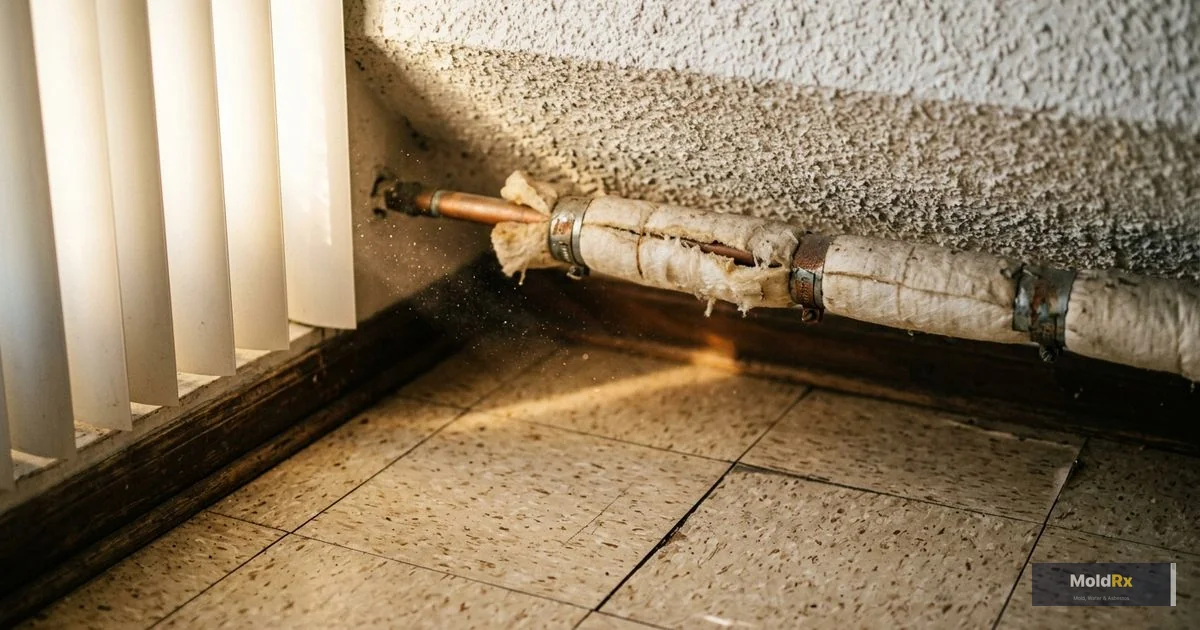
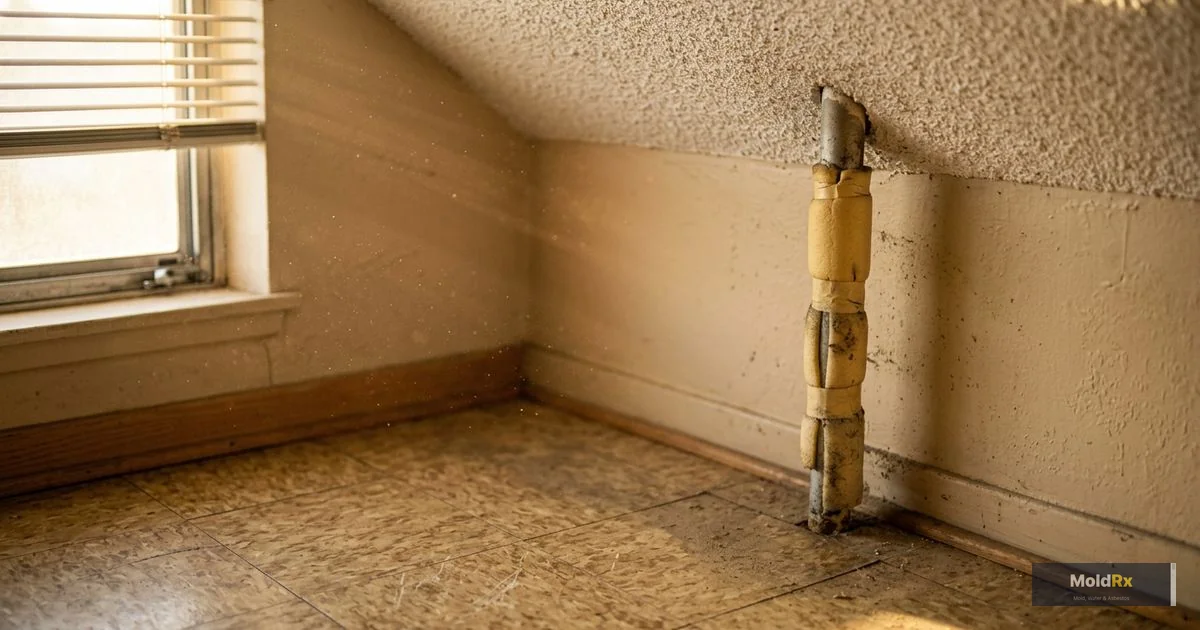
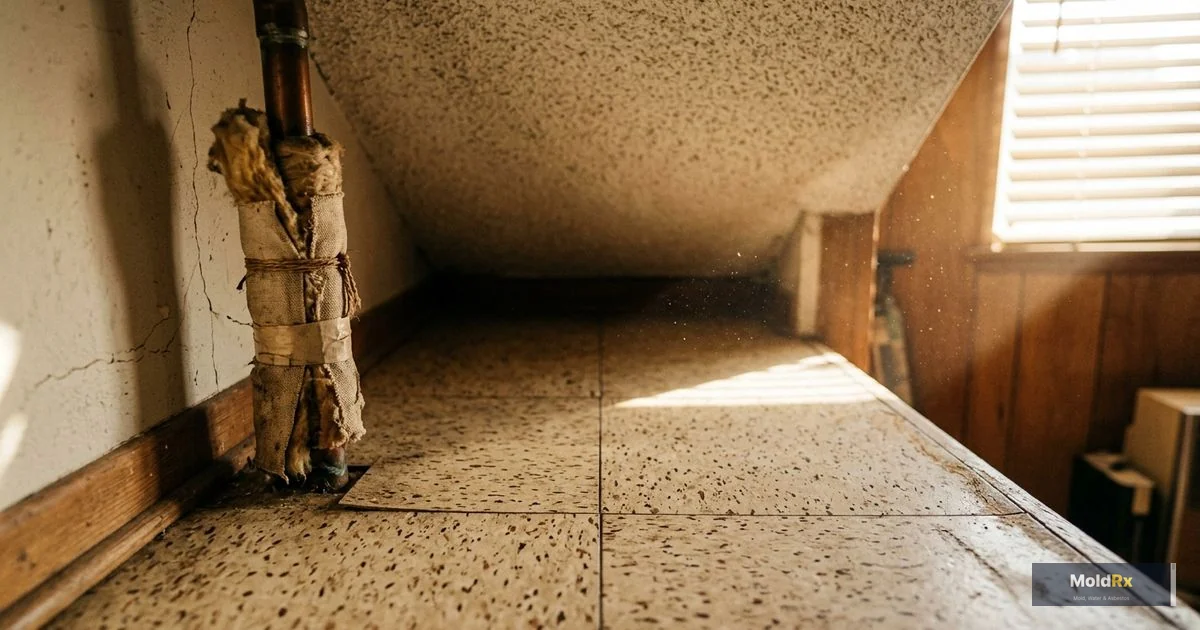
Crumbling pipe insulation in a garage, flaking ceiling texture in a bedroom, cracked floor tiles lifting at the edges — if materials in a pre-1980 Anaheim home show visible deterioration, the risk of fiber release increases substantially. Damaged ACM can release fibers during normal daily activity. Testing identifies whether the damaged material contains asbestos so you can make informed decisions about repair, encapsulation, or removal.
When Purchasing Older Investment Properties
Anaheim has a significant stock of multi-family housing — duplexes, fourplexes, and apartment buildings — many from the 1960s and 1970s boom. Investors acquiring these properties for repositioning need comprehensive asbestos surveys before value-add work begins. Multi-unit properties face stricter abatement regulations, and discovering asbestos mid-renovation can halt a project for weeks.
Common Asbestos-Containing Materials in Anaheim Homes
Anaheim's housing spans several distinct construction eras, each with its own asbestos profile.
Floor Tiles and Mastic (9"x9" Vinyl)
Manufactured from the 1950s through the early 1980s, 9"x9" vinyl floor tiles contained 5% to 70% chrysotile asbestos. The black cutback adhesive (mastic) beneath them frequently contains asbestos as well. In Anaheim tract homes built during the 1950s and 1960s — particularly in West Anaheim, Brookhurst, and areas surrounding Disneyland — these tiles are commonly hidden beneath newer flooring layers. Intact tiles are low-risk, but sanding, scraping, or breaking them during removal releases fibers into your living space.
Popcorn and Textured Ceilings
Spray-applied textured ceilings were standard from the mid-1960s through 1980. Anaheim homes from this period frequently have popcorn or stippled ceilings containing chrysotile asbestos. The EPA banned asbestos in spray-applied surfacing in 1978, but existing stock continued to be applied into the early 1980s. Scraping textured ceilings without testing is one of the most common sources of residential asbestos exposure — and one of the most avoidable.
Pipe and Duct Insulation
Corrugated paper wrap, calcium-silicate blocks, and air-cell insulation on HVAC components in pre-1980 homes commonly contain asbestos. In Anaheim, where air conditioning runs heavily during summer months, ductwork insulation and pipe wrapping were essential. These materials are often in the worst condition because they sit in garages, utility closets, and attic spaces where temperatures are extreme and maintenance is minimal.
Roofing Materials and Siding
Asbestos-cement roofing shingles, roofing felt, and siding panels were widely used in California construction through the 1970s. Dense and weather-resistant, they can remain on a home for decades — which means they are still present on many older Anaheim properties. These materials are low-risk while intact but become a testing and abatement concern at roof replacement time.
Joint Compound, Plaster, Caulking, and Vermiculite Insulation
Drywall joint compound manufactured before 1980 frequently contained asbestos to improve workability and crack resistance. Because joint compound is applied at every seam and screw hole, even a small remodel can disturb a surprising quantity of material. Vermiculite attic insulation — small, accordion-shaped granules in gray-brown or gold — is another concern. Much of the vermiculite sold in the United States came from the Libby, Montana mine, contaminated with tremolite asbestos. Anaheim homes that received insulation upgrades during the 1970s energy crisis should be tested before any attic work.
How Asbestos Testing Works
Understanding the process helps you plan your project timeline and know what to expect.
1. Pre-Testing Consultation
Testing begins with a conversation about your property — when the home was built, what materials you plan to disturb, and whether you have noticed any damage. This determines which areas need sampling and how many samples are required. For a straightforward Anaheim renovation, the inspector can usually scope the work during a brief phone consultation.
2. Bulk Sample Collection
A certified inspector collects bulk samples following EPA procedures. Each suspected material is sampled separately — the inspector wets the material to suppress fiber release, removes a small section, and seals it in a labeled container. Homogeneous materials like floor tiles require a minimum of three samples per distinct area. The process is minimally invasive, and each collection point is sealed after sampling.
3. NVLAP-Accredited Laboratory Analysis
Samples go to an NVLAP-accredited laboratory for PLM (Polarized Light Microscopy) analysis, which identifies asbestos fiber type and estimates concentration. When PLM results are negative but low-level asbestos is suspected, TEM (Transmission Electron Microscopy) provides higher sensitivity. Standard turnaround is 3 to 5 business days; rush service (24 to 48 hours) is available when your timeline is tight.
4. Results Interpretation and Recommendations
You receive a written report identifying each material sampled, whether asbestos was detected, the fiber type, and the estimated concentration. We walk you through what each result means for your specific project: which materials require licensed abatement, which can be safely managed in place, and which areas are clear for standard construction work.
What Happens If Asbestos Is Found?
A positive result does not automatically mean your home is dangerous or that expensive removal is your only option. The response depends on material condition, project scope, and applicable regulations.
When Removal Is Required
Removal is required when your renovation will physically disturb ACM — tearing out positive-testing flooring, removing a wall with ACM joint compound, or scraping an asbestos-containing ceiling. SCAQMD Rule 1403 requires notification at least 10 working days before removal begins, and all abatement must be performed by a DOSH-registered contractor. There are no exemptions for homeowner self-abatement on multi-unit residential properties, and Anaheim's substantial inventory of duplexes, apartment buildings, and condominiums falls under this provision.
When Encapsulation May Be an Option
Encapsulation applies a sealant over intact ACM to prevent fiber release without physical removal. It is appropriate for materials in good condition that will remain in place — asbestos-cement siding on a wall that is not being renovated, or intact floor tiles being covered with new flooring rather than torn out. For Anaheim homeowners undertaking partial renovations — updating a kitchen while leaving adjoining rooms untouched — encapsulation can be a practical and cost-effective solution for materials outside the renovation footprint.
When Leaving It Undisturbed Is Acceptable
If ACM is in good condition and will not be disturbed by renovation or normal use, leaving it in place is often the safest and most cost-effective option. Intact asbestos materials do not release fibers. Many Anaheim homeowners discover asbestos during testing for one project and manage materials in unaffected areas rather than removing everything at once — a practical strategy that is both safe and sensible.
Anaheim Asbestos Risk by Construction Era
Anaheim's growth happened in distinct waves tied to agriculture, Disneyland, the post-war housing boom, and planned community development. Each era brought different asbestos risks. Knowing when your home was built helps set expectations before testing.
Pre-1940s (The Colony and Early Anaheim): Anaheim's oldest homes predate widespread asbestos use. Structures in the Colony, Five Points, and Historic Palm districts were built with wood, plaster, and early-twentieth-century materials. However, many underwent renovations during the 1940s through 1970s that may have introduced ACM. Testing is recommended before renovation, particularly if the home has been modified over the decades.
1940s-1950s (Post-War Expansion and Disneyland): The post-war boom and Disneyland's 1955 opening transformed Anaheim from an agricultural town into a rapidly growing suburb. Homes from this era — now 70 to 85 years old — may contain asbestos in nearly every material category. Central and western Anaheim neighborhoods carry the highest asbestos risk. Testing is essential before any renovation.
1960s-1970s (Peak Suburban Growth): The single largest building era in Anaheim's history, filling vast tracts with single-family homes, apartments, and commercial properties. Homes commonly contain asbestos in popcorn ceilings, vinyl floor tiles, pipe insulation, and joint compound. The late 1970s represent a transition — the EPA began restricting asbestos, but products in the supply chain continued to be installed. Testing is essential for any renovation.
1970s-1980s (Anaheim Hills First Phase): Development began in 1971 across the former Nohl Ranch, with the first neighborhood opening in 1972. By the early 1980s, over 15,000 residents lived in Anaheim Hills. Early-phase homes may contain ACM from existing product inventory. Later 1980s construction carries lower but non-zero risk. Testing is recommended before interior renovation.
1990s-2000s (Eastern Expansion and Platinum Triangle): Developments along Weir Canyon Road and the Platinum Triangle near Angel Stadium carry minimal asbestos risk from original materials. However, SCAQMD Rule 1403 still requires a survey before demolition regardless of building age, and infill projects on sites with older structures may encounter ACM.
What Sets MoldRx Apart
- Honest assessment. If testing is not necessary for your project, we will tell you. We have no financial incentive to recommend testing or abatement you do not need.
- NVLAP-accredited lab partners. Every sample is analyzed by a nationally accredited laboratory using PLM and, when warranted, TEM methods that meet EPA and Cal/OSHA standards.
- Clear, actionable results. No jargon-filled reports that leave you guessing. Plain language, specific recommendations, and a clear path forward for your Anaheim project.
- Family-owned accountability. We only send vetted asbestos testing professionals we stand behind. No subcontractor roulette — the people who show up are the people we trust with our own homes.
Get your free consultation — no obligations.
Anaheim Neighborhoods and Areas We Serve
Our asbestos testing services cover all residential and commercial properties in Anaheim, including:
- Colony Historic District — Anaheim's original 1857 settlement with over 1,000 qualified historic structures. Homes range from Victorian-era originals to Craftsman bungalows, many renovated during peak asbestos decades. Original materials may be asbestos-free, but later modifications frequently introduced ACM.
- West Anaheim — Dense residential neighborhoods built during the 1950s and 1960s suburban boom. Tract housing carries high asbestos risk across virtually every material category. Homes along Beach Boulevard and Magnolia Avenue corridors have often undergone multiple renovations, creating layered conditions where older ACM hides beneath newer finishes.
- Central Anaheim / Brookhurst — Mid-century residential and commercial development. Single-family homes, multi-family units, and commercial buildings from the 1950s through 1970s predominate. Testing is essential before renovation.
- Anaheim Hills — Master-planned community developed from 1971 onward. Neighborhoods like Westridge, Canyon Rim, Nohl Ranch, Deer Canyon, and Oak Hills span three decades of construction. Earlier phases (1970s) carry moderate to high risk; later phases (1990s-2000s) carry progressively lower risk.
- Platinum Triangle / Resort District — Newer high-density development near Angel Stadium and Honda Center carries low asbestos risk from original materials, but older commercial structures near the Disneyland Resort — many dating to the 1960s and 1970s — should be tested before renovation.
- Five Points and Historic Palm Districts — Older residential and commercial properties with mixed-era construction. Testing recommended before any renovation.
We serve all Anaheim ZIP codes: 92801, 92802, 92804, 92805, 92806, 92807, and 92808.
Nearby Communities
We also serve neighboring cities including Fullerton to the north, Orange to the east, Garden Grove to the south, Buena Park to the west, Placentia and Yorba Linda to the northeast, Stanton and Cypress to the southwest, and Villa Park to the southeast.
Related Services in Anaheim
-> All services
Frequently Asked Questions
Is asbestos testing required before renovation in Anaheim?
Yes. SCAQMD Rule 1403 requires an asbestos survey before renovation or demolition in the South Coast Air Quality Management District, which includes all of Anaheim. The only exception is single-unit dwelling renovation involving less than 100 square feet of intact material. Most residential projects exceed that threshold and require testing.
How many samples need to be collected?
EPA procedures require a minimum of three samples per homogeneous material in each distinct area. A typical Anaheim home undergoing renovation might need 10 to 20 samples across ceiling texture, floor tile, mastic, joint compound, insulation, and roofing material. Properties with additions built in different decades may require more because each construction phase can contain different materials. Your inspector determines the exact number based on your property's age and project scope.
How long do asbestos test results take?
Standard PLM analysis takes 3 to 5 business days. Rush service is available with turnaround as fast as 24 hours when your project timeline demands it. TEM analysis, if needed, typically requires 5 to 7 business days.
Can I collect asbestos samples myself?
California does not prohibit homeowners from collecting samples in their own single-family home, but the practice is strongly discouraged. Improper technique can release fibers into your living space. Additionally, samples collected by uncertified individuals may not be accepted for regulatory compliance — if you need results for a building permit, SCAQMD notification, or real estate transaction, use a certified inspector.
What does a positive asbestos test mean for my renovation?
A positive result means asbestos fibers were detected in the sampled material. Any material exceeding 1% asbestos is classified as ACM under federal and California regulations. A positive result does not mean immediate danger — intact ACM does not release fibers. But if your renovation will disturb that material, licensed abatement must be performed before construction can proceed.
Do all pre-1980 Anaheim homes contain asbestos?
No, but industry data suggests 80% or more of pre-1980 buildings contain at least one asbestos-containing material. Some Anaheim homes may have had asbestos removed during previous renovations. Others were built with non-asbestos alternatives available alongside asbestos products. Laboratory testing is the only way to determine what your specific home contains.
Do I need testing if my Anaheim home was built after 1980?
SCAQMD Rule 1403 requires a survey before demolition regardless of building age. For renovation, asbestos risk is significantly lower in post-1980 homes but not zero — some products like roofing materials, gaskets, and imported floor tiles contained asbestos well after initial EPA bans. Early 1980s Anaheim Hills homes may still contain ACM from existing product inventory.
My home is in the Colony Historic District — does that change the testing process?
The testing process is the same regardless of historic designation. However, Colony District homes deserve extra consideration. Many structures are 100+ years old and have been renovated across different decades. Original late-nineteenth-century materials may be asbestos-free, but additions and modifications from the 1940s through 1970s may have introduced ACM. A thorough inspection accounts for the full construction history, not just the original build date.
Will my contractor handle asbestos testing?
Some general contractors coordinate testing as part of pre-construction planning, but many do not. Getting testing done independently before your contractor starts is the most reliable approach — if asbestos is discovered mid-project because testing was skipped, all work stops until abatement is complete, adding weeks and significant cost to your timeline.
Get Asbestos Testing in Anaheim
Planning a remodel on your West Anaheim tract home, renovating a Colony District bungalow, or buying a property in Anaheim Hills — testing gives you the information you need before the first wall comes down. Whether your home is a 1955 ranch near Brookhurst, a 1968 apartment building on Katella, or a 1980s residence above Nohl Canyon, the process is straightforward and the results are definitive.
In a city with 170 years of development history, testing is not an obstacle to your renovation — it is the first step in doing it right. A few days and a few hundred dollars in lab fees protect your health, your property value, and your project timeline.
Call MoldRx to schedule your asbestos test — (888) 609-8907. Know before you start.