Asbestos Testing in Aliso Viejo, CA — MoldRx
Vetted Asbestos Testing Specialists Serving Aliso Viejo and South Orange County
You are planning a kitchen remodel in your Canyon Vista townhome, replacing the original flooring in a Glenwood condo, or buying a mid-1980s unit in one of Aliso Viejo's earliest development phases. Before that work starts, you need to know whether the materials you are about to cut, scrape, or demolish contain asbestos. Aliso Viejo is genuinely newer than most South Orange County cities — the first family moved in during November 1982, and the vast majority of the city's roughly 20,000 homes were built between the mid-1980s and early 2000s. That places most properties after the peak era of asbestos use. But "lower risk" is not "no risk." Asbestos-containing materials remained on supplier shelves and in active installation well into the late 1980s and, for certain product categories, into the early 1990s. California law and SCAQMD Rule 1403 require an asbestos survey before renovation or demolition regardless of when a structure was built. MoldRx only sends vetted asbestos testing professionals who understand the specific construction patterns and regulatory requirements that apply across Aliso Viejo's master-planned neighborhoods.
Request your free consultation — we will help you determine if testing is needed for your project.
Why Aliso Viejo Properties Still Carry Asbestos Risk
From Moulton Ranch to Master-Planned Community
The land beneath Aliso Viejo was once part of the 26,000-acre Moulton Ranch, a holding that traced its lineage to the 1842 Mexican land grant awarded to Juan Avila. In 1976, the Mission Viejo Company purchased the final 6,600 acres to create a new planned community. Orange County approved the master plan in 1979, envisioning 20,000 homes for a projected population of 50,000. Homes were first offered for sale in March 1982, and the first family moved in that November. Development proceeded in phases through the late 1980s, accelerated through the 1990s, and continued with infill construction into the early 2000s. By incorporation on July 1, 2001, the population had reached approximately 42,000. The 2020 census counted 52,176 residents.
This phased construction on a massive scale means the same developers, subcontractors, and material suppliers built hundreds of units per phase using identical products. That consistency is directly relevant to asbestos risk: if one unit within a development phase used asbestos-containing materials, there is a strong probability every unit in that phase did.
The 1980s Were Not Asbestos-Free
The EPA began restricting asbestos in spray-applied surfacing materials in 1973 and expanded those restrictions in 1978. California banned asbestos in insulation materials the same year. But these regulations did not eliminate asbestos overnight. Existing inventory — roofing felt, joint compound, vinyl floor tiles, cement board, and adhesive products manufactured before the bans — continued to be installed into the mid-1980s. The EPA's attempted comprehensive ban in 1989 was largely overturned by a federal appeals court in 1991, leaving asbestos legal in products historically manufactured with it.
For Aliso Viejo, this means homes built during the earliest phases — roughly 1982 through 1986 — were constructed while asbestos-containing products still circulated through the supply chain. Roofing materials, flooring products, and cement fiber applications manufactured with asbestos appeared in Southern California construction into the late 1980s. Federal OSHA 1926.1101 and Cal/OSHA Title 8 §1529 both recognize this extended timeline by requiring presumed asbestos-containing material assessments for buildings constructed before specific regulatory cutoff dates.
Over 60 Percent Attached Housing
Aliso Viejo's housing stock is distinctive in South Orange County. More than 60 percent of residential units are attached — condominiums, townhomes, and planned-unit developments in communities like Canyon Villas, California Renaissance, Coronado, Canyon Vista, and Westridge. This density matters for asbestos testing because attached units within the same phase were built by the same contractor using the same materials — a single positive result can inform an entire community. Shared walls, attics, and mechanical systems also mean disturbing asbestos-containing materials in one unit can generate fiber migration into adjacent units. And many Aliso Viejo HOAs now require asbestos survey documentation before approving renovation permits, consistent with SCAQMD Rule 1403.
When Asbestos Testing Is Necessary
Aliso Viejo's construction timeline creates a sliding scale of risk. Here is how to evaluate whether your project warrants testing.
Before any renovation or demolition: SCAQMD Rule 1403 requires an asbestos survey before renovation or demolition work in the South Coast Air Quality Management District, which includes all of Orange County. The survey must be conducted by a Cal/OSHA-certified consultant or a professional holding a current AHERA Building Inspector certification from a Cal/OSHA-approved training course. The only narrow exception is renovation of an owner-occupied single-family home where less than 100 square feet of intact material is removed. Non-compliance fines can exceed $20,000 per day, and negligence leading to exposure or contamination can trigger criminal penalties.
When buying a home from the 1980s: Pre-purchase testing helps you budget for planned renovations and negotiate accordingly. Knowing the asbestos status before closing eliminates surprise abatement expenses after you take ownership.
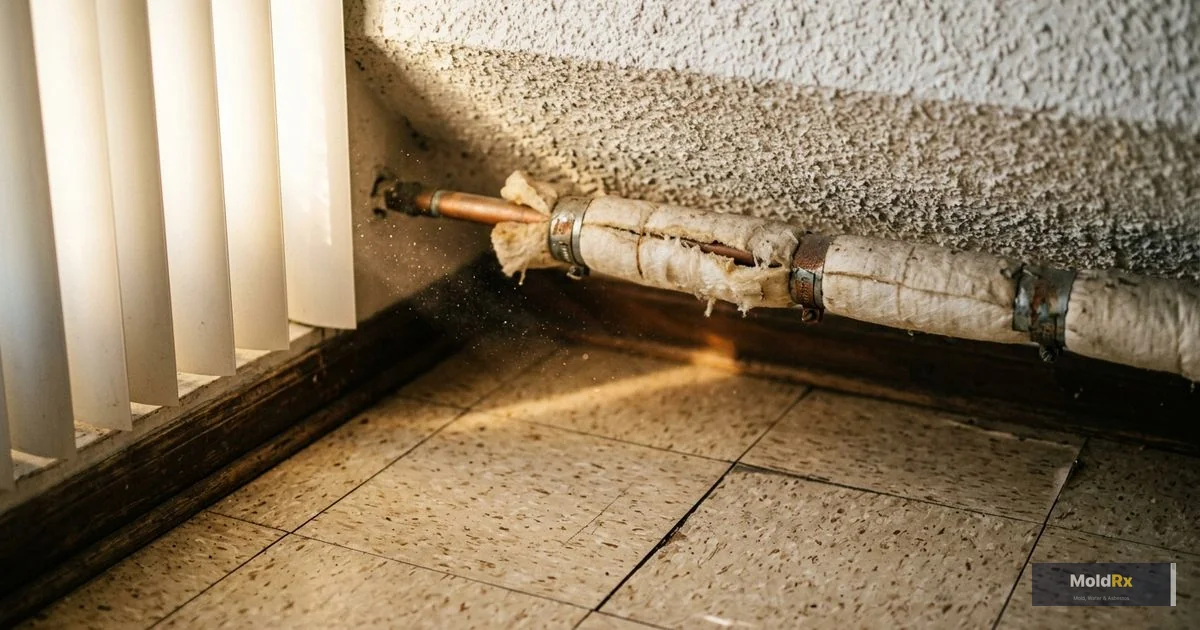
When materials show damage: Water damage from aging plumbing or roof leaks can saturate building materials that were previously stable. Crumbling pipe insulation, cracked floor tiles, or peeling ceiling texture in a pre-1990 home warrants testing because deteriorating materials are more likely to release fibers.
When your HOA requires it: Virtually every Aliso Viejo residential community has an HOA, and many now require asbestos survey documentation before approving renovation permits. Check your architectural guidelines before starting any project involving demolition, flooring removal, or ceiling modification.
Before roof replacement, flooring updates, or interior remodeling: Roofing materials from the 1980s are among the most common asbestos-containing products found in Aliso Viejo. Vinyl floor tiles and their black mastic, joint compound, and textured coatings from this era have tested positive across Southern California. Testing determines whether your contractor can proceed with standard methods or whether licensed abatement must come first.
Common Asbestos-Containing Materials in Aliso Viejo Homes
Given Aliso Viejo's 1980s-to-2000s construction timeline, the materials of greatest concern differ from what you would find in a 1960s or 1970s home. Here is where asbestos is most likely to appear in Aliso Viejo properties, listed by relative probability.
Roofing materials and underlayment: Concrete roof tiles and roofing felt from the 1980s are among the most common asbestos-containing materials found across Aliso Viejo. These products were manufactured with asbestos longer than most other building materials. If your home was built before 1990 and still has its original roof, test before replacement.
Vinyl floor tiles and mastic adhesive: Both the tiles and the black cutback adhesive bonding them to the subfloor may contain asbestos. Homes from the early-to-mid 1980s are most likely to have asbestos-containing flooring, but isolated instances have been found in homes built as late as the early 1990s. In many Aliso Viejo units, newer carpet or laminate was laid directly over original vinyl tile — a common discovery during renovation.
Joint compound and drywall texture: Drywall joint compounds containing chrysotile asbestos were standard through the early 1980s. If your home was built during the earliest phases — 1982 through roughly 1985 — the joint compound at every seam and screw hole should be tested before sanding or removal.
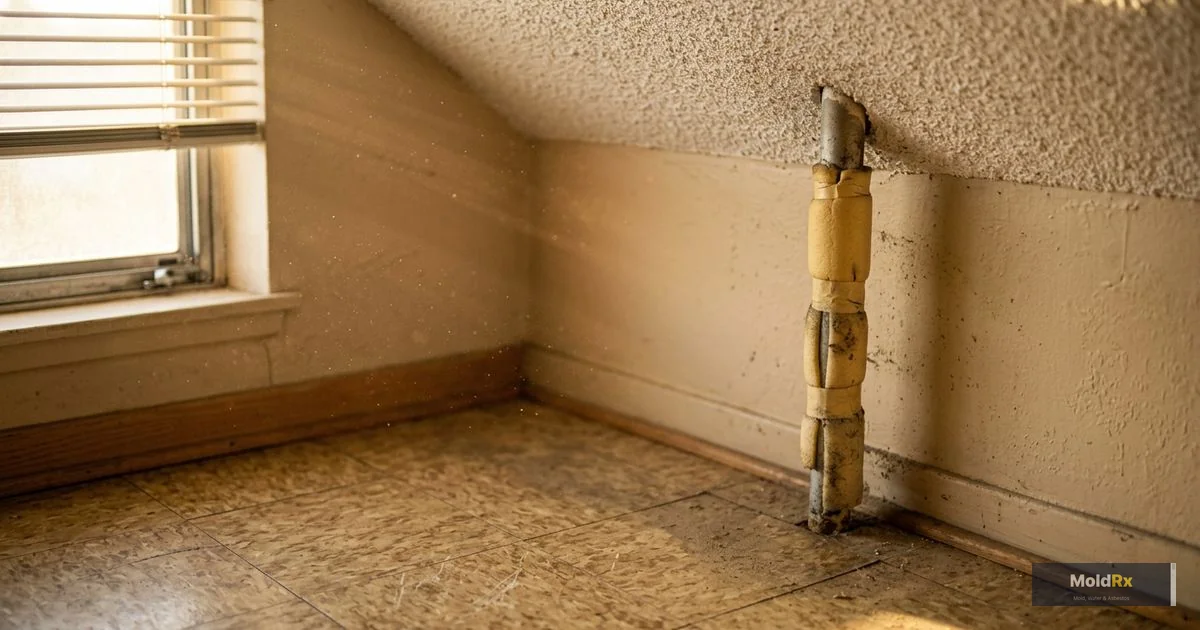
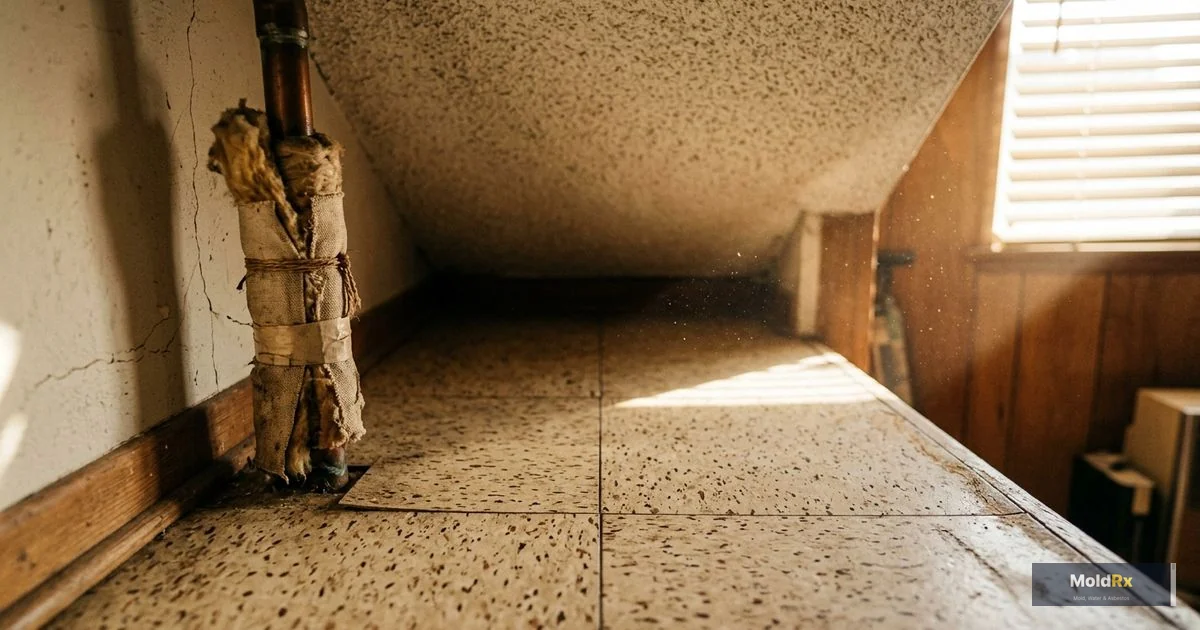
Pipe insulation and HVAC components: Insulation wrapping on hot water pipes, HVAC duct connections, and duct tape from the 1980s may contain asbestos. These materials are typically found in utility closets, attics, and garages — often overlooked until an HVAC replacement or plumbing repair forces their removal.
Exterior cement products: Cement board siding, soffit panels, and certain stucco applications from the 1980s occasionally test positive. These are non-friable while intact but release fibers when cut, drilled, or ground during renovation.
Popcorn ceilings and acoustic texture: While popcorn ceilings are less prevalent in Aliso Viejo than in older South Orange County communities, some early-phase homes have textured ceilings that should be tested before scraping. The EPA banned asbestos in spray-applied surfacing in 1978, but existing inventory continued to be installed into the early 1980s.
How Asbestos Testing Works
1. Pre-Testing Consultation
Testing begins with a conversation about your property and your plans. When was your Aliso Viejo home built? What phase of the community is it in? What work are you planning? These details determine whether testing is necessary and which materials need sampling. If your home is a 2003 build in a later development phase and you are replacing kitchen cabinets, we will likely tell you testing is not needed. If it is a 1984 townhome in one of the original phases and you are gutting a bathroom, testing is essential.
2. Professional Sample Collection
A vetted asbestos testing specialist collects samples following EPA protocols and Cal/OSHA Title 8 §1529 requirements. Each suspect material type is sampled separately — the inspector wets the material to suppress fiber release, extracts a small sample, and seals it in a labeled container. EPA procedures require a minimum of three samples per homogeneous material in each distinct area. In attached Aliso Viejo homes, the inspector takes extra care to minimize disturbance that could affect adjacent units.
3. NVLAP-Accredited Laboratory Analysis
Samples go to an NVLAP-accredited laboratory for analysis. The primary method is PLM (Polarized Light Microscopy), which identifies asbestos fiber type — chrysotile, amosite, crocidolite — and estimates concentration. When PLM results are inconclusive or higher precision is needed, particularly for floor tiles and some textured coatings, TEM (Transmission Electron Microscopy) provides greater sensitivity. Both methods are EPA-approved and accepted by SCAQMD. Standard PLM turnaround is three to five business days; rush service with 24- to 48-hour turnaround is available when your timeline is tight.
4. Results Interpretation and Project Planning
You receive a clear, written report identifying each material sampled, its location, whether asbestos was detected, the fiber type, and the estimated concentration. We walk you through what each result means for your specific project — which materials require licensed abatement, which can be managed in place, and which areas are clear for standard renovation work. The report meets documentation standards required by SCAQMD, Cal/OSHA, the City of Aliso Viejo building department, HOA approval processes, and real estate transactions.
What Happens If Asbestos Is Found?
A positive result does not automatically mean your home is dangerous or that expensive removal is your only option. The response depends on the material's condition, its location, and your renovation plans.
When removal is required: If your renovation will physically disturb asbestos-containing materials, licensed abatement must happen first. SCAQMD Rule 1403 requires notification at least 10 working days before removal, and all abatement must be performed by a DOSH-registered contractor holding a CSLB C-22 asbestos abatement specialty license. In Aliso Viejo's attached housing, multi-unit abatement rules may apply and containment must account for shared walls and mechanical systems.
When encapsulation works: Encapsulation seals intact asbestos-containing materials to prevent fiber release without removal — appropriate for undamaged materials remaining in place, such as siding on a wall not being renovated or intact floor tiles being covered rather than torn out.
When leaving it alone is best: Intact, undisturbed asbestos-containing materials do not release fibers. Many Aliso Viejo homeowners discover asbestos during testing for one project and simply manage materials in unaffected areas — monitoring condition periodically rather than pursuing unnecessary removal.
What Sets MoldRx Apart
-
Honest assessment. If testing is not necessary for your project, we will tell you. A 2001-built home in a later development phase getting a cabinet refresh does not need comprehensive asbestos sampling. We focus testing where it is actually warranted based on your property's age and your project scope.
-
NVLAP-accredited lab partners. Every sample is analyzed by an NVLAP-accredited laboratory using PLM and, when warranted, TEM methods that meet EPA, OSHA 1926.1101, and Cal/OSHA standards.
-
Clear, actionable results. No jargon-filled reports that leave you guessing. Plain language, specific recommendations, and a clear path forward for your Aliso Viejo project. If we reference a regulation like SCAQMD Rule 1403 or a Cal/OSHA Title 8 §1529 threshold, we explain what it means for your situation in practical terms.
-
Family-owned accountability. MoldRx only sends vetted asbestos testing professionals we stand behind. No subcontractor roulette — the people who show up are the people we trust with our own homes.
Get your free estimate — no obligations, honest guidance.
Aliso Viejo Asbestos Risk by Construction Era
Aliso Viejo's phased development creates a clear risk gradient based on when each neighborhood was built.
1982--1986 (Earliest Phases): Highest relative asbestos risk within Aliso Viejo. Building products manufactured before EPA restrictions took full effect were still being installed. Joint compounds, textured ceiling products, roofing materials, vinyl floor tiles, pipe insulation, and adhesive products from this period may contain asbestos. Treat any renovation disturbing original materials in an early-phase home as you would a pre-1980 property — assume suspect materials contain asbestos until lab testing says otherwise.
1987--1995 (Middle Phases): Risk drops significantly but does not disappear. Most manufacturers had voluntarily phased asbestos out by the late 1980s, but specialty products, imported materials, and remaining warehouse inventory still contained it. Roofing, cement fiber, and some textured coatings from this era have tested positive across Southern California. Testing is recommended before disturbing original materials, particularly roofing, flooring, and exterior cement products.
1996--2005 (Later Phases and Infill): Asbestos risk is very low but technically not zero. The U.S. never enacted a comprehensive ban on all asbestos products. For most renovation projects in homes from this era, testing is not typically necessary unless you encounter unusual materials. However, SCAQMD Rule 1403 still requires a survey before demolition regardless of building age.
Post-2005 (Recent Construction): Negligible asbestos risk. Contemporary building products contain no meaningful asbestos content.
Aliso Viejo Neighborhoods We Serve
Our vetted asbestos testing professionals serve all of Aliso Viejo within ZIP code 92656, including every residential community in this master-planned city.
- Glenwood — Golf course community surrounding the Aliso Viejo Country Club. Mix of single-family homes and townhomes; earlier phases warrant closer assessment.
- Pacific Ridge — Gated hilltop community with panoramic views and larger custom homes. Testing recommended for any renovation disturbing original 1980s-era materials.
- Canyon Vista — Family-friendly neighborhood with attached and detached housing. Mid-to-late 1980s homes should have original materials tested before renovation.
- Westridge — Private gated community with larger single-family homes including Oak View Estates.
- Canyon Villas — One of Aliso Viejo's earliest condo communities, first developed in 1982. Highest asbestos probability in the city due to early construction date.
- California Renaissance — Mediterranean-inspired condo community built 1988-1989, 203 units. Targeted testing of roofing, flooring, and cement products recommended.
- Canyon Crest — Condos and townhomes from the late 1980s and early 1990s. Lower risk than earliest phases but not negligible for flooring and roofing.
- The Meadows — 1990s development phase. Lower asbestos risk, though original roofing and exterior materials may warrant testing.
- Wood Canyon — Family-oriented community near Wood Canyon trails. Test original materials before renovation in units built before 1990.
- Aliso Viejo Ranch — Testing needs depend on specific construction date within the development timeline.
Nearby Communities
We also serve Aliso Viejo's South Orange County neighbors, including Laguna Niguel to the south, Laguna Hills to the west, Laguna Beach to the southwest, Mission Viejo to the north, and Lake Forest to the northeast. We cover the commercial and mixed-use areas along Enterprise and Columbia as well.
Related Services in Aliso Viejo
- Asbestos Removal in Aliso Viejo
- Mold Removal in Aliso Viejo
- Mold Testing in Aliso Viejo
- Water Damage Restoration in Aliso Viejo
-> All services in Aliso Viejo
Frequently Asked Questions
Is asbestos testing required before renovating in Aliso Viejo?
Yes, in most cases. SCAQMD Rule 1403 requires an asbestos survey before renovation or demolition work on any building in Orange County, regardless of age or size. The survey must be performed by a Cal/OSHA-certified consultant or an AHERA-certified building inspector. The only exception is renovation of an owner-occupied single-family home involving less than 100 square feet of intact material. Skipping this step exposes you to fines exceeding $20,000 per day and potential criminal liability if negligence leads to exposure. Under OSHA 1926.1101 and Cal/OSHA Title 8 §1529, building owners are responsible for identifying the presence, location, and quantity of asbestos-containing materials before construction work begins.
My Aliso Viejo home was built in the 1990s. Do I still need asbestos testing?
For most 1990s-built homes in Aliso Viejo, asbestos testing is not necessary for typical interior renovations. However, if your project involves removing original roofing materials, exterior cement products, or floor tiles with black mastic adhesive, testing is a reasonable precaution. These specific product categories had the longest overlap with asbestos use. SCAQMD Rule 1403 also requires a survey before any demolition regardless of building age. A targeted test of the specific materials you plan to disturb is quick and eliminates uncertainty.
How many samples are needed for an Aliso Viejo home?
EPA procedures require a minimum of three samples per homogeneous material in each distinct area. A typical Aliso Viejo home undergoing renovation might need 6 to 15 samples across floor tile, mastic, ceiling texture, joint compound, roofing, and pipe insulation. Your inspector determines the exact number based on your property and project scope. For attached units in communities like Canyon Villas, Canyon Vista, or California Renaissance, knowing that identical materials were used across the entire development phase can help focus the sampling scope.
How long do results take?
Standard PLM analysis at an NVLAP-accredited laboratory takes three to five business days. Rush service is available with turnaround as fast as 24 hours. TEM analysis, when needed for inconclusive PLM results, typically requires five to seven business days. If you are working against an HOA approval deadline, contractor schedule, or real estate closing, rush processing keeps your project on track.
Can I collect asbestos samples myself in Aliso Viejo?
California allows owner-occupants of residential buildings with four or fewer dwelling units to collect their own samples. However, improper technique can release fibers and produce inaccurate results. Samples collected by uncertified individuals may not satisfy HOA documentation requirements, SCAQMD compliance standards, or building permit applications. In attached housing — over 60 percent of Aliso Viejo's units — improper sampling can affect neighboring units through shared walls. Professional collection follows containment protocols that protect your household and produce results accepted for all regulatory and transactional purposes.
What happens if asbestos is found in my Aliso Viejo home?
Finding asbestos does not automatically mean a large removal bill. Intact, undisturbed materials in good condition can be managed in place with periodic monitoring. Materials that are damaged or located where renovation work will occur typically require professional abatement by a DOSH-registered contractor holding a CSLB C-22 specialty license. SCAQMD Rule 1403 requires notification at least 10 working days before removal. Your testing report provides documentation needed to scope removal accurately and coordinate abatement with your contractor's schedule.
Does my Aliso Viejo HOA require asbestos testing before renovation?
Many Aliso Viejo HOAs now require asbestos survey documentation for renovation approval. This varies by community — check your architectural guidelines or contact your property management company. Communities including Glenwood, Canyon Villas, California Renaissance, Pacific Ridge, Westridge, and Canyon Vista all have active HOAs with renovation review processes. Regardless of HOA-specific requirements, SCAQMD Rule 1403 independently requires asbestos surveys before renovation on most properties. Getting the survey completed early prevents delays in both HOA approval and contractor scheduling.
Get Asbestos Testing in Aliso Viejo
Aliso Viejo's newer construction means asbestos concerns are legitimately lower here than in neighboring cities with 1960s and 1970s housing stock. But "lower" is not "absent," and the only way to confirm what is inside your walls, floors, and ceilings is professional laboratory analysis — especially for homes built during the earliest 1980s phases and for any renovation where original materials will be disturbed.
MoldRx only sends vetted asbestos testing professionals who understand Aliso Viejo's construction patterns, material choices, and regulatory landscape. Honest guidance about what testing you actually need — not a one-size-fits-all approach that treats a 1984 townhome the same as a 2001 single-family home.
No scare tactics. No unnecessary testing. Just accurate information so you can plan your project with confidence.
Call (888) 609-8907 or request your estimate to schedule asbestos testing for your Aliso Viejo property.